
The Worst Maritime Disaster in US History. Nobody Remembers.
In April 1865, the wooden side-wheel steamboat SS Sultana was packed with over 2,100 paroled Union prisoners of war heading home from Confederate camps. Seven miles north of Memphis, its hastily patched tubular boilers exploded, killing an estimated 1,195 passengers in the deadliest maritime disaster in United States history.

In this dossier (11 chapters) ▾
Historical Dossier: The Sultana Disaster Location: The Mississippi River near Memphis, Tennessee and Marion, Arkansas | Year: 1865 | Key Figures: Captain J. Cass Mason, Reuben B. Hatch, Captain Frederic Speed, Captain George Augustus Williams
The War Ends, the Prisoners Go Home
In April 1865 the American Civil War was almost over. Robert E. Lee had surrendered at Appomattox on 9 April, and across the South the Confederacy was collapsing. Among those who needed to get home were thousands of Union soldiers released from Confederate prisoner-of-war camps, including Cahaba and Andersonville. They were thin, ill and desperate to go north.
The government would pay steamboat captains to carry them. At Vicksburg, Mississippi, the quartermaster Reuben Benton Hatch proposed such a deal to Captain James Cass Mason of the steamboat Sultana: the government would pay a fixed amount for every soldier, $2.75 for each enlisted man and $8 for each officer. Every extra man was extra money.
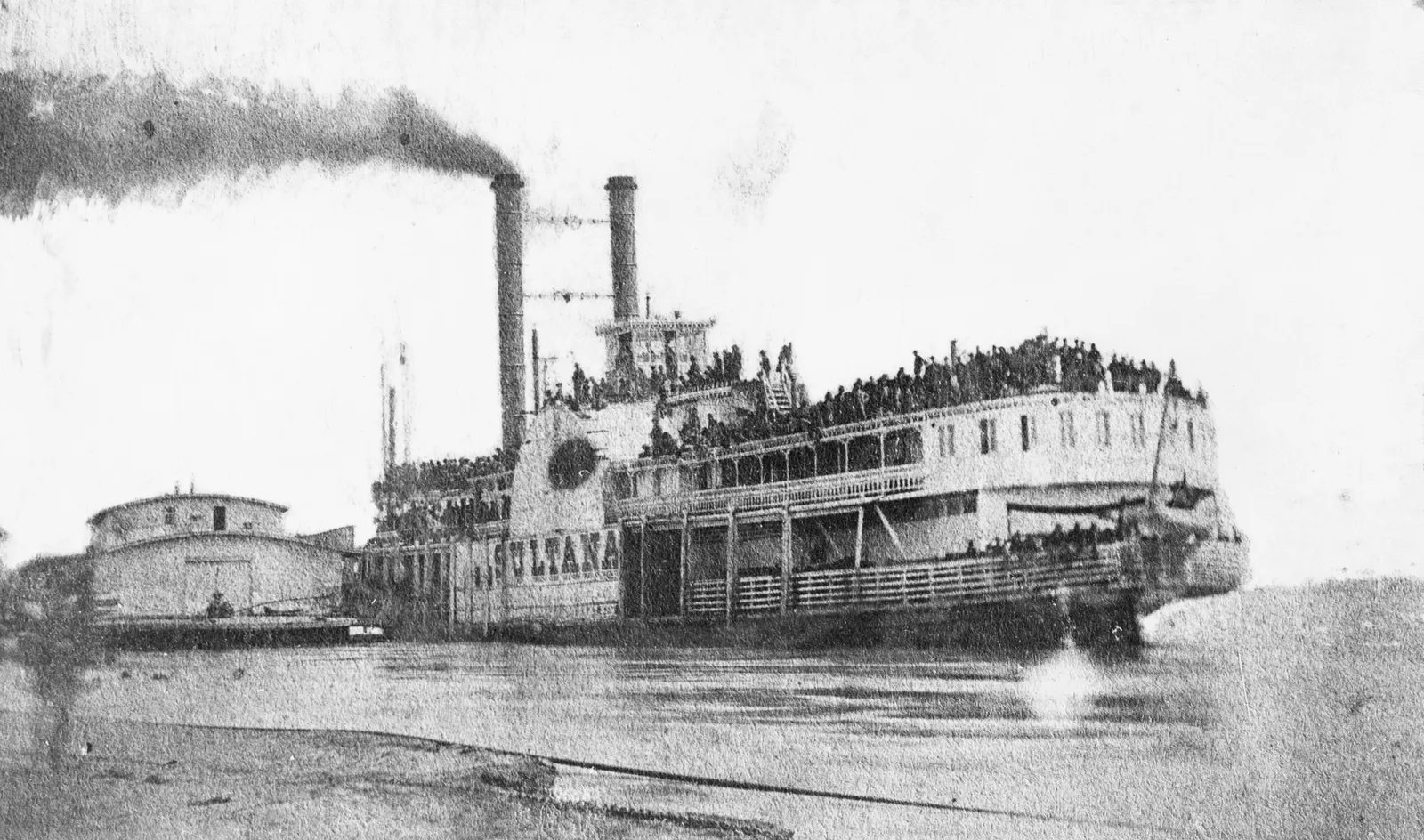
A Ship Built for 376
The Sultana was a wooden side-wheel steamboat built in 1863 at Cincinnati, Ohio. She was 260 feet long, with a beam of 42 feet, and she was designed to carry 376 passengers and a crew of 85. She worked the cotton trade between St. Louis and New Orleans.
On 13 April, a few days after Lee’s surrender, Mason left St. Louis, and at Cairo, Illinois, he learned of Lincoln’s assassination and carried the news south. On 21 April the Sultana left New Orleans. Near Vicksburg one of her boilers developed a leak.
A proper repair would have taken two or three days. The chief engineer persuaded a mechanic to patch the boiler temporarily, and the work took one day. The Sultana was now ready to take on her load, and every day spent in port was money lost.
Overloaded
When the Sultana left Vicksburg on 24 April she carried approximately 2,127 people: about 1,950 paroled prisoners, 22 guards, 70 fare-paying passengers and 85 crew. She had been licensed for 376 passengers. The men were packed into every available space, and in places the decks creaked and sagged under the weight.
Many of the soldiers came from Ohio, Michigan, Indiana, Kentucky, Tennessee and West Virginia. They had survived the prison camps. Most of them were sleeping on the crowded decks when the boat steamed north on a river swollen with spring floods.
The Explosion
At about 2 a.m. on 27 April 1865, roughly seven miles north of Memphis, three of the Sultana’s four boilers suddenly and violently exploded. The blast came from the top rear of the boilers and went upward at a 45-degree angle, tearing through the crowded decks and destroying the pilothouse. It threw some deck passengers into the river and blew a hole 25 to 30 feet wide in the steamer.
Fire spread over the wooden superstructure. The survivors faced an impossible choice: stay with the burning boat or take their chances in the cold spring floodwater of the Mississippi, in the dark, with many of them already weak from months in captivity.
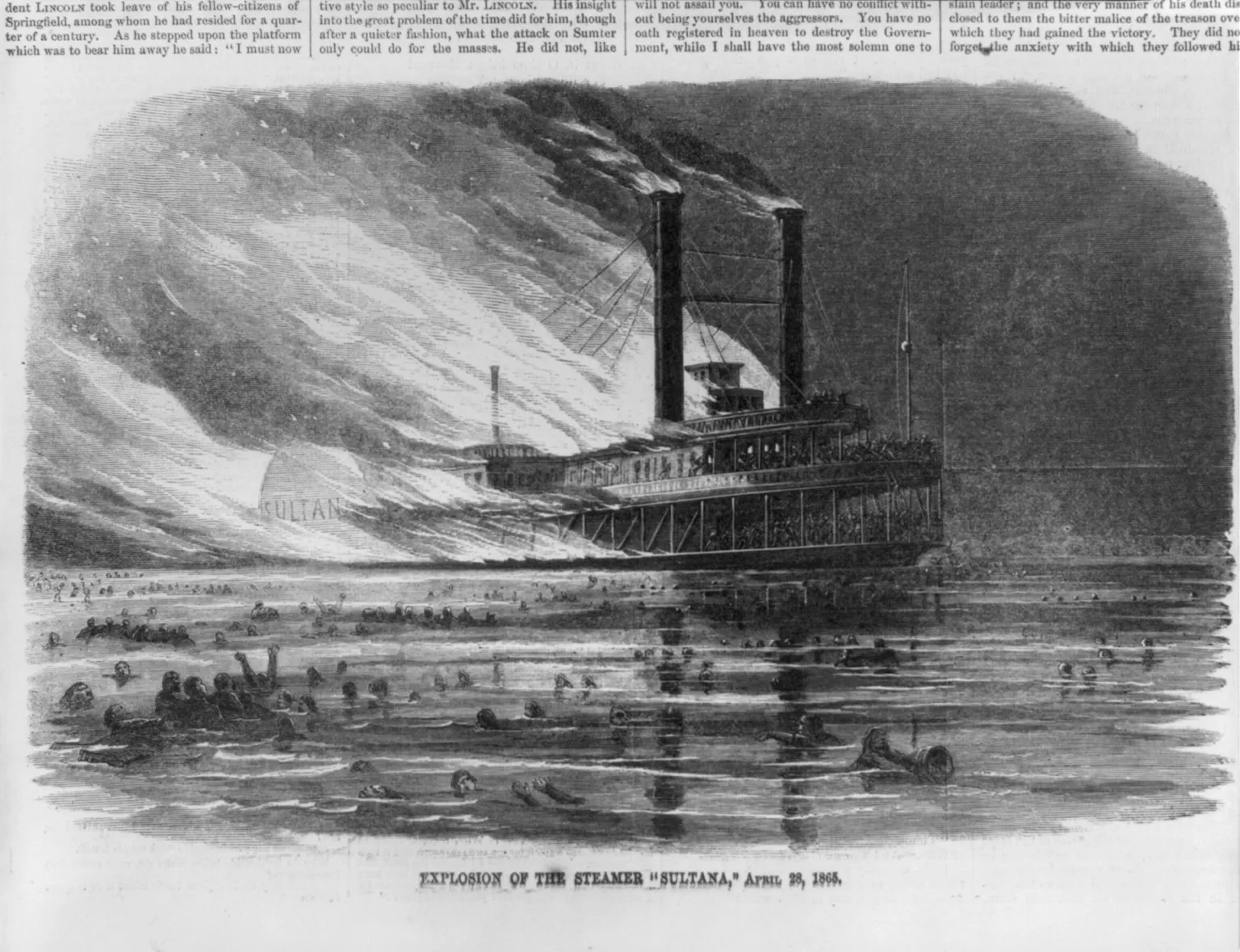
The steamer Bostona arrived about 30 minutes after the explosion and rescued many. The burning hull drifted for about six miles before sinking at around 7 a.m. near Mound City, close to what is now Marion, Arkansas. Bodies kept turning up downriver for months.
How Many Died?
The exact toll is uncertain, and the figures vary by source. The most recent research puts it at 1,164. Brigadier General William Hoffman reported 1,238 in 1865, the Bureau of Military Justice 1,100 in 1867, the U.S. Congress and War Department 1,259 in 1880, and the U.S. Customs Service 1,547. The War Department recorded 931 survivors, though recent research suggests 963.
On most of these counts the Sultana killed fewer people than the Titanic did, about 1,500 in 1912. What it remains is the deadliest maritime disaster in the history of the United States.
No One Held Accountable
Nobody faced lasting consequences. Captain Frederic Speed was charged with overcrowding the boat, but he was acquitted because he had been at the parole camp all day and had not himself put a single soldier on board. Captain George Augustus Williams, who had actually loaded the men, was a regular Army officer and a West Point graduate, and the military protected him. Hatch quickly left the service to avoid a court-martial and went into hiding. Mason died in the disaster. As one account concludes: “In the end, no one was ever held accountable for what remains the deadliest maritime disaster in United States history.”
Why It Is Forgotten
The disaster received little attention at the time. It happened on 27 April 1865, the day after the killing of John Wilkes Booth, Lincoln’s assassin, and the newspapers were occupied with that story. A disaster that took the lives of more than a thousand soldiers who had survived the prison camps was crowded out of the news within days.
Rediscovery
In 1982, a Memphis attorney, Jerry O. Potter, led an expedition that found blackened deck planks and timbers about 32 feet under a soybean field on the Arkansas side of the river, about four miles from Memphis, where the river had shifted over the years. A temporary museum opened in Marion, Arkansas, in 2015, and a permanent facility is expected to open in the autumn of 2026.
What the Record Shows
8 sourced claims in this story, resting on 5 primary and historical records. Numbers link to the bibliography below.
- SS Sultana was certified to carry 376 passengers but embarked about 1,950 paroled Union prisoners, and about 2,127 people in all, at Vicksburg - sources: 1, 4
- Captain J. Cass Mason permitted a temporary soft patch over a bulged boiler to avoid losing the transport contract - sources: 1, 2
- Three of the four tubular boilers exploded at 2:00 AM on April 27, 1865, north of Memphis - sources: 1, 3
- The explosion and fire killed between 1,168 and 1,800 people, the deadliest maritime disaster in United States history (though fewer than the Titanic) - sources: 2, 3
- The majority of victims were Union soldiers who had survived harsh imprisonment in Cahaba and Andersonville - sources: 1, 3
- The tragedy received scant newspaper coverage due to Lincoln’s assassination and the death of John Wilkes Booth - sources: 2, 4
- Captain Frederic Speed was charged with overcrowding the boat but was acquitted, since he had not personally loaded the men - sources: 1, 4
- The wreckage was located in 1982 buried underneath farmland in Marion, Arkansas, following course changes of the river - sources: 4, 5
Archival Evidence & Picture Credits
Every image on this page was checked against its Wikimedia Commons file page.
- The steamboat Sultana at Helena, Arkansas, on 27 April 1865, with her decks crowded with soldiers (Wikimedia Commons) - Wikimedia Commons file page
- A contemporary print of the explosion of the steamer Sultana in April 1865 (Library of Congress / Wikimedia Commons) - Wikimedia Commons file page
- A depiction of the rescue of survivors from the Sultana (Wikimedia Commons) - Wikimedia Commons file page


Verified Archival Sources & Bibliography
Every claim in this account has been fact-checked against primary archives and scholarly repositories:
- Civil War History: The Destruction of the Sultana - A Reexamination (Huffstodt) (academic)
- Internet Archive: The Sultana Tragedy - America’s Greatest Maritime Disaster (Jerry O. Potter) (book)
- American Battlefield Trust: The Sultana Disaster (historical research)
- Wikipedia: Sultana (steamboat) (reference)
- Sultana Disaster Museum & Historical Research Center (Marion, Arkansas) (primary)
Echoes of History Uncut. "The Worst Maritime Disaster in US History. Nobody Remembers.." Echoes of History Uncut. Last modified September 15, 2026. https://echoesofhistoryuncut.com/articles/ss-sultana/.

An independent history publication using AI-assisted research, drafting and production. Consult each article’s citations and limitations; source inclusion does not establish independent verification of every claim.
▶
Watch the Complete Archival Documentary on YouTube
Subscribe to Echoes of History Uncut on YouTube for full widescreen 16:9 documentaries, primary archival footage, and declassified deep dives.