
Two Ships Collided. The Blast Flattened Part of a City.
On the morning of December 6, 1917, two vessels collided in the harbor narrows of Halifax, Nova Scotia. One was a French munitions freighter packed with 2,900 tons of high explosives. The resulting blast flattened two square kilometers of the city, killed nearly 2,000 people, and stood as the largest artificial explosion before the atomic bomb.

In this dossier (10 chapters) ▾
Historical Dossier: The Halifax Explosion Location: Halifax Harbour, Nova Scotia, Canada | Year: 6 December 1917 | Key Figures: Captain Aimé Le Médec, Francis Mackey, Captain Haakon From, William Hayes, Vince Coleman, Justice Arthur Drysdale
Two Ships in the Narrows
On the morning of 6 December 1917, in the middle of the First World War, Halifax harbour was crowded with shipping. Two ships were heading through a narrow channel known as the Narrows. The French cargo ship Mont-Blanc, under Captain Aimé Le Médec, with pilot Francis Mackey, carried TNT, picric acid, guncotton and benzol. The Norwegian Imo, under Captain Haakon From with pilot William Hayes, was chartered to carry Belgian relief supplies.
The Imo entered the Narrows at about 7:30 a.m. and was going faster than the 5-knot speed limit. Mackey saw her about 4,000 feet away and was alarmed by her course. The pilots exchanged whistle signals: Mackey’s single blast was answered by two blasts from the Imo, which meant that the Norwegian ship would not give way. Both ships stopped their engines. Mackey tried to avoid a collision by ordering a hard turn to port, but the Imo suddenly sounded three blasts to go astern, and her bow swung into the Mont-Blanc’s starboard side at 8:45 a.m.
Fire
The collision knocked over barrels of benzol on the Mont-Blanc’s deck, and it flowed into the hold. When the Imo’s engines went astern, sparks ignited the benzol vapours. The fire spread quickly up the ship’s side. Captain Le Médec, afraid of an immediate explosion, ordered the crew to abandon ship. The tug Stella Maris and boats from HMS Highflyer tried to fight the fire and then pulled back, because it was too fierce.
Many people in Halifax and Dartmouth stopped what they were doing to watch the burning ship.
9:04:35
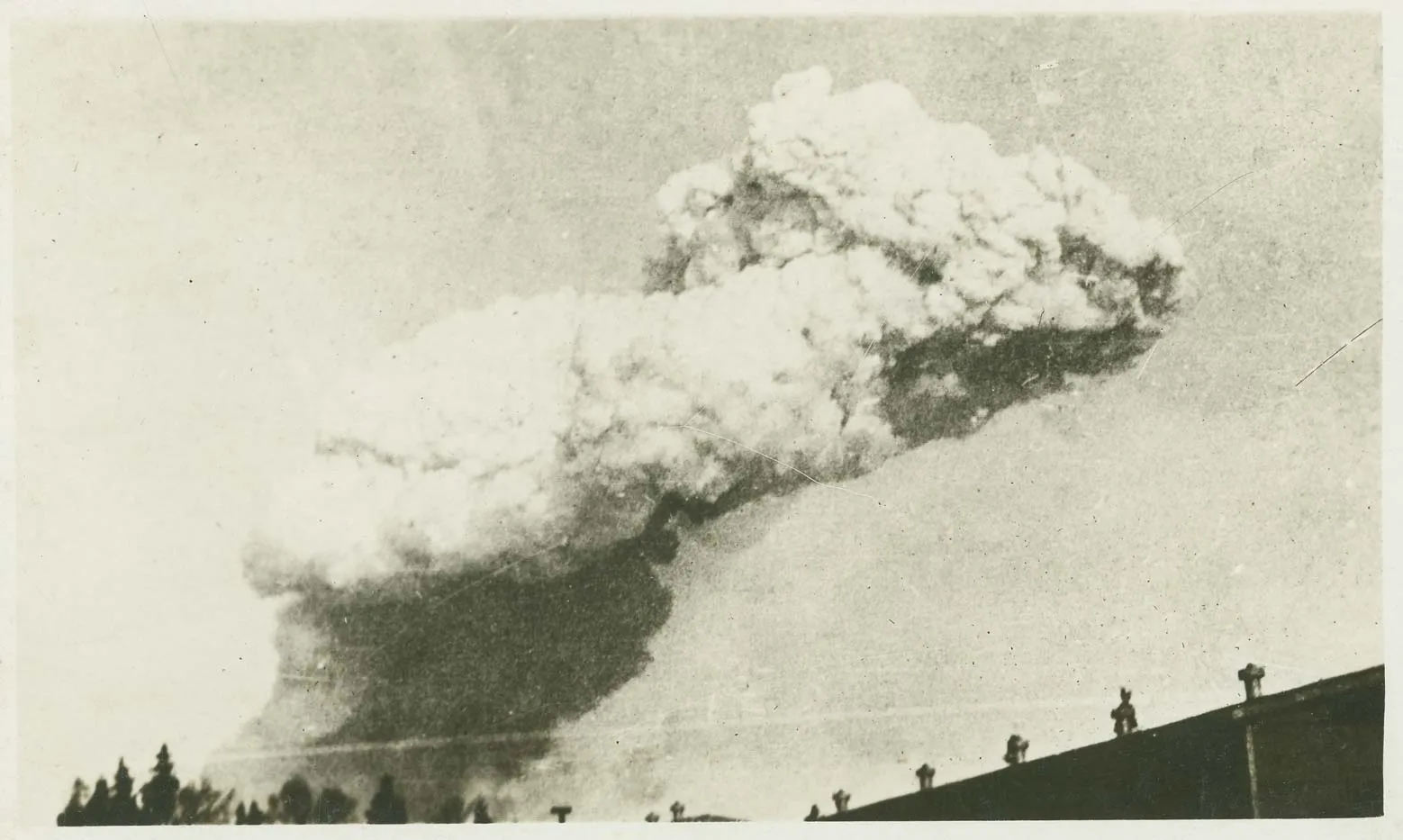
At 9:04:35 a.m., the fire reached the cargo. The explosion released energy equivalent to about 2.9 kilotons of TNT. White-hot fragments of iron fell across Halifax and Dartmouth. A pyrocumulus cloud rose to at least 3,600 metres. The blast was felt 207 kilometres away in Cape Breton and 180 kilometres away on Prince Edward Island.
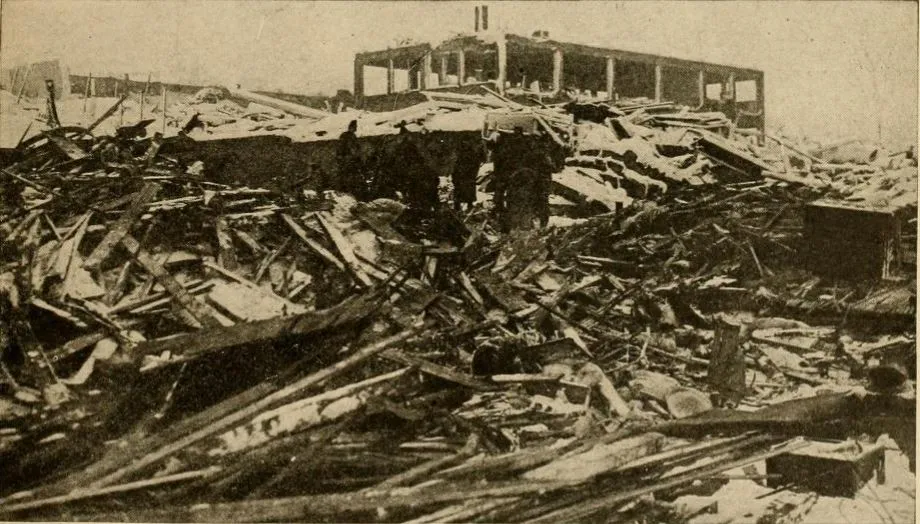
Nearly every structure within 800 metres of the explosion was destroyed. The blast killed more than 1,600 people immediately and injured about 9,000 more. The Halifax Explosion Remembrance Book names 1,782 confirmed victims. About 12,000 buildings were destroyed or badly damaged, 6,000 people were left homeless, and 25,000 were without adequate shelter. The damage was estimated at CA$35 million at the time.

Hundreds of people who had been watching the fire from their windows were blinded when the blast shattered the glass in front of them. The Richmond district was devastated. Large factories near Pier 6, including the Acadia Sugar Refinery, were flattened, and most of their workers were killed.
Vince Coleman
At the railyard, about 230 metres from Pier 6, the dispatcher Vince Coleman learned from a sailor what the burning ship was carrying. A passenger train from Saint John, New Brunswick, was due within minutes. Coleman went back to his post. The Maritime Museum of the Atlantic records one version of his final message: “Hold up the train. Ammunition ship afire in harbor making for Pier 6 and will explode. Guess this will be my last message. Good-bye boys.”
His warning halted all trains heading for Halifax. Coleman was killed at his post. His message probably spared the roughly 300 passengers on the train from the same fate.
The Relief
Help began within minutes, from neighbours and fellow workers. The new military hospital at Camp Hill took about 1,400 victims on the day of the explosion. Royal Navy cruisers sent rescue parties ashore. The American cruiser USS Tacoma changed course and arrived by 2 p.m., and the American steamship Old Colony, in port for repairs, was turned into a hospital ship.
The Halifax Relief Commission was formed around noon under Lieutenant Governor MacCallum Grant. It organised medical care, transport, food, shelter and funerals. The first rescue train left Truro at about 10 a.m. and reached Halifax by noon, and a dozen trains had arrived by nightfall. The next day brought a blizzard with 16 inches of snow, which hampered the relief effort but helped to put out fires.
Who Was to Blame?
A judicial inquiry began on 13 December 1917 under Justice Arthur Drysdale. Its first report, on 4 February 1918, blamed the captain of the Mont-Blanc, the pilot Mackey and Commander F. Evan Wyatt of the Royal Canadian Navy. Drysdale’s civil judgment of 27 April 1918 found the Mont-Blanc wholly at fault. On appeal, the Supreme Court of Canada, on 19 May 1919, and the Judicial Committee of the Privy Council, on 22 March 1920, held that both ships shared the blame for errors in navigation. Nobody was ever convicted of a crime in connection with the disaster.
The Tree From Halifax
Boston had been among the first cities to send help, through its Red Cross and the Massachusetts Public Safety Committee. In 1918 Halifax sent a Christmas tree to Boston as thanks. The gift was resumed in 1971, and every year a large spruce from Nova Scotia stands on Boston Common as the city’s official Christmas tree.
What the Record Shows
8 sourced claims in this story, resting on 5 primary and historical records. Numbers link to the bibliography below.
- The French freighter SS Mont-Blanc and Norwegian vessel SS Imo collided in Halifax Harbour on December 6, 1917 - sources: 1, 4
- Mont-Blanc was carrying approximately 2,900 tons of wartime explosives including picric acid, TNT, and benzol - sources: 1, 2
- The resulting detonation released an estimated explosive energy of 2.9 kilotons of TNT - sources: 4
- The explosion flattened two square kilometers of Halifax and generated a devastating tsunami wave - sources: 1, 5
- Train dispatcher Vincent Coleman sacrificed his life to telegraph an emergency stop to incoming passenger train No. 10 - sources: 1, 6
- Nearly 2,000 people were killed and over 9,000 injured, predominantly by blast shockwaves and shattered glass - sources: 1, 5
- It stood as the largest artificial accidental detonation in human history before nuclear weapons - sources: 2
- Boston immediately dispatched emergency relief trains with surgeons and nurses, sparking the annual Boston Christmas Tree tradition - sources: 1, 5
Archival Evidence & Picture Credits
Every image on this page was checked against its Wikimedia Commons file page.
- The cloud rising over Halifax after the explosion of 6 December 1917 (Wikimedia Commons) - Wikimedia Commons file page
- A panoramic view of the damage to the Halifax waterfront after the explosion in 1917 (Wikimedia Commons) - Wikimedia Commons file page
- The ruins in the Richmond district of Halifax after the explosion in 1917 (Wikimedia Commons) - Wikimedia Commons file page


Verified Archival Sources & Bibliography
Every claim in this account has been fact-checked against primary archives and scholarly repositories:
- The Canadian Encyclopedia: The Halifax Explosion (reference)
- Internet Archive: The Great Halifax Explosion (John U. Bacon) (book)
- Wikipedia: Halifax Explosion (reference)
- Nova Scotia Archives: The Halifax Explosion Database & Wreck Records (primary)
- Veterans Affairs Canada: Patrick Vincent Coleman War Memorial (primary)
Echoes of History Uncut. "Two Ships Collided. The Blast Flattened Part of a City.." Echoes of History Uncut. Last modified September 15, 2026. https://echoesofhistoryuncut.com/articles/halifax-explosion/.

An independent history publication using AI-assisted research, drafting and production. Consult each article’s citations and limitations; source inclusion does not establish independent verification of every claim.
▶
Watch the Complete Archival Documentary on YouTube
Subscribe to Echoes of History Uncut on YouTube for full widescreen 16:9 documentaries, primary archival footage, and declassified deep dives.