
A River Smelled So Bad That Parliament Nearly Fled. So They Rebuilt London.
In the sweltering summer of 1858, London experienced the Great Stink: the River Thames was so overloaded with raw human waste that the overpowering stench drove MPs to soak their curtains in disinfectant and debate moving Parliament out of London. Facing public fury and cholera outbreaks, the government funded Joseph Bazalgette to construct a monumental network of subterranean brick sewers that eliminated waterborne epidemics and modernised the city.

In this dossier (15 chapters) ▾
- 01 A Growing City and a River of Waste
- 02 Summer 1858
- 03 The House of Commons
- 04 Bazalgette’s Sewers
- 05 The Cathedrals of Sewage
- 06 Cholera
- 07 The Disease Behind the Smell
- 08 An Engineer in Waiting
- 09 Parliament Under Siege
- 10 Embankments and Engines
- 11 The Last Cholera
- 12 Why It Matters
- 13 What the Record Shows
- 14 Archival Evidence & Picture Credits
- 15 Verified Archival Sources & Bibliography
Historical Dossier: The Great Stink of London Location: The River Thames and the Palace of Westminster, London, England | Year: 1858 | Key Figures: Joseph Bazalgette, Benjamin Disraeli, Michael Faraday, Queen Victoria
A Growing City and a River of Waste
London in the first half of the nineteenth century grew from about one million people to about three million. Its sewers, designed for rainwater and street runoff, were not made to carry the waste of a metropolis. Then came flush toilets. Households that had once used cesspits now sent water, and waste, into the old sewers and on into the Thames. London had over 200,000 cesspits and 360 sewers, many of them in poor repair, and factory and slaughterhouse waste went into the river as well.
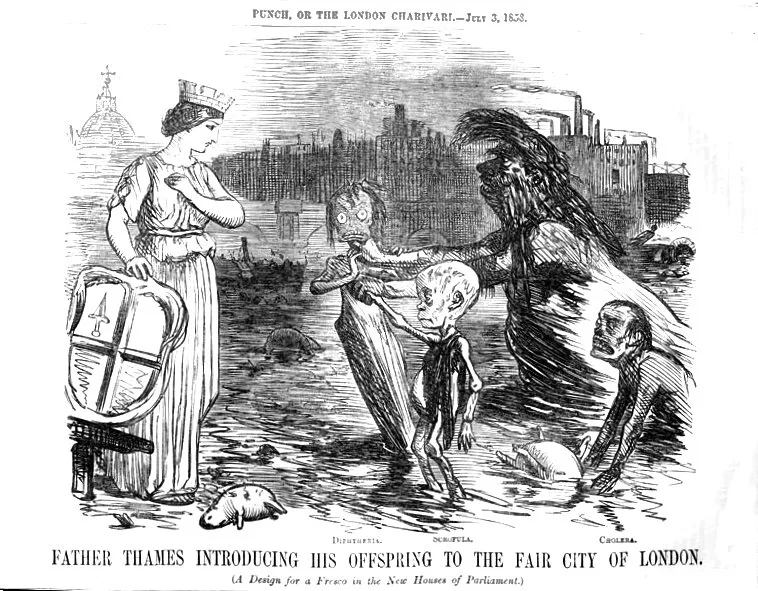
In 1855 Michael Faraday took a boat on the river and wrote to The Times about what he saw. He described a river so foul that it made visible clouds, “a real sewer.”
Summer 1858
In the summer of 1858 a heatwave settled over London. Temperatures were 34 to 36°C in the shade, and reached 48°C in the sun. There was also a drought. The river fell, and the sewage lay exposed along the banks.
The smell became unbearable. Charles Dickens described the Thames as “a deadly sewer … in the place of a fine, fresh river.” Queen Victoria and Prince Albert are said to have abandoned a pleasure cruise within minutes.
The House of Commons
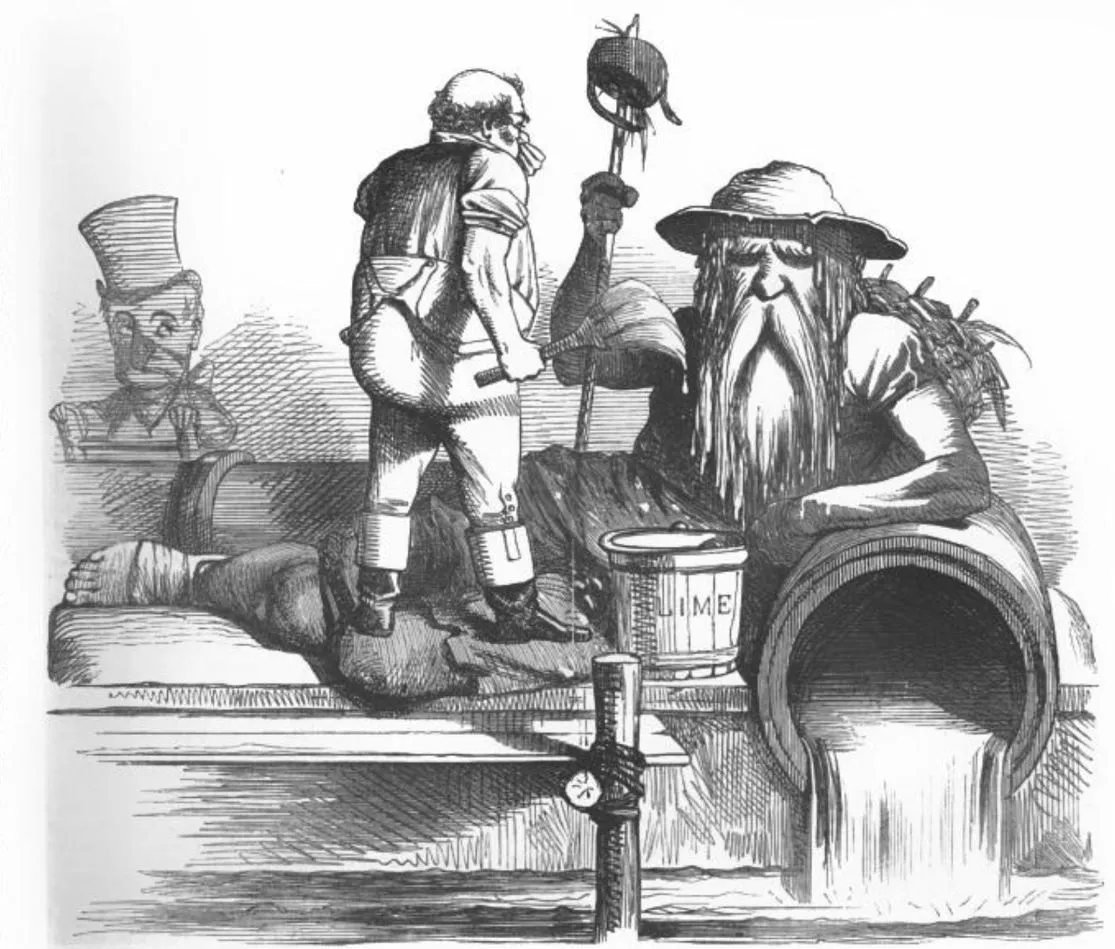
The Houses of Parliament stand beside the river. The smell came in through the windows, and the curtains were soaked in chloride of lime in an attempt to mask it. It did not work.
Benjamin Disraeli, then Chancellor of the Exchequer, introduced the Metropolis Local Management Amendment Bill. He called the Thames “a Stygian pool, reeking with ineffable and intolerable horrors.” Parliament passed the bill within 18 days, in August 1858.
Bazalgette’s Sewers
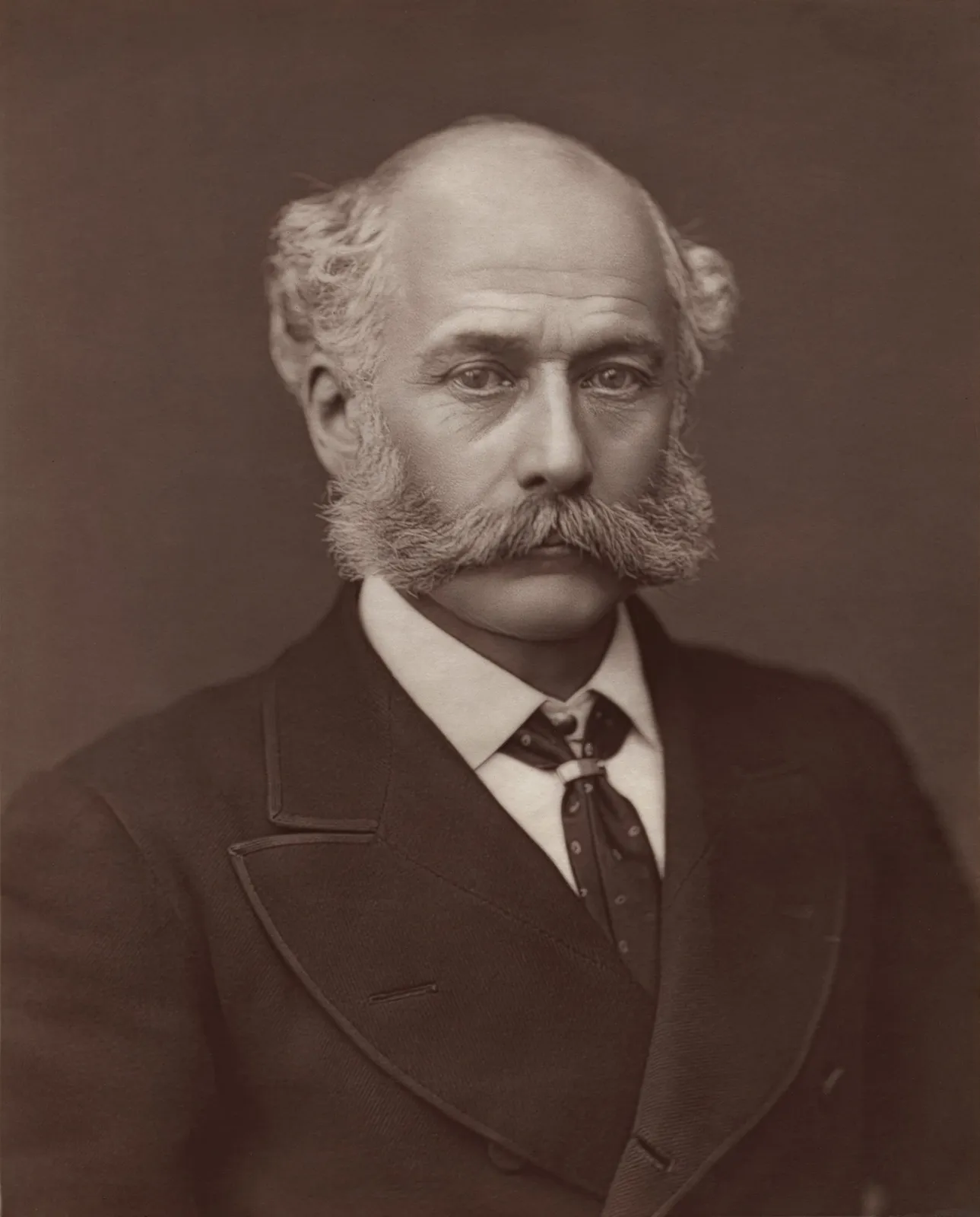
The man chosen to solve the problem was the civil engineer Joseph Bazalgette. His plan was to catch the sewage before it reached the Thames, and carry it eastward, far downstream, to where it could be released on the ebb tide. The system included 1,100 miles of street sewers and 82 miles of main intercepting sewers, with high-, mid- and low-level lines and pumping stations to lift the flow.
Construction ran from 1859 to 1875, used about 318 million bricks, and cost about £6.5 million.
The Cathedrals of Sewage
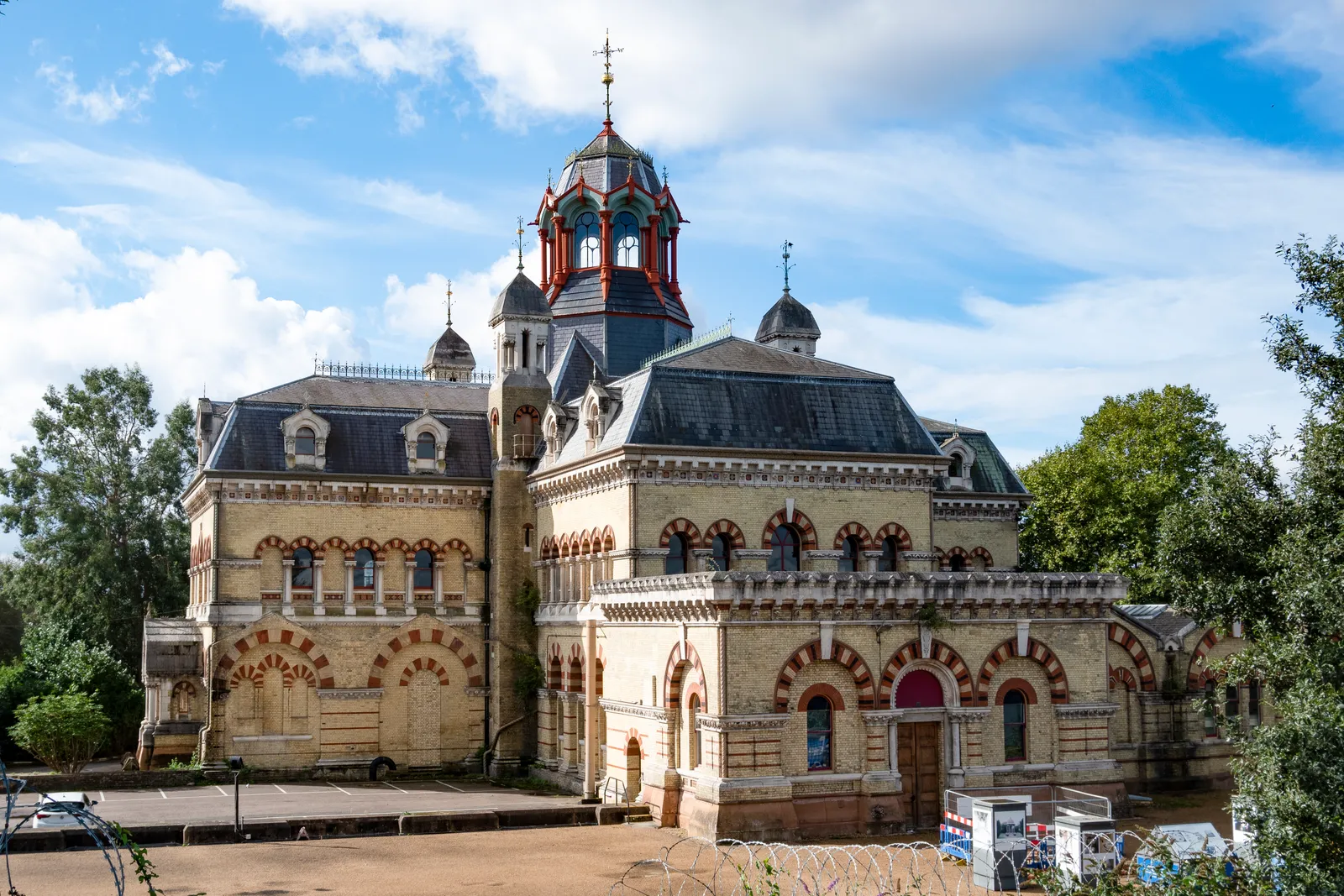
The pumping stations were designed to be as handsome as cathedrals. Abbey Mills and Crossness became Victorian landmarks, and Crossness was opened by the Prince of Wales in 1865.
Cholera
The Great Stink was also a health scare. At the time, people believed that disease was carried by foul air, the “miasma” theory. The stench frightened them, and it was linked in the public mind with the cholera that had struck London repeatedly.
The sewers did end cholera in London. The last outbreak, in 1866, was in the one area that had not yet been connected to Bazalgette’s system. The infrastructure still works today, serving millions of Londoners, though it is under strain.
The Disease Behind the Smell
The stink mattered because the people of London had seen what the river could do. A cholera outbreak in 1831 killed 6,536 Londoners. The epidemic of 1848 and 1849 killed 14,137, and a third, in 1853 and 1854, killed about 10,738.
Victorian doctors mostly believed that cholera spread through foul air, “miasma” from rotting matter. A physician, John Snow, disagreed. After the 1848–49 epidemic he published On the Mode of Communication of Cholera, arguing that the disease travelled in water. Few paid attention. During the Broad Street outbreak in Soho in 1854, he observed that “the rates of death were higher in those areas supplied by the Lambeth and the Southwark and Vauxhall water companies.” He had the handle taken off the contaminated pump on Broad Street, and deaths fell. It was later found that “a leaking sewer ran near the well from which the water was drawn.”
An Engineer in Waiting
The Metropolitan Commission of Sewers was created in 1848, at the urging of the reformer Edwin Chadwick, as the first single authority for London’s sanitation. It replaced seven of eight earlier sewer authorities, some of which went back to the reign of Henry VIII. In August 1849 it took on Joseph Bazalgette as an assistant surveyor, and after the chief engineer, Frank Foster, died in 1852, Bazalgette took over and refined plans for a complete sewerage system.
The Metropolis Management Act 1855 replaced the Commission with the Metropolitan Board of Works. By June 1856 Bazalgette had finished his plan. London was divided into high-, middle- and low-level drainage zones, with small local sewers feeding bigger mains, which ran into the Northern and Southern Outfall Sewers. He designed the system for a population of 4.5 million, though London then had about three million, and explained, in a remark attributed to him, that “we’re only going to do this once.”
Parliament Under Siege
The heat of June 1858 made the plan urgent. Parliament was close to the river, and there was talk of moving the government to Oxford or St Albans. Disraeli was seen leaving committee meetings “with a mass of papers in one hand, and with his pocket handkerchief applied to his nose.”
On 15 June 1858 Disraeli tabled his bill, calling the Thames “a Stygian pool, reeking with ineffable and intolerable horrors.” It became law on 2 August. It allowed the Board of Works to borrow £3 million, to be repaid through a three-penny household levy over forty years, and it adopted Bazalgette’s plan. It required the outfalls to be placed, “as far as may be possible,” outside London.
Embankments and Engines
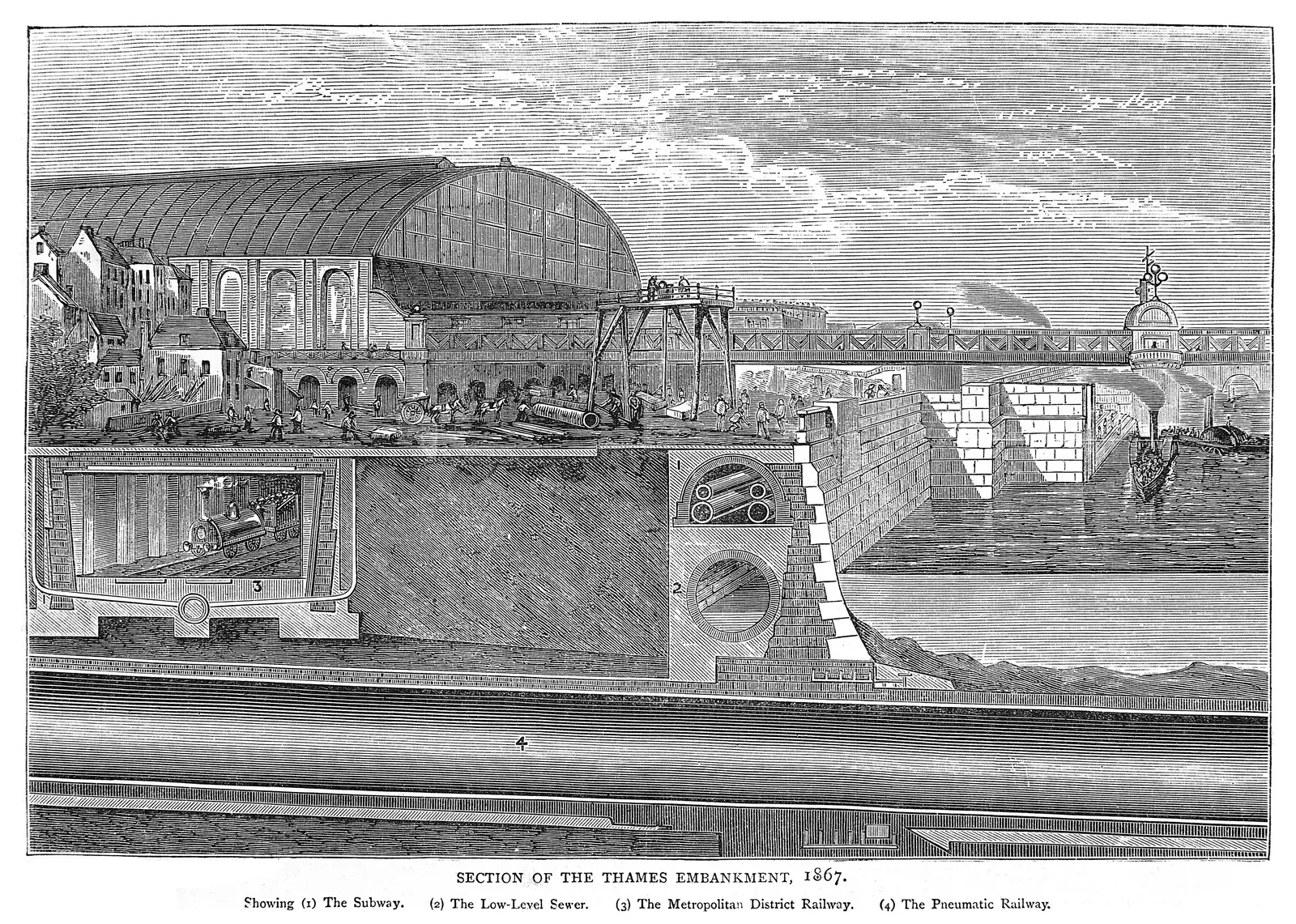
Work began in January 1859. It needed 318 million bricks and 880,000 cubic yards of concrete and mortar, and cost about £6.5 million. Bazalgette built three new embankments with sewers in them, the Victoria Embankment, the Chelsea Embankment and the Albert Embankment, which also took 52 acres of land from the river and relieved the traffic on the roads.
Some parts of London lay below the high-water mark, so sewage had to be lifted by pumps, at Abbey Mills in Stratford and at Crossness on the Erith Marshes, up 21 to 36 feet into gravity-fed mains. Both pumping stations were designed by Bazalgette with the consulting engineer Charles Driver, and Crossness had four huge beam engines made by James Watt and Co., called Victoria, Prince Consort, Albert Edward and Alexandra. The Prince of Wales opened Crossness on 4 April 1865, in front of royalty, MPs, the Lord Mayor and archbishops. The Victoria Embankment opened in July 1870 and the Chelsea Embankment in July 1874.
The Last Cholera
One more epidemic came, in 1866, and it killed 5,596 people. It was almost entirely in the East End, between Aldgate and Bow, which had not yet been joined to Bazalgette’s system. The East London Water Company drew its water half a mile below the point where it discharged sewage, and the incoming tide carried pollution back upstream. Ninety-three percent of the deaths were in this unconnected zone.
Dr William Farr’s investigation made the case. The Lancet said that his findings would render “irresistible the conclusions… in regard to the influence of the water-supply in causation of the epidemic.” It was London’s last cholera epidemic, and it settled the argument in favour of the water-borne theory. The completed system, in service by 1875, was said to have added “some 20 years to their chance of life” for Londoners, and the historian John Doxat concluded that Bazalgette “probably did more good, and saved more lives, than any single Victorian official.”
Why It Matters
The Great Stink is often told as a joke about Parliament and its curtains. It is better understood as the moment when a political class that had ignored a public-health crisis for years was forced to act, because the crisis had reached its own windows. London got a sewer system that has lasted more than 150 years.
What the Record Shows
8 sourced claims in this story, resting on 6 primary and historical records. Numbers link to the bibliography below.
- A heatwave in June–July 1858 caused the sewage-choked River Thames to ferment, precipitating the Great Stink - sources: 1, 2
- London’s population had climbed past 2.5 million, discharging over 250,000 tons of raw waste weekly into the tidal river - sources: 1, 3
- The stench was so intense that Parliament soaked curtains in chloride of lime and abandoned committee rooms - sources: 1, 4
- In August 1858, Parliament drafted and passed the Metropolis Local Management Amendment Act in just 18 days - sources: 1, 4
- Chief Engineer Joseph Bazalgette designed and supervised eighty-two miles of main intercepting brick tunnels - sources: 2, 5
- Over 318 million bricks and unprecedented volumes of Portland cement were utilized across 1,100 miles of street drains - sources: 2, 5
- Magnificent Victorian Gothic pumping stations, including Abbey Mills and Crossness, housed steam beam engines - sources: 1, 6
- The project eliminated waterborne cholera epidemics from central London and continues to serve the city today - sources: 2, 3
Archival Evidence & Picture Credits
Every image on this page was checked against its Wikimedia Commons file page.
- A satirical sketch of Father Thames introducing his children, cholera, scrofula and diphtheria, to the city of London (Wikimedia Commons) - Wikimedia Commons file page
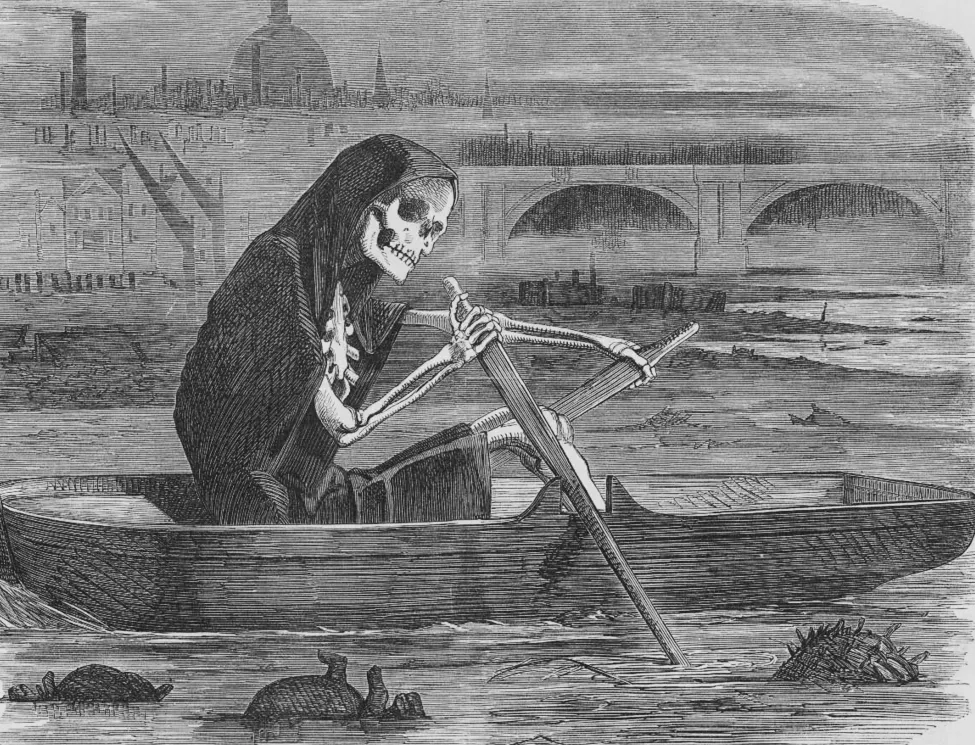
- A Punch cartoon of 1858, The Silent Highwayman, showing the Thames as a figure of Death (Punch / Wikimedia Commons) - Wikimedia Commons file page
- A Punch cartoon on the efforts to deal with the Thames (Punch / Wikimedia Commons) - Wikimedia Commons file page
- The construction of the brick sewers of the new London sewerage system (Wellcome Collection / Wikimedia Commons) - Wikimedia Commons file page
- Sir Joseph William Bazalgette, the engineer of London’s sewers (Wikimedia Commons) - Wikimedia Commons file page
- Abbey Mills Pumping Station, one of the ornate pumping stations of Bazalgette’s system (Wikimedia Commons) - Wikimedia Commons file page


Verified Archival Sources & Bibliography
Every claim in this account has been fact-checked against primary archives and scholarly repositories:
- Wikipedia: The Great Stink (reference)
- Internet Archive: The Great Stink of London: Sir Joseph Bazalgette and the Cleansing of the Victorian Metropolis (Stephen Halliday) (book)
- World Archaeology: The Thames and the Great Stink of 1858 (academic)
- UK Parliament Hansard: State of the River Thames Debates, July 1858 (primary)
- Institution of Civil Engineers (ICE Virtual Library): The Main Drainage of London (Sir Joseph Bazalgette, 1865) (primary)
- Historic England: Abbey Mills Pumping Station Listing & Architectural Survey (primary)
Echoes of History Uncut. "A River Smelled So Bad That Parliament Nearly Fled. So They Rebuilt London.." Echoes of History Uncut. Last modified September 19, 2026. https://echoesofhistoryuncut.com/articles/great-stink-london-1858/.

An independent history publication using AI-assisted research, drafting and production. Consult each article’s citations and limitations; source inclusion does not establish independent verification of every claim.
▶
Watch the Complete Archival Documentary on YouTube
Subscribe to Echoes of History Uncut on YouTube for full widescreen 16:9 documentaries, primary archival footage, and declassified deep dives.