
A Whole Town Faked Wild West Shootouts for Tourists
In the 1870s, the sleepy railroad junction of Palisade, Nevada, had virtually no crime. Annoyed by Eastern train travelers disappointed by the lack of lawless frontier danger, the entire town conspired to stage elaborate, bloody gun battles with blanks and butcher's blood every time the passenger train pulled in.

In this dossier (8 chapters) ▾
Historical Dossier: Palisade, Nevada and the Legend of the Staged Gunfights Location: Palisade, Eureka County, Nevada, USA | Year: 1868–1910 | Key Figures: Central Pacific Railroad, Eureka and Palisade Railroad, the townspeople of Palisade
A Railroad Town in the Canyon
Palisade, Nevada, owes its existence to the railroad. It was established in 1868 as a station on the Central Pacific Railroad, and it took its name from Palisade Canyon, a rocky obstacle that railroad builders had to get through along the Humboldt River. A post office opened in May 1870.
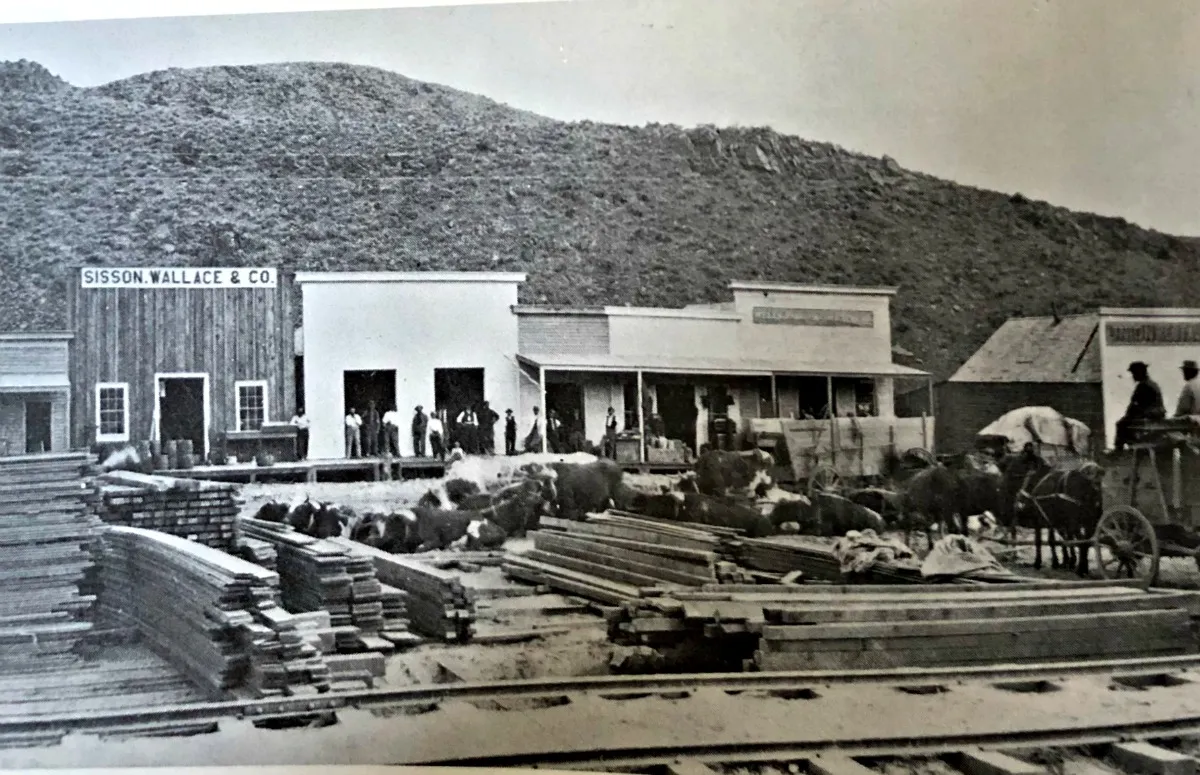
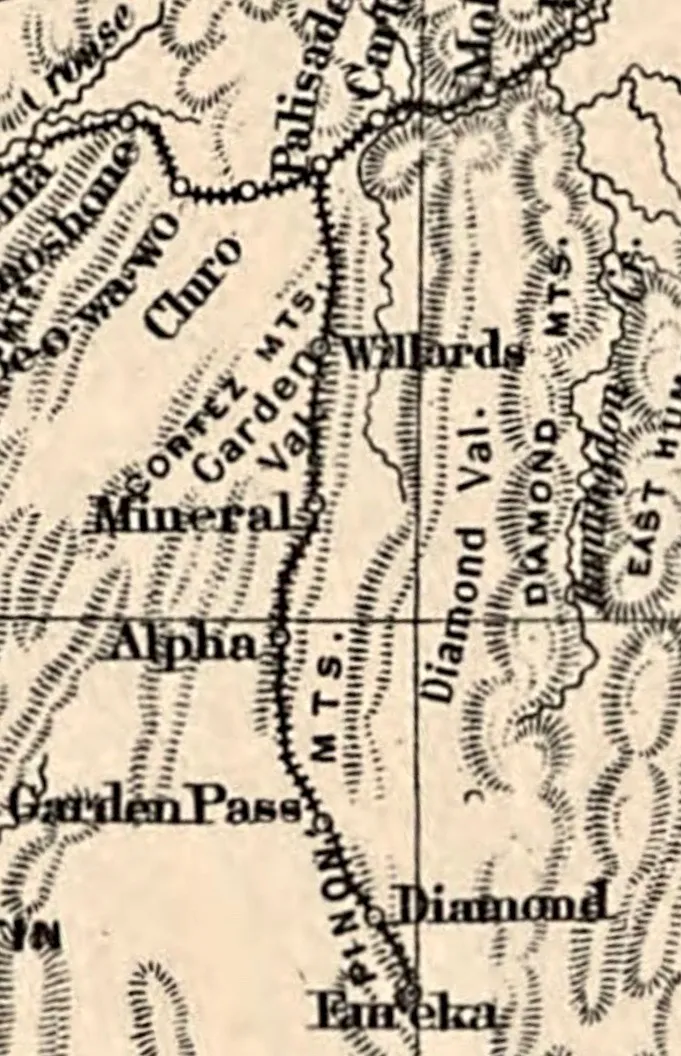
The town was a transport hub for the mining camps of the surrounding country, among them Mineral Hill, Hamilton and Eureka. Its fortunes turned upward in 1874, when the narrow-gauge Eureka and Palisade Railroad opened and connected the mines to the main line. By the late 1870s Palisade had hotels, saloons, stores, houses, two churches and a school. At its peak it had roughly 600 residents.
This is the Palisade the record can support: a busy junction, full of railway workers, shopkeepers and miners’ families, where trains stopped, passengers changed and freight moved on to the silver camps.
The Story Everyone Tells
Then there is the legend, which is far more fun. The story goes that in the early 1870s, passengers on the new transcontinental trains were disappointed. They had read dime novels about the Wild West and expected outlaws, and instead the stops along the line looked like ordinary American towns. The people of Palisade, so the tale runs, decided to give them what they wanted.
Whenever a train pulled in, the residents were said to stage gunfights and bank robberies. The accounts add colour: blank cartridges loaded with black powder, cattle blood from the local slaughterhouse, townspeople falling dead in the street and getting up again when the whistle blew. Some versions say local Western Shoshone people and soldiers from nearby posts joined the performance. In the legend, nobody knew the truth except the residents, and the showmanship faded after a few years.
It is an appealing picture of a town with a sense of humour, and it is repeated in many places. Even so, the reliability of the story needs to be stated plainly, because the documentary evidence for it is thin.
What Can and Cannot Be Shown
The most direct statement comes from the reference work itself: “In reality, crime in Palisade was low and the town did not have a sheriff.” The same account treats the staged gunfights as something the residents were “said to” do. The sources behind the legend that can be traced include a popular book on historical fakes and frauds, Kathryn Lindskoog’s Fakes, Frauds & Other Malarkey (1993), and a web article, not contemporary records such as diaries, tickets, court papers or eyewitness letters from the 1870s.
That does not prove the tale is false. A small town with no sheriff and a lot of free time could have staged a show now and then, and the story might be a memory of a real prank that grew in the retelling. It does mean that the claims people often add, such as the exact number of years, the use of Shoshone participants and cavalry, and newspapers back East reporting the shootouts as real crimes, should be treated as unproven. The Library of Congress holds the Nevada newspapers of the 1870s, including the Eureka Daily Sentinel and the Elko Independent, so the claim that Eastern papers printed these accounts is one that a researcher could in principle check, and this page has not been able to do that.
What is well supported is the quiet side of the story. Palisade was a place where, in the words of the record, crime was low and no sheriff was needed. The irony of the legend is that the real town was the opposite of the one the tourists wanted.
The Fall of Palisade
The good years did not last. After 1885, mining declined and the railroads carried less traffic, and people began to leave. The Western Pacific Railroad came through in 1908, but in 1910 floods destroyed much of the town and damaged all three railroad lines. Palisade never recovered.
Its post office closed in 1961, and the town became a near ghost town. In 2005 it was sold at auction for $150,000 to a buyer who was not named. The canyon and the railbed are still there.
Why the Legend Holds On
The legend of Palisade endures because it flatters both sides. It lets modern readers laugh at the gullible Eastern tourists, and it lets Westerners imagine that the “wild” in Wild West was partly theatre. There is something to that idea. The American frontier was shaped by novels, newspapers and travelling shows as much as by actual outlaws, and tourists did arrive with fixed expectations.
The honest version of Palisade’s story is a little less dramatic, and arguably more interesting: a calm railroad town that has been remembered, for a century and a half, as the home of the fiercest fake gunfights in the West. Whether or not the townspeople ever fired a single blank, the legend proves how much people wanted the frontier to be violent, and how readily they believe it is.
What the Record Shows
7 sourced claims in this story, resting on 4 primary and historical records. Numbers link to the bibliography below.
- Palisade, Nevada, was established in 1869 as a quiet junction for the Central Pacific and Eureka railroads - sources: 4
- Crime in Palisade was low and the town had no sheriff - sources: 2
- Townsfolk are reported, in a long-repeated legend, to have staged mock gunfights for arriving passenger trains (traced to popular accounts, not contemporary records) - sources: 3
- In the legend, performers used blank black powder cartridges and cattle blood from the local slaughterhouse - sources: 3
- Some versions of the legend add that Shoshone people and cavalry took part (unverified) - sources: 3
- The legend says Eastern periodicals printed reports of lawlessness in Palisade (not verified here) - sources: 2, 5
- The legend says the hoax ran for several years without real violence or exposure - sources: 3
Archival Evidence & Picture Credits
Every image on this page was checked against its Wikimedia Commons file page.
- Palisade, Nevada, along the Humboldt River in the 1870s (Wikimedia Commons) - Wikimedia Commons file page
- A Eureka and Palisade Railroad narrow-gauge train and depot (Wikimedia Commons) - Wikimedia Commons file page


Verified Archival Sources & Bibliography
Every claim in this account has been fact-checked against primary archives and scholarly repositories:
- Internet Archive: The History of Nevada (Sam P. Davis) (book)
- Smithsonian Magazine: The Wild West Town That Faked Shootouts to Entertain Disappointed Tourists (historical feature)
- Wikipedia: Palisade, Nevada (reference)
- Library of Congress (Chronicling America): Eureka Daily Sentinel and Elko Independent archives 1874-1878 (primary)
Echoes of History Uncut. "A Whole Town Faked Wild West Shootouts for Tourists." Echoes of History Uncut. Last modified September 15, 2026. https://echoesofhistoryuncut.com/articles/palisade-nevada/.

An independent history publication using AI-assisted research, drafting and production. Consult each article’s citations and limitations; source inclusion does not establish independent verification of every claim.
▶
Watch the Complete Archival Documentary on YouTube
Subscribe to Echoes of History Uncut on YouTube for full widescreen 16:9 documentaries, primary archival footage, and declassified deep dives.