
Enemy Soldiers Stopped Fighting for Christmas. Did They Play Football?
On Christmas Eve 1914, five months into the slaughter of World War One, gunfire along the Western Front suddenly died down. German soldiers lit small candles on miniature Christmas trees placed atop their parapets and began singing 'Stille Nacht' across the frozen mud. In response, British troops answered with English carols. By dawn on Christmas Day, thousands of mortal enemies climbed unarmed out of their trenches, meeting in the cratered expanse of No Man's Land to bury fallen comrades, exchange cigarettes and plum puddings, and even play impromptu football matches.

In this dossier (11 chapters) ▾
Historical Dossier: The Christmas Truce of 1914 Location: The Western Front, mainly the Ypres sector, Belgium and France | Year: 24–25 December 1914 | Key Figures: Pope Benedict XV, Bruce Bairnsfather, Alfred Anderson, Captain Edward Hulse, General Horace Smith-Dorrien
Five Months of War
By December 1914 the First World War was five months old. The opening rush of armies had stalled, and trenches ran from the North Sea to the Swiss border. The soldiers on both sides were living in cold, wet holes within shouting distance of one another.
On 7 December Pope Benedict XV made a formal appeal for a Christmas truce, asking that “the guns may fall silent at least upon the night the angels sang.” Both governments rejected it. Around the same time, 101 British suffragettes published an Open Christmas Letter to the women of Germany and Austria, calling for peace.
Live and Let Live
The truce did not come from nowhere. Fraternisation had already begun along the front. By early November, soldiers had noticed quiet periods during the distribution of rations. A German surgeon recorded regular half-hourly truces in December to collect the dead, during which French and German troops swapped newspapers. Officers on both sides, among them a young Charles de Gaulle, discouraged it.
The trenches were close enough for talk. Many German soldiers had lived in England, especially London, so there was little problem of language. They shouted greetings and talked about football results, and then they began to sing to one another.
Christmas Eve
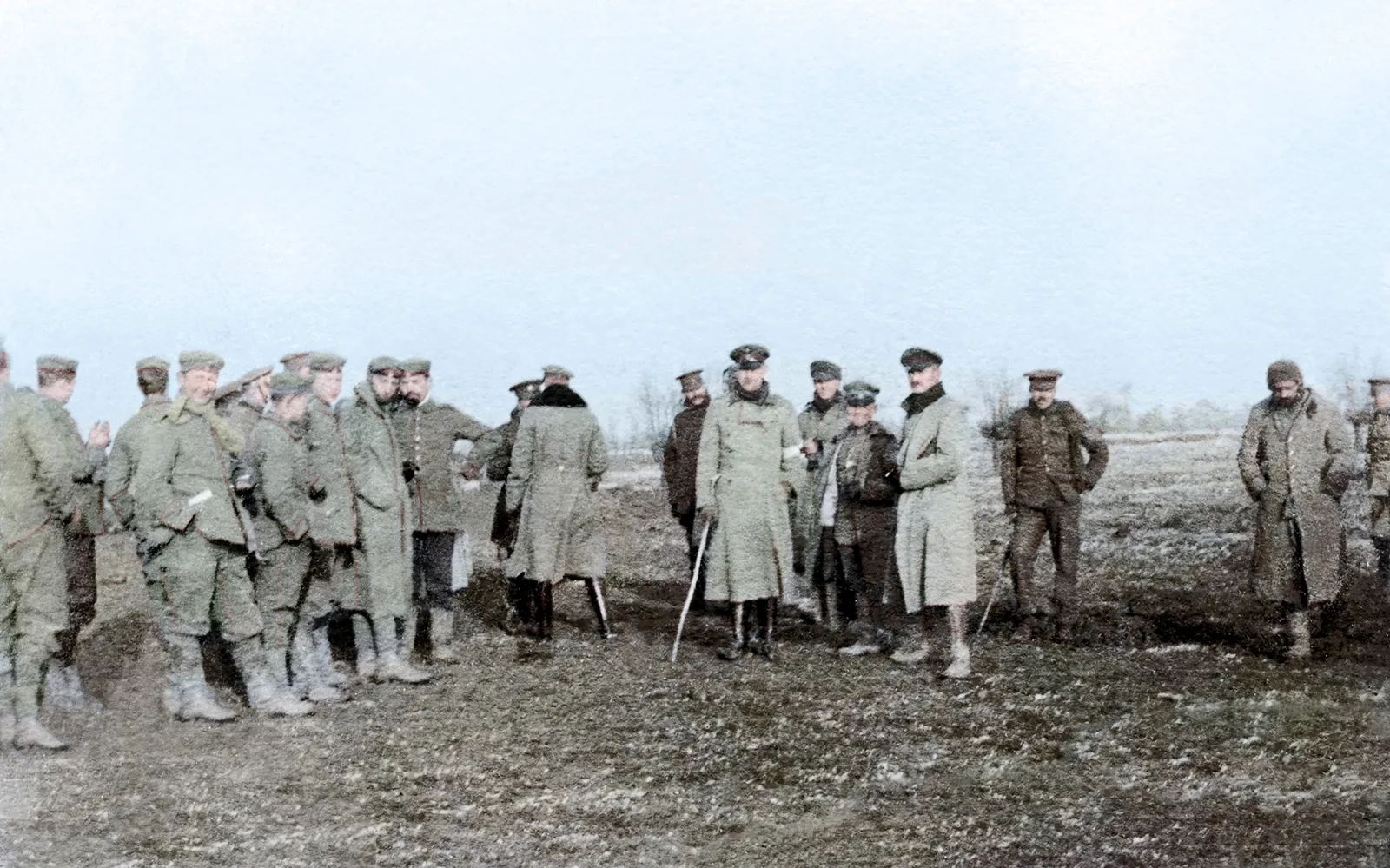
Around 100,000 British and German soldiers took part in informal ceasefires along the front. On Christmas Eve, in many places, the Germans put candles on their trenches and set up small Christmas trees, and sang carols. The British answered with songs of their own. Then came greetings shouted across No Man’s Land, and soon small groups climbed out into the space between the lines.
A German lieutenant, Johannes Niemann, wrote that he “grabbed my binoculars and looking cautiously over the parapet saw the incredible sight of our soldiers exchanging cigarettes, schnapps and chocolate with the enemy.”
Christmas Day
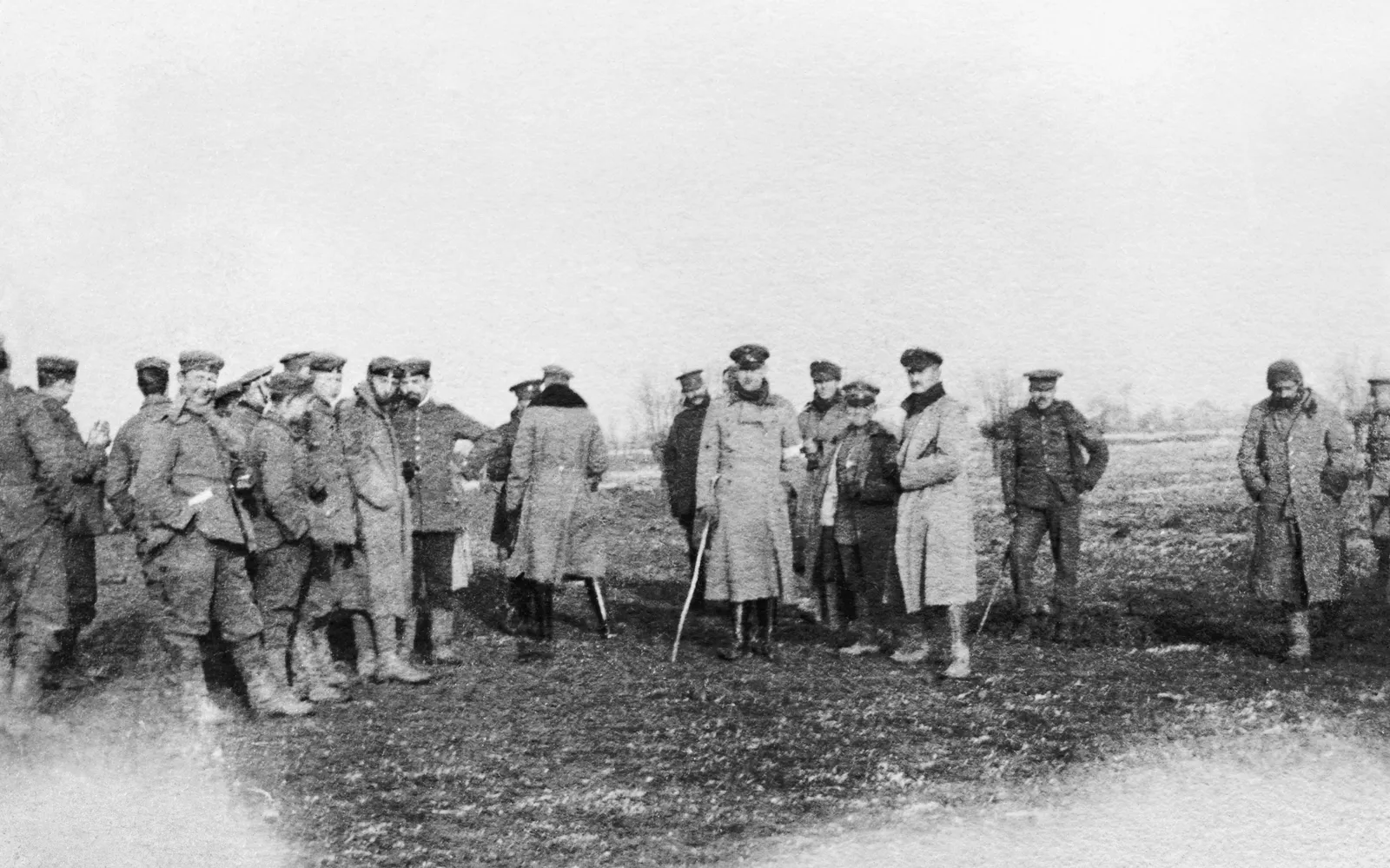
Soldiers traded food, tobacco, alcohol, buttons and hats. Alfred Anderson of the 1st/5th Black Watch remembered: “I remember the silence, the eerie sound of silence… All I’d heard for two months in the trenches was the hissing, cracking and whining of bullets in flight.”
Bruce Bairnsfather, the cartoonist, who served through the war, recalled meeting a German officer: “being a bit of a collector, I intimated to him that I had taken a fancy to some of his buttons… I brought out my wire clippers and, with a few deft snips, removed a couple of his buttons and put them in my pocket.” Henry Williamson wrote to his mother on Boxing Day: “Yesterday the British & Germans met & shook hands in the Ground between the trenches, & exchanged souvenirs, & shook hands… Marvellous, isn’t it?”
Captain Edward Hulse described meeting a German interpreter from Suffolk who had left behind a motorcycle, and a sing-song that ended with “Auld Lang Syne” sung by English, Scots, Irish, Prussian and Württemberg soldiers together. “It was absolutely astounding,” he wrote, “and if I had seen it on a cinematograph film I should have sworn that it was faked!”
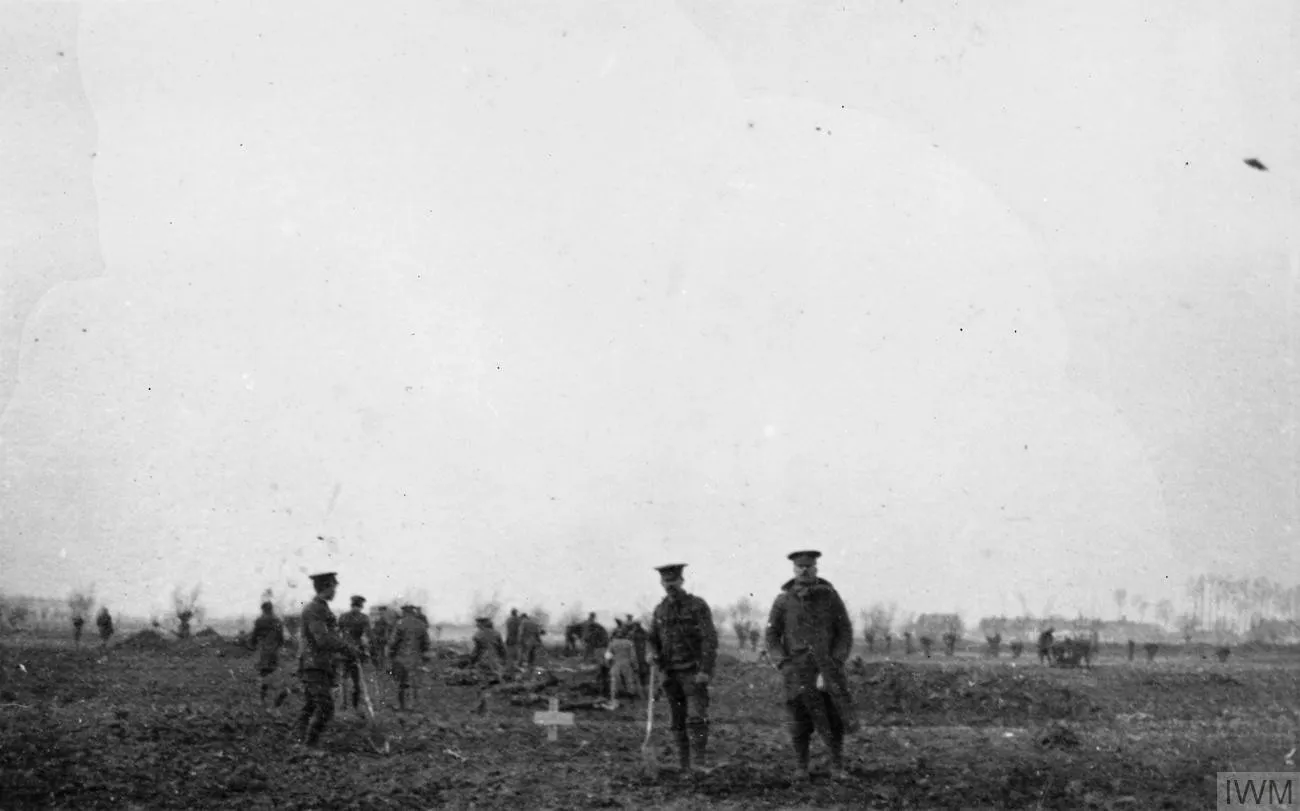
The guns fell silent so that the dead could be buried. Joint services were held in many sectors. In some places the truce lasted through Christmas night, and in others into New Year’s Day.
The Football Question
The football match is the most famous and the most disputed part of the story. A doctor with the Rifle Brigade wrote in The Times on 1 January 1915 of “a football match… played between them and us in front of the trench.” Lieutenant Kurt Zehmisch of the 134th Saxon Infantry Regiment said that the English “brought a soccer ball from their trenches, and pretty soon a lively game ensued.”
Historians are cautious. In 1984, Malcolm Brown and Shirley Seaton concluded that organised matches were unlikely, because of the state of the ground, and that reports may refer to kickabouts with improvised balls such as bully-beef tins. The former Western Front Association chairman Chris Baker noted: “There are two references to a game being played on the British side, but nothing from the Germans.” Mike Dash’s 2011 research concluded that “there is plenty of evidence that football was played that Christmas Day, mostly by men of the same nationality but in at least three or four places between troops.”
Orders From Above
Commanders did not welcome it. General Horace Smith-Dorrien, commanding II Corps, issued orders forbidding friendly contact with the Germans. A German order of 29 December forbade fraternisation and warned that “every approach to the enemy… will be punished as treason.” Adolf Hitler, then a corporal in a Bavarian reserve regiment, is reported to have opposed the truce.
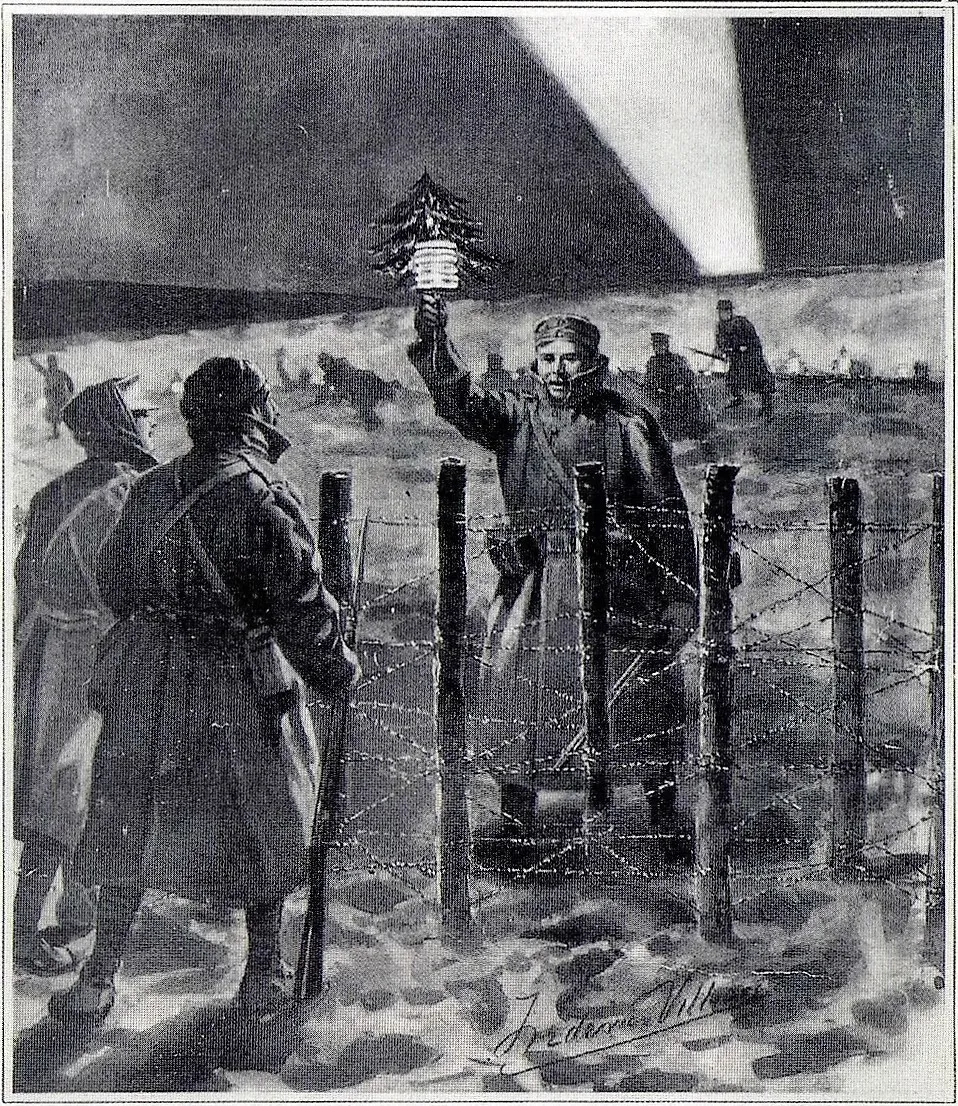
The press at first said little. The New York Times, published in neutral America, broke the unofficial embargo on 31 December 1914, and British papers soon followed with letters from soldiers. By 8 January photographs were appearing in The Mirror and The Sketch.
After 1914
There were later attempts at truces, but they were rarer and smaller. In December 1915, commanders on the Allied side tried to prevent a repeat with raids and harassment. Sir Iain Colquhoun of the Scots Guards was court-martialled for permitting burial truces against orders. He was found guilty and reprimanded, but General Douglas Haig annulled the punishment, possibly because Colquhoun’s wife’s uncle was the Prime Minister, H. H. Asquith.
The last known survivor of the truce, Alfred Anderson of the Black Watch, died on 21 November 2005 at the age of 109.
Why It Is Remembered
The Christmas Truce is the best-known case of a wider practice of “live and let live” in trench warfare, in which front-line soldiers made unofficial agreements to avoid killing one another. It lasted only a few days. But the men who took part, in letters and diaries, left a record of how quickly an enemy could become a person.
What the Record Shows
8 sourced claims in this story, resting on 5 primary and historical records. Numbers link to the bibliography below.
- Pope Benedict XV requested an official Christmas armistice in December 1914, which military commands rejected - sources: 1, 2
- The truce began on Christmas Eve 1914 with German troops placing candles and trees on parapets and singing Stille Nacht - sources: 1, 3
- British soldiers responded with English carols, leading to spontaneous ceasefires across two-thirds of the British sector - sources: 2, 3
- Unarmed soldiers met in No Man’s Land to recover and bury dead comrades in joint Christian burial services - sources: 1
- Troops traded gifts including plum puddings, tobacco, cigars, beer, and uniform badges - sources: 2, 5
- Multiple contemporary diaries and letters describe informal football matches played on the frozen turf - sources: 3
- High commands issued strict disciplinary decrees banning fraternization under threat of court-martial - sources: 1, 5
- Routine troop rotations were mandated afterward to prevent unit familiarity across opposing trench parapets - sources: 2, 6
Archival Evidence & Picture Credits
Every image on this page was checked against its Wikimedia Commons file page.
- German and British soldiers together in No Man’s Land during the Christmas Truce of 1914 (Imperial War Museums / Wikimedia Commons) - Wikimedia Commons file page
- British and German troops meeting in No Man’s Land during the unofficial truce, with men of the Northumberland Hussars (Imperial War Museums / Wikimedia Commons) - Wikimedia Commons file page
- British and German troops meeting in No Man’s Land, Christmas 1914 (Imperial War Museums / Wikimedia Commons) - Wikimedia Commons file page
- A depiction of the Christmas Truce published on the front page of the Illustrated London News on 9 January 1915 (Illustrated London News / Wikimedia Commons) - Wikimedia Commons file page


Verified Archival Sources & Bibliography
Every claim in this account has been fact-checked against primary archives and scholarly repositories:
- Wikipedia: Christmas Truce (reference)
- Internet Archive: Christmas Truce: The Western Front, December 1914 (Malcolm Brown & Shirley Seaton) (book)
- Imperial War Museums: The Real Story of the Christmas Truce (primary)
- The National Archives (UK): War Office Records: First World War Trench Diaries (WO 95) (primary)
- National WWI Museum and Memorial: The Christmas Truce Archive & Letters (primary)
Echoes of History Uncut. "Enemy Soldiers Stopped Fighting for Christmas. Did They Play Football?." Echoes of History Uncut. Last modified September 15, 2026. https://echoesofhistoryuncut.com/articles/christmas-truce-1914/.

An independent history publication using AI-assisted research, drafting and production. Consult each article’s citations and limitations; source inclusion does not establish independent verification of every claim.
▶
Watch the Complete Archival Documentary on YouTube
Subscribe to Echoes of History Uncut on YouTube for full widescreen 16:9 documentaries, primary archival footage, and declassified deep dives.