
Operation Mincemeat: The Dead Man Who Carried a Fake Invasion Plan
In April 1943 a British submarine slipped a corpse into the sea off Huelva, Spain. He was dressed as a Royal Marines officer and carried letters suggesting the Allies would invade Greece and Sardinia, not Sicily. The Germans read them and believed them. The dead man was Glyndwr Michael, a homeless Welshman, and his grave now carries both names.

In this dossier (10 chapters) ▾
- 01 The Problem: Everyone Could See Sicily Coming
- 02 The Body
- 03 Building “Major Martin”
- 04 Into the Sea at Huelva
- 05 The Germans Read the Letters
- 06 Did It Save Lives?
- 07 Two Names on One Grave
- 08 What the Record Shows
- 09 Archival Evidence & Picture Credits
- 10 Verified Archival Sources & Bibliography
Historical Dossier: Operation Mincemeat Location: London; HMS Seraph off Huelva, Spain | Year: January – July 1943 | Key Figures: Ewen Montagu, Charles Cholmondeley, Glyndwr Michael (“Major William Martin”), Lt. Bill Jewell, coroner Bentley Purchase
The Problem: Everyone Could See Sicily Coming
By late 1942 the Allies had won in North Africa and were choosing their next target in Europe. Sicily was the obvious choice, so the task was to make the Germans believe otherwise.
The Allies knew Hitler feared an attack on the Balkans, which supplied Germany with copper, bauxite, chrome and oil. So they ran a deception, Operation Barclay, to play on that fear. Mincemeat was one part of it.
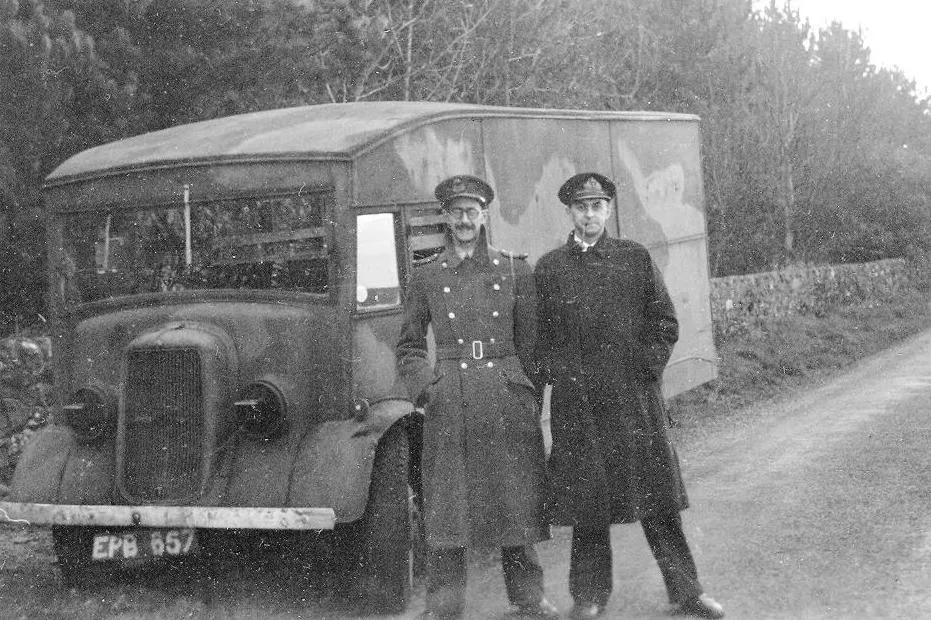
The idea went back to the 1939 “Trout memo” written by Rear Admiral John Godfrey and his assistant, Ian Fleming, which listed ways to plant false information on the enemy. One was a dead body carrying fake papers. Charles Cholmondeley, an RAF officer seconded to MI5, worked it into a plan, and with the naval intelligence officer Ewen Montagu he made it real.
The Body
They needed a man who looked as if he had drowned after a plane crash at sea. In January 1943 the London coroner Bentley Purchase found one: almost certainly Glyndwr Michael, a homeless Welshman who had died after eating rat poison containing phosphorus. Purchase told them the small amount of poison would not be detected in a body supposed to have been in the sea for days. Montagu worried that the thin, under-nourished man did not look like a fit field officer. He does not have to, Purchase replied: “only a staff officer.”
Montagu never named him publicly. He described the man as “a bit of a ne’er-do-well” whose “only worthwhile thing … he did after his death”. In 1996 an amateur historian, Roger Morgan, found evidence in the Public Record Office that the body was Glyndwr Michael.
Building “Major Martin”
Montagu and Cholmondeley turned the body into Captain (Acting Major) William Martin of the Royal Marines, attached to Combined Operations. They gave him what spies call pocket litter, the small things a real person carries:
- a photograph of a fiancée called Pam (really the MI5 clerk Jean Leslie) and two love letters from her;
- a receipt for a diamond engagement ring from a Bond Street jeweller, £53 10s 6d;
- a letter from his father and a note from the family solicitor;
- a demand from Lloyds Bank to pay an overdraft of £79 19s 2d.
His identity card photograph was not of the corpse. Pictures of the body looked obviously dead, so an MI5 officer who resembled him, Captain Ronnie Reed, posed in uniform instead.
The real cargo was in a briefcase chained to him: a personal letter from one British general to another, suggesting the Allies would land in Greece and Sardinia and use Sicily only as a feint.
Into the Sea at Huelva
On 17 April 1943 the body was dressed, sealed in a canister packed with dry ice, and driven overnight to Greenock in Scotland. There it went aboard the submarine HMS Seraph. Her commander, Lt. Bill Jewell, told his crew the canister held a secret weather instrument.
At 4:15 a.m. on 30 April, Seraph surfaced off Huelva on Spain’s southern coast, where German agents were known to be active. With the crew sent below, the officers lowered the body into the water. Jewell read Psalm 39, then ran the engines astern so the wash pushed the body towards shore. He signalled the Admiralty: “Mincemeat completed”.
A Spanish fisherman found the body at about 9:30 that morning. Spanish doctors certified death by drowning, and on 2 May “Major William Martin” was buried in Huelva with full military honours.
The Germans Read the Letters
Spain was officially neutral but friendly to Germany. The briefcase passed through Spanish naval hands to Madrid, where Spanish officers, pressed by the German intelligence service, the Abwehr, slid the damp letters out of their sealed envelopes, dried and photographed them, soaked them again in salt water and put them back. The copies reached the Germans on 8 May. When the briefcase was returned to the British, tests on the paper showed the letters had been unfolded and read.
On 14 May, codebreakers at Bletchley Park decrypted a German message warning that the invasion would come in the Balkans. A signal went to Churchill: “Mincemeat swallowed rod, line and sinker.”
Hitler, disagreeing with Mussolini that Sicily was the likely target, ordered Greece, Sardinia and Corsica defended. He sent the 1st Panzer Division from France to Greece. By the end of June German troops on Sardinia had doubled to 10,000. Four hours into the invasion of Sicily on 9 July, German aircraft were still leaving Sicily to reinforce Sardinia.
Did It Save Lives?
The invasion went better than planners feared. The British had expected 10,000 killed or wounded in the first week; about a seventh of that number became casualties. The navy expected to lose 300 ships and lost 12. A campaign planned for 90 days was over in 38.
How much of that was Mincemeat is another question. The historian Ben Macintyre wrote that its exact impact is impossible to calculate. Michael Howard called it “perhaps the most successful single deception operation of the entire war”, but thought Hitler’s long-standing obsession with the Balkans mattered more. Jon Latimer pointed to other factors too, including Hitler’s distrust of his Italian allies. Mincemeat worked; the claim that it alone saved thousands of soldiers goes further than the evidence.
Two Names on One Grave
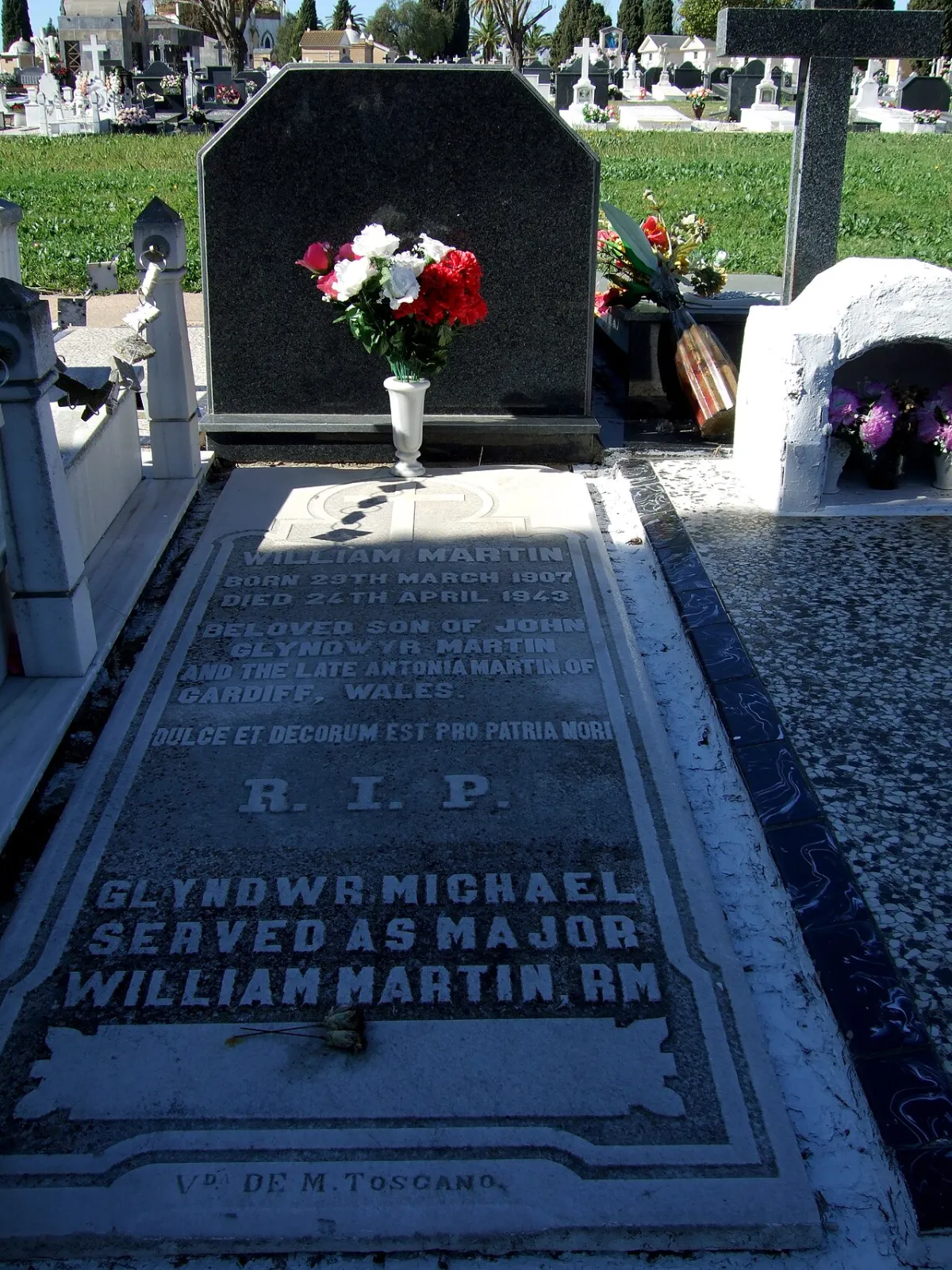
The Commonwealth War Graves Commission took over the grave in Huelva in 1977. In 1997 it added a line beneath the name of the man who never existed: “Glyndwr Michael served as Major William Martin RM”.
What the Record Shows
7 sourced claims in this story, resting on 2 sources. Numbers link to the bibliography below.
- Ewen Montagu and Charles Cholmondeley planned and ran the operation as part of the wider Operation Barclay deception - sources: 1, 2
- The body was dressed as Major William Martin of the Royal Marines and carried pocket litter including a photograph of a fiancée, “Pam”, who was really MI5’s Jean Leslie - sources: 1, 2
- HMS Seraph released the body off Huelva on 30 April 1943 - sources: 1, 2
- The letters suggested the Allies would invade Greece and Sardinia, with Sicily as a feint - sources: 1, 2
- Spanish officials copied the letters and passed them to German intelligence - sources: 1, 2
- Germany moved forces to Sardinia and Greece, and the invasion of Sicily on 9 July 1943 came as a surprise - sources: 1, 2
- The body was Glyndwr Michael, identified in 1996; his name was added to the grave in 1997 - sources: 1
Archival Evidence & Picture Credits
Every image on this page was checked against its Wikimedia Commons file page.
- Charles Cholmondeley and Ewen Montagu, 1943, photographed by St John “Jock” Horsfall (public domain) - Wikimedia Commons file page
- The grave of “William Martin” in Huelva, photographed by smasheng (GNU Free Documentation License) - Wikimedia Commons file page


Verified Archival Sources & Bibliography
Every claim in this account has been checked against the sources below:
- Wikipedia: Operation Mincemeat (reference, drawing on Macintyre 2010, Smyth 2010 and Montagu 1953)
- Imperial War Museums: What was Operation Mincemeat? (museum)
Further reading: Ben Macintyre, Operation Mincemeat (2010); Denis Smyth, Deathly Deception: The Real Story of Operation Mincemeat (2010); Ewen Montagu, The Man Who Never Was (1953).
Echoes of History Uncut. "Operation Mincemeat: The Dead Man Who Carried a Fake Invasion Plan." Echoes of History Uncut. Last modified October 13, 2026. https://echoesofhistoryuncut.com/articles/operation-mincemeat/.

An independent history publication using AI-assisted research, drafting and production. Consult each article’s citations and limitations; source inclusion does not establish independent verification of every claim.
▶
Watch the Complete Archival Documentary on YouTube
Subscribe to Echoes of History Uncut on YouTube for full widescreen 16:9 documentaries, primary archival footage, and declassified deep dives.