
A Wave of Molasses Killed 21 People in Boston
On January 15, 1919, a colossal steel tank holding 2.3 million gallons of fermenting industrial molasses burst in Boston's crowded North End. A twenty-five-foot tsunami of thick syrup moving at thirty-five miles per hour swept through streets, smashing buildings, lifting an elevated railway train from its trestle, and killing twenty-one people.

In this dossier (10 chapters) ▾
Historical Dossier: The Great Molasses Flood Location: North End, Boston, Massachusetts, USA | Year: 15 January 1919 | Key Figures: Purity Distilling Company, United States Industrial Alcohol, Hugh W. Ogden, Lieutenant Commander H. J. Copeland
A Tank on the Waterfront
At the edge of Boston’s crowded North End stood a huge steel tank owned by the Purity Distilling Company, later acquired by the United States Industrial Alcohol Company (USIA) in 1917. It held molasses, which the company used to make industrial alcohol, a product with military importance in the First World War. On 15 January 1919 it held 2.3 million gallons, weighing roughly 13,000 short tons.
The tank had been a problem from the beginning. It leaked from the time it was first filled in 1915, and it was never properly tested. The steel was about half the thickness that standards would have required, and it lacked manganese, which made it brittle. The treasurer, Arthur Jell, ran no water test to check for leaks and ignored the groans of the tank as it filled.
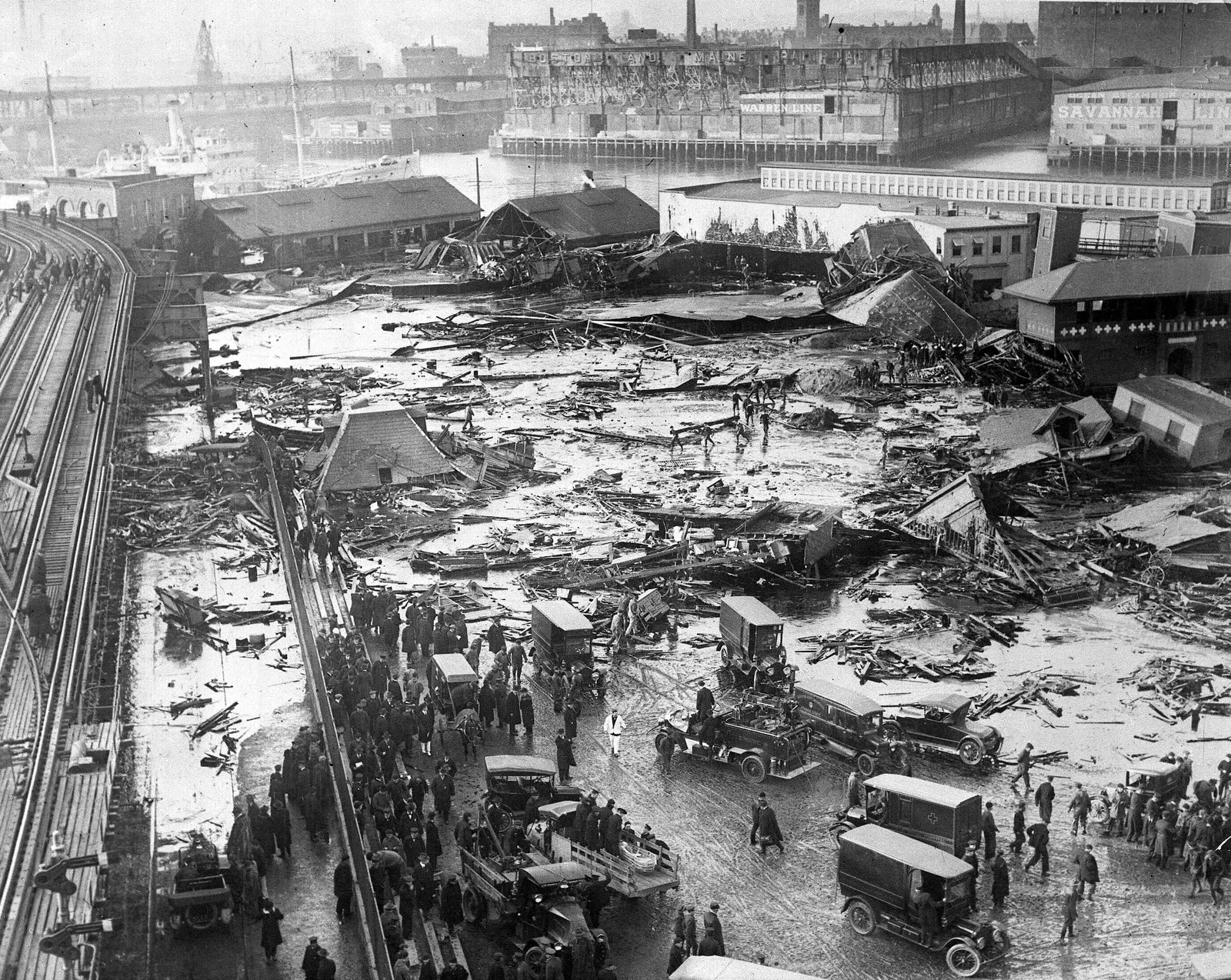
12:30 p.m.
The weather played its part. Boston had been bitterly cold, and then the temperature climbed above 40°F. A ship had delivered fresh, warmer molasses into the tank the day before. At about 12:30 p.m. on 15 January, the tank ruptured without any warning. Cracks that had started at the rivet holes gave way, and the tank, whose internal pressure had been raised by carbon dioxide from fermentation, burst open.
The wave that came out was about 25 feet high at its peak and moved at about 35 miles an hour. Molasses behaves in a way that makes it very dangerous: it flows fast in the first surge and then thickens as it cools. Scientific American put it this way: “A wave of molasses is even more devastating than a typical tsunami… initially moved fast enough to sweep people up and demolish buildings, only to settle into a more gelatinous state that kept people trapped.”
The Damage
The wave ran through several blocks to a depth of two or three feet. It destroyed the firehouse of Engine Company 31 and damaged the structure of the Boston Elevated Railway on Atlantic Avenue, bending its girders.
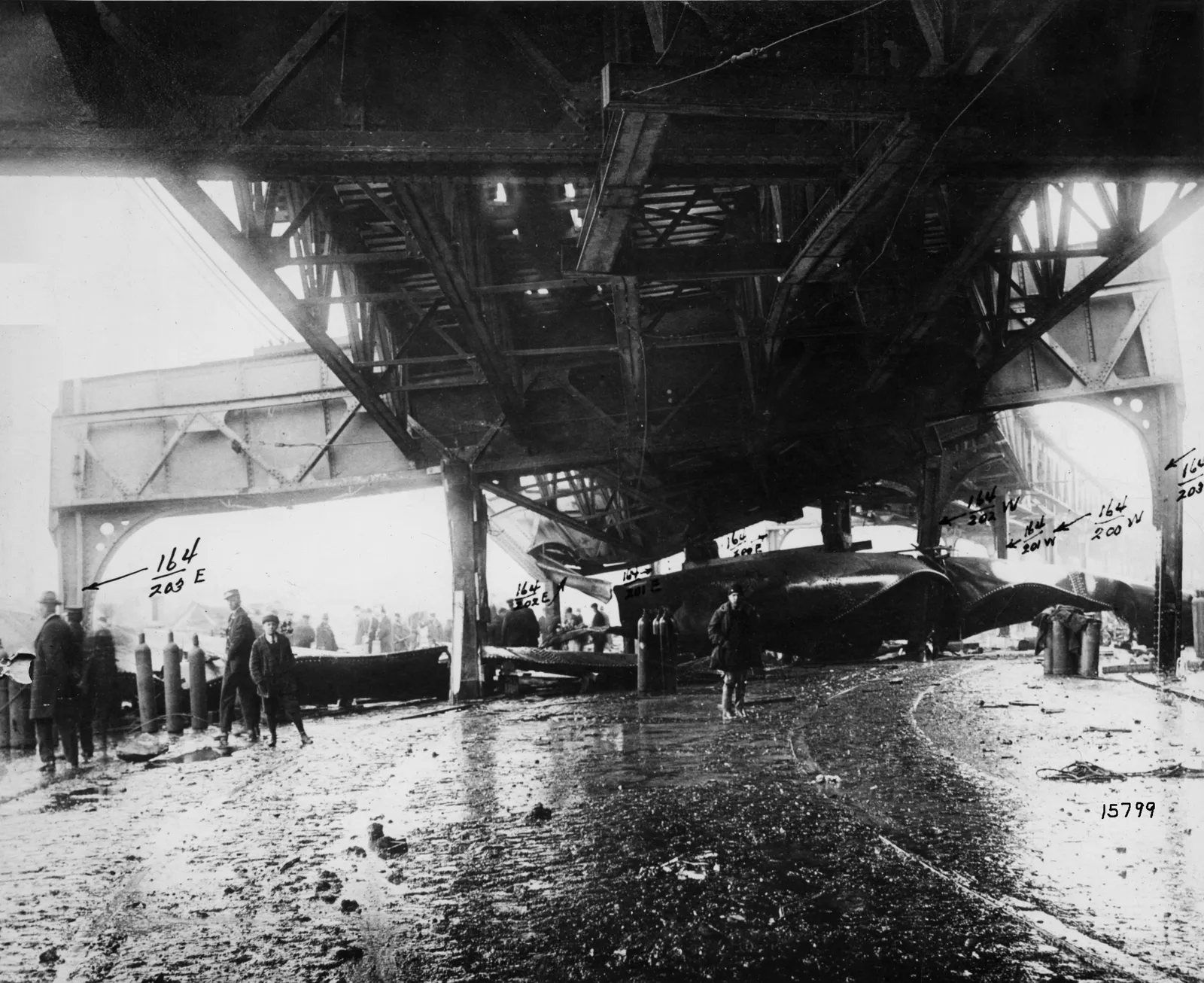
Twenty-one people and several horses were killed, and about 150 were injured. The dead included laborers from the North End Paving Yard, firefighters, teamsters, and children, among them 10-year-old Maria Di Stasio and Pasquale Iantosca.
Rescue and Cleanup
The first rescuers to arrive were 116 Navy cadets under Lieutenant Commander H. J. Copeland, from the training ship USS Nantucket, who waded into the knee-deep molasses to pull out survivors. The Red Cross and Army and Navy workers set up a makeshift hospital in a nearby building. Recovery work went on for four days.
The cleanup used salt water, pumped from a fireboat, and sand. The harbour stayed brown with molasses until the summer. The molasses spread across Greater Boston on the shoes of rescuers, cleanup crews and sightseers, and it got onto subway platforms, trains, streetcars and telephones. As one account noted, “Everything that a Bostonian touched was sticky.”
The Lawsuit
The disaster led to one of the first class-action lawsuits in Massachusetts, brought by 119 residents against USIA. The company first said that anarchists had blown up the tank, because it was used for alcohol connected with munitions. The court-appointed auditor, Hugh W. Ogden, spent three years hearing the evidence and found USIA responsible. The company paid $628,000 in damages, about $11.7 million in 2025 dollars. Families of the dead reportedly received about $7,000 per victim.
The case helped to shape modern regulation of corporate responsibility. Among the reforms was a requirement that licensed architects and civil engineers oversee major construction.
Why the Tank Failed
Engineers have since confirmed the main causes. A 2014 analysis confirmed that the steel was deficient. A 2016 study at Harvard used cold corn syrup to model the flood, with historical weather data, and confirmed contemporary accounts of its speed. It also explained why victims became trapped: the molasses cooled and thickened within moments.
A Park in the North End
Today the site is Langone Park, with Little League fields, playgrounds and bocce courts. A plaque from the Bostonian Society commemorates the disaster at the adjacent Puopolo Park. During the 100th anniversary in 2019, ground-penetrating radar found the concrete base of the tank, 20 inches below the surface of the baseball diamond. People in the North End say that, for decades, the smell of molasses lingered on hot days.
What the Record Shows
8 sourced claims in this story, resting on 4 primary and engineering historical records. Numbers link to the bibliography below.
- A 50-foot steel storage tank holding 2.3 million gallons of molasses ruptured on January 15, 1919 - sources: 4
- The resulting wave reached 25 feet in height and traveled at an estimated 35 miles per hour - sources: 2
- Twenty-one people were killed and roughly 150 injured, predominantly by suffocation and blunt trauma - sources: 2, 4
- The force of the flood derailed a Boston Elevated Railway streetcar and collapsed buildings - sources: 2, 3
- The tank was constructed with substandard steel thickness and was never subjected to water safety testing - sources: 2
- Management painted the tank brown to disguise chronic leakage through weeping rivets - sources: 2, 4
- The owner company USIA falsely blamed Italian anarchist sabotage during the civil inquest - sources: 2, 4
- The landmark auditor’s verdict held the company liable for negligence, spurring mandatory engineering blueprints - sources: 5
Archival Evidence & Picture Credits
Every image on this page was checked against its Wikimedia Commons file page.
- The wreckage after the Boston molasses disaster of 1919 (Wikimedia Commons) - Wikimedia Commons file page
- The Boston Elevated Railway structure, with bent girders, after the Molasses Flood in January 1919 (City of Boston Archives / Wikimedia Commons) - Wikimedia Commons file page


Verified Archival Sources & Bibliography
Every claim in this account has been fact-checked against primary archives and scholarly repositories:
- Internet Archive: Dark Tide - The Great Boston Molasses Flood of 1919 (Stephen Puleo) (book)
- Boston Public Library: The Great Molasses Flood Archival Photograph Collection (primary)
- Wikipedia: Great Molasses Flood (reference)
- American Society of Civil Engineers (ASCE): Historical Engineering Case Studies in Industrial Failure (primary)
Echoes of History Uncut. "A Wave of Molasses Killed 21 People in Boston." Echoes of History Uncut. Last modified September 15, 2026. https://echoesofhistoryuncut.com/articles/boston-molasses-flood/.

An independent history publication using AI-assisted research, drafting and production. Consult each article’s citations and limitations; source inclusion does not establish independent verification of every claim.
▶
Watch the Complete Archival Documentary on YouTube
Subscribe to Echoes of History Uncut on YouTube for full widescreen 16:9 documentaries, primary archival footage, and declassified deep dives.