
He Had Never Run a Marathon. He Entered One at the Olympics.
At the 1952 Olympics in Helsinki, Emil Zatopek of Czechoslovakia won the 5,000 and 10,000 metres - and on the day of one of those wins his wife Dana took gold in the javelin. Then he ran the first marathon of his life. Halfway through he asked the world record holder, Jim Peters, if the pace was too fast; Peters, joking, said it wasn't fast enough. Zatopek sped up and won in an Olympic record.

In this dossier (9 chapters) ▾
Historical Dossier: Zátopek’s Triple at Helsinki Location: Olympic Stadium, Helsinki, Finland | Year: 20–27 July 1952 | Key Figures: Emil Zátopek, Dana Zátopková, Jim Peters, Alain Mimoun, Reinaldo Gorno
The Boy from the Bata Factory
Emil Zátopek was born on 19 September 1922 in Kopřivnice, in what was then Czechoslovakia, the seventh child of a modest family. At sixteen he went to work at the Baťa shoe factory in Zlín. He did not become a runner by choice: a strict factory sports coach ordered him into a race, over his protests that he was too weak. He came second among a hundred competitors, and the result lit something in him.
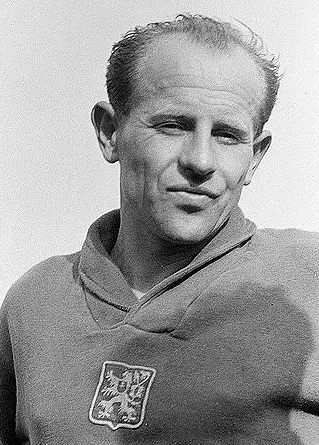
He modelled his training on that of the Finnish champion Paavo Nurmi. By 1944, only four years into serious work, he had broken Czechoslovak records at 2,000, 3,000 and 5,000 metres. After the war he became an army officer, which gave him more time to train. And he trained in a way that others thought was mad. He helped popularise interval training, running repeated hard efforts with short recoveries, and he did it in heavy work boots, in snow and in bad weather.
His style was unlike anyone else’s: a contorted face, a rolling head, a swinging torso. When people asked about it, he reportedly answered: “It isn’t gymnastics or figure skating, you know.”
London, and the Warm-Up Act
At the 1948 London Olympics Zátopek won the 10,000 metres. In the 5,000 metres he finished second to Belgium’s Gaston Reiff, in a driving rainstorm. Those Games made him an Olympic champion, but they also gave him a reason to want more. The runner who had been beaten at 5,000 metres in London arrived in Helsinki four years later with a plan to put that right.
The 10,000 and the 5,000
At Helsinki in 1952, Zátopek’s first event was the 10,000 metres, on 20 July. He won, and broke the Olympic record.
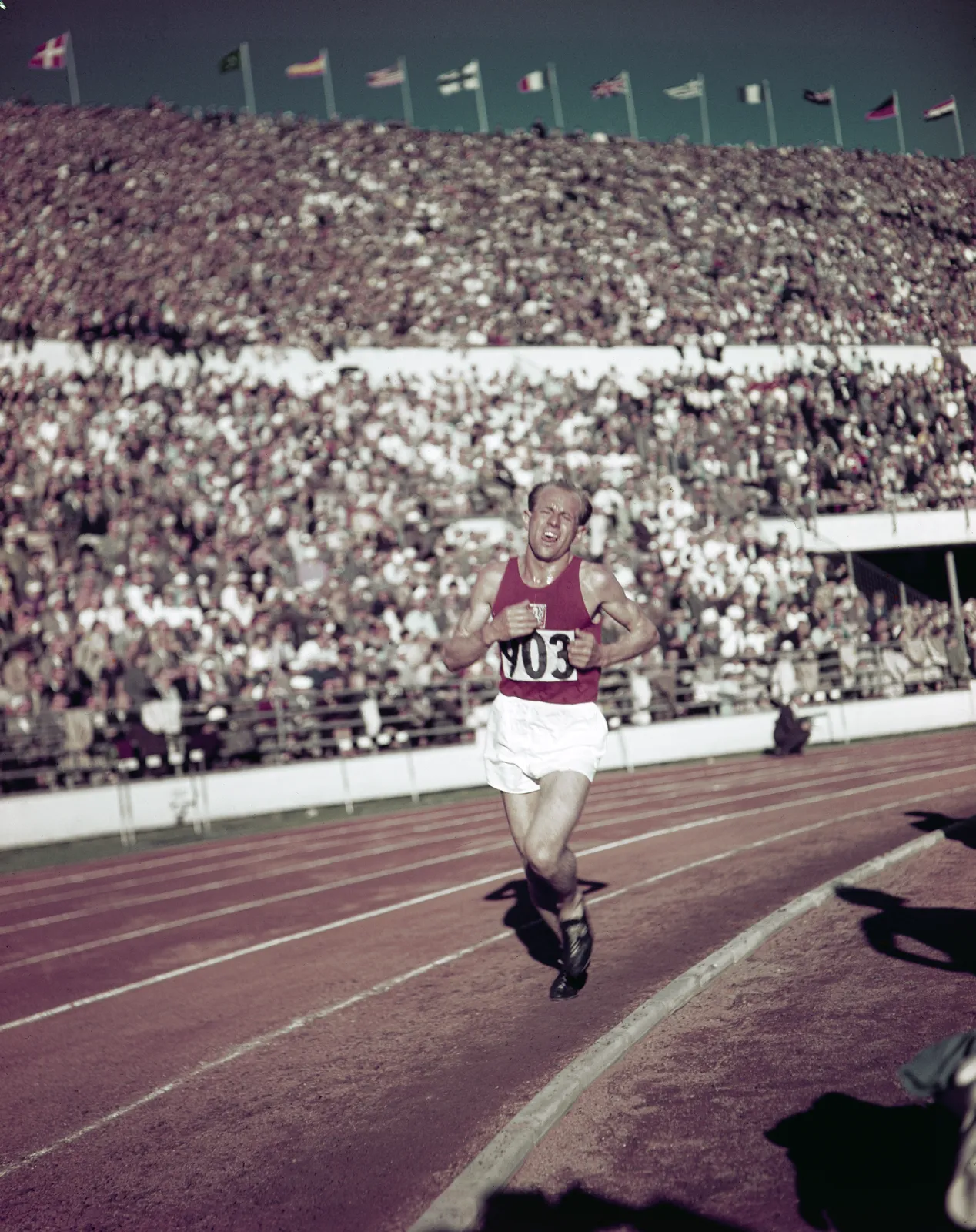
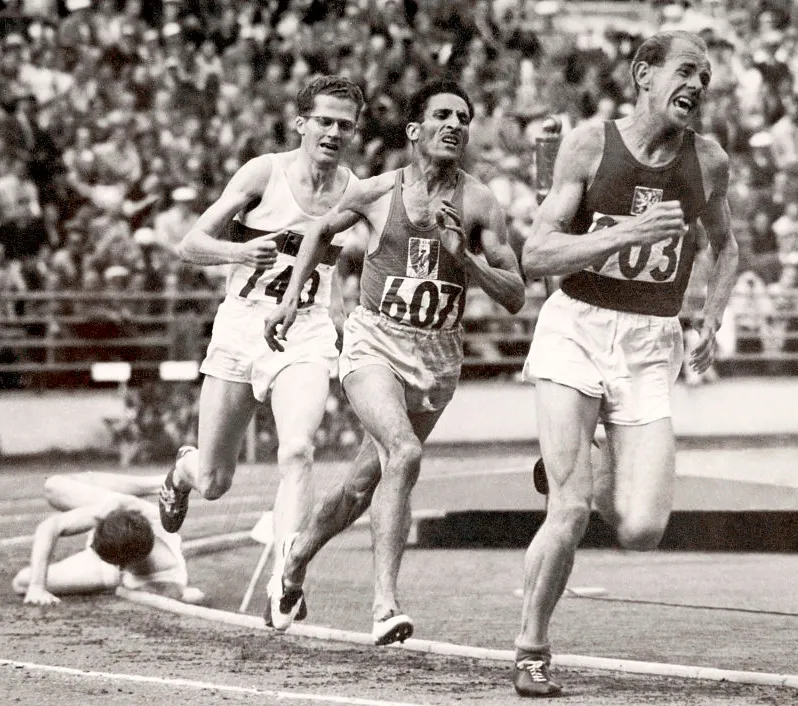
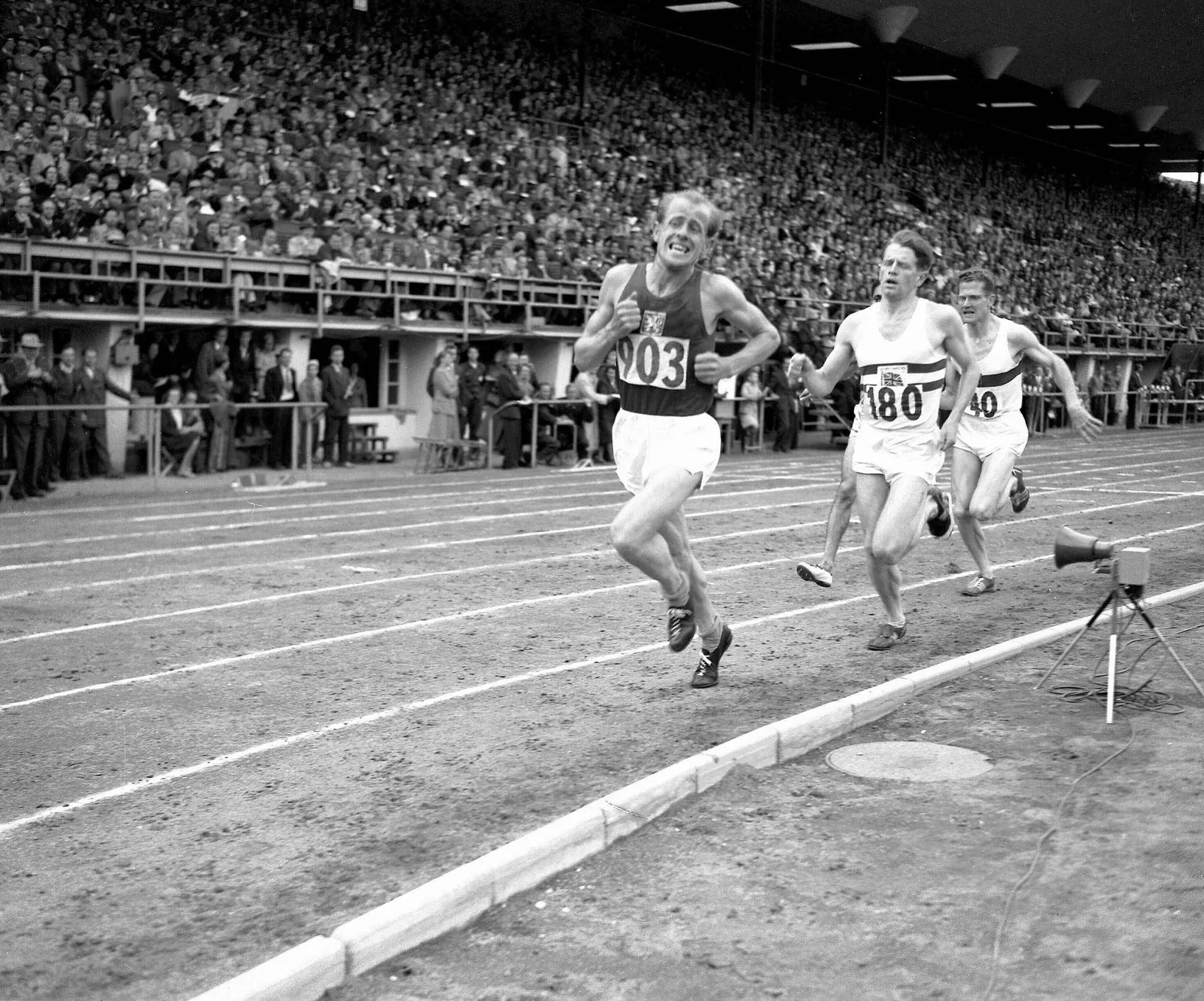
Four days later, on 24 July, came the 5,000 metres, and it was far closer. With a lap to go Zátopek was fourth. A final lap of about 57.5 seconds took him past Alain Mimoun of France, Herbert Schade of West Germany and Chris Chataway of Great Britain, and he won. His wife, Dana Zátopková, who was born on the same day and year as he was, won the Olympic javelin gold that same day, moments after his race.
When he joked that his victory had “inspired” her throw, she is said to have shot back: “Really? Okay, go inspire some other girl and see if she throws a javelin fifty metres!”
The Marathon He Had Never Run
Then came the marathon on 27 July. Zátopek had never run one. He had not intended to run one at the Games. But he entered, and his plan for it was simple: stay with the favourite. The favourite was Jim Peters of Britain, the world-record holder.
Peters went out hard. By 15 kilometres he had spent a great deal of his energy, and Zátopek had stayed with him. Then, as the story goes, Zátopek asked his rival whether the pace was fast enough. Peters, trying to bluff, answered that it was “too slow.” Zátopek took him at his word, accelerated, and left him behind. Peters could not finish.
Zátopek won, with Argentina’s Reinaldo Gorno second, more than two minutes behind. He had won the 10,000 metres, the 5,000 metres and the marathon at a single Olympics, and no one has done so since.
A Home Full of Rivals
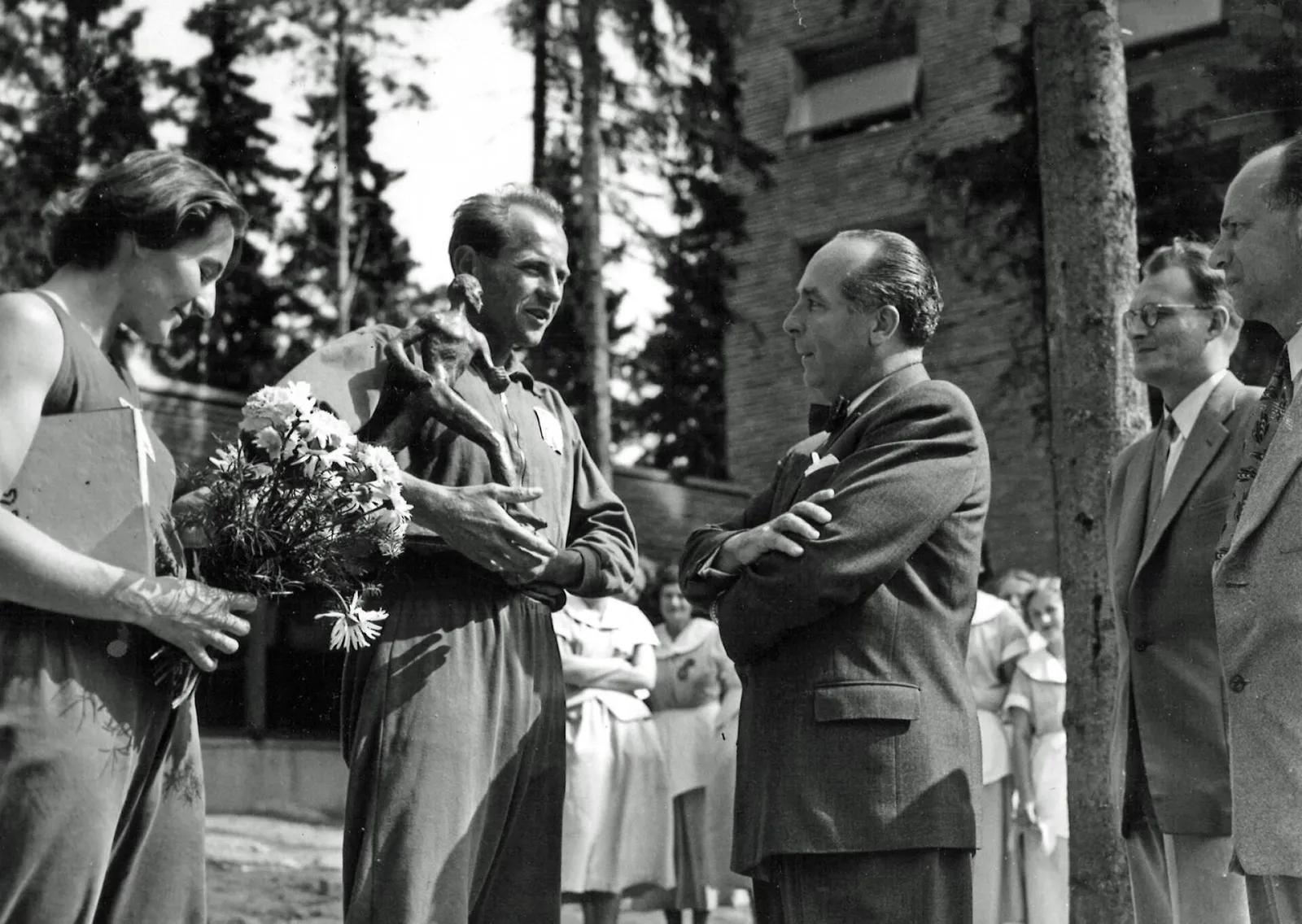
Zátopek was a generous champion. He spoke six languages and regularly hosted foreign athletes at his home in Prague. The British runner Gordon Pirie called it “the merriest and gayest home I’ve been in.” In 1957 Emil and Dana were witnesses at the Prague wedding of the American Olympic hammer champion Harold Connolly and the Czechoslovak discus champion Olga Fikotová, at the height of the Cold War, and Zátopek successfully asked President Antonín Zápotocký to allow the marriage.
He also kept running. In 1954 he became the first runner to break 29 minutes for 10,000 metres, and over the years he held world records at 5,000, 20,000, 25,000 and 30,000 metres and for the one-hour run.
The Price of Principle
His life after sport took a hard turn. After the Prague Spring of 1968, Zátopek, who had been a supporter of the Communist Party, backed the reformers. He lost his military rank, was expelled from the party and was removed from his posts. He was made to do menial work, including prospecting for natural resources around Bohemia, and he was separated from his wife for five years. In 1977 he was allowed to return to Prague to a job monitoring foreign sports publications. He was officially rehabilitated on 9 March 1990 by President Václav Havel.
Zátopek died in Prague on 21 November 2000, aged 78, after complications from a stroke. In 2013 the editors of Runner’s World named him the greatest runner of all time. The record he set in Helsinki, three long-distance golds at one Games, still stands.
What the Record Shows
10 sourced claims in this story, resting on 10 sources. Numbers link to the bibliography below.
- Emil Zatopek had never run a marathon before, and he ran one at the 1952 Olympics in Helsinki - sources: 9, 2, 3
- At the 1952 Olympics in Helsinki, Emil Zatopek of Czechoslovakia won the 5,000 metres and the 10,000 metres - sources: 8, 2, 3
- Emil Zatopek’s wife Dana won the Olympic javelin on the same day that he won the 5,000 metres - sources: 9, 8, 6, 5
- Zatopek then ran the marathon, the first marathon of his life - sources: 2, 3, 9
- Halfway through the marathon, Zatopek ran alongside Jim Peters, the world record holder, and asked him if the pace was too fast - sources: 2, 3
- Peters replied that the pace was not fast enough, which he later said was a joke, and Zatopek sped up - sources: 2, 3
- Jim Peters succumbed to cramp and failed to finish the marathon - sources: 2, 3
- Zatopek won the marathon in Olympic record time - sources: 10, 1
- Emil Zatopek is the only runner to have won all three - the 5,000 metres, the 10,000 metres and the marathon - at one Olympics - sources: 10, 7, 4, 2
- The 1952 Olympic marathon was the first marathon of Zatopek’s life - sources: 2, 3, 9
Archival Evidence & Picture Credits
Every image on this page was checked against its Wikimedia Commons file page.
- Emil Zátopek, whose strained face and rolling head made his style unmistakable (Wikimedia Commons) - Wikimedia Commons file page
- The 10,000 metres at the Helsinki Olympics of 1952, the first of Zátopek’s three golds (Wikimedia Commons) - Wikimedia Commons file page
- Herbert Schade, Alain Mimoun and Emil Zátopek at the 1952 Games (Wikimedia Commons) - Wikimedia Commons file page
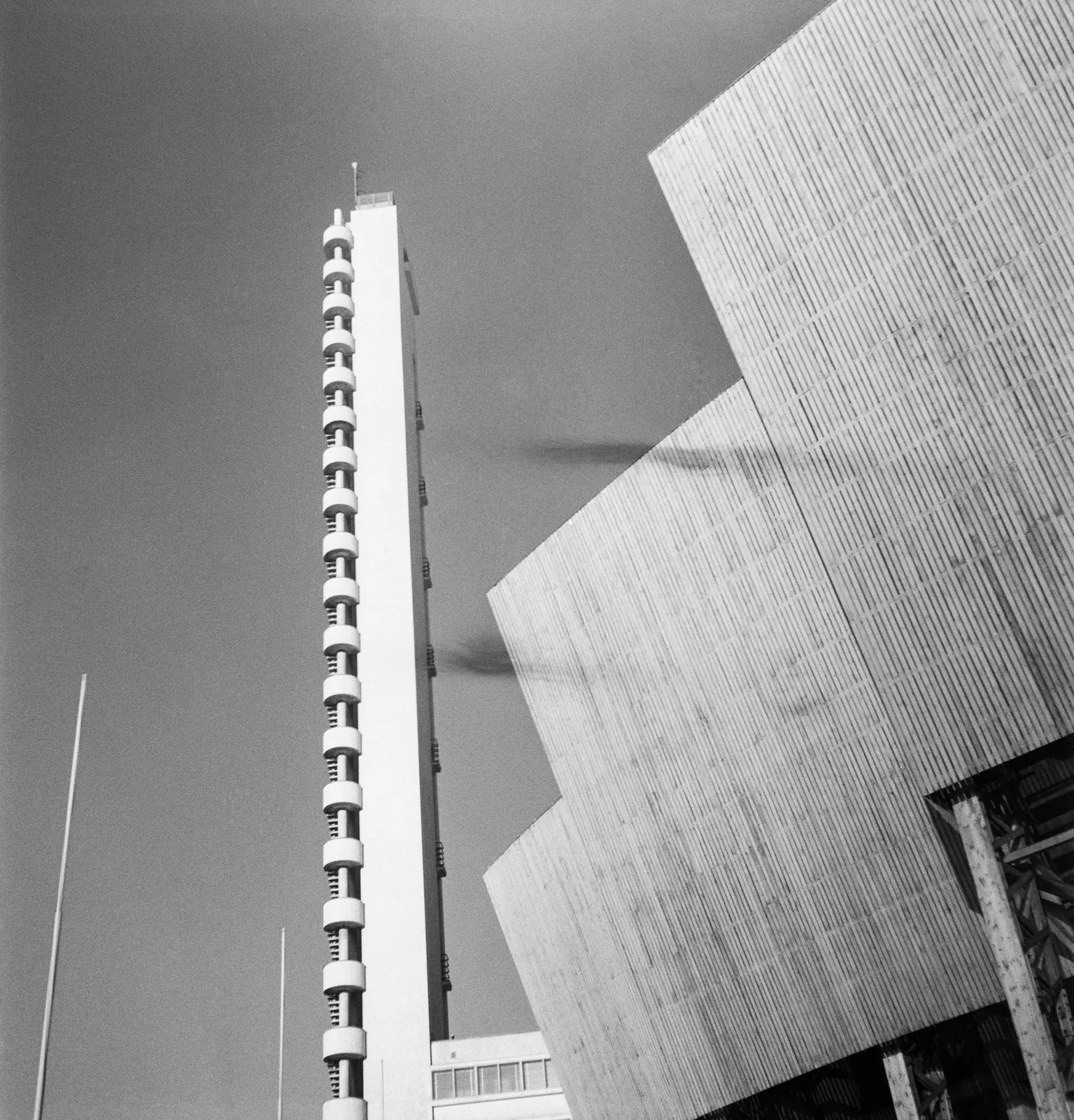
- Helsinki Olympic Stadium in 1952, where the marathon finished (Wikimedia Commons) - Wikimedia Commons file page
- Emil and Dana Zátopek in Finland in 1952 (Wikimedia Commons) - Wikimedia Commons file page
- Zátopek in the 5,000 metres final at Helsinki in 1952 (Wikimedia Commons) - Wikimedia Commons file page


Verified Archival Sources & Bibliography
Every claim in this account has been fact-checked against primary archives and scholarly repositories:
- Wikipedia: Emil Zátopek (reference)
- The Guardian: 50 stunning Olympic moments No 41: Emil Zatopek the triple-gold winner (news)
- Olympedia: 1952 Marathon, Men (primary)
- World Athletics: Marking the centenary of the birth of Zatopek (primary)
- World Athletics: 1952 Olympic javelin champion Zatopkova dies (primary)
- AIMS: Dana Zátopková obituary (primary)
- Olympics.com: Emil Zatopek (primary)
- Evening Star (Washington, D.C.), July 24, 1952 - Library of Congress, Chronicling America (news)
- Evening Star (Washington, D.C.), August 3, 1952 - Library of Congress, Chronicling America (news)
- Atlanta Daily World, July 29, 1952 - Library of Congress, Chronicling America (news)
Echoes of History Uncut. "He Had Never Run a Marathon. He Entered One at the Olympics.." Echoes of History Uncut. Last modified September 23, 2026. https://echoesofhistoryuncut.com/articles/zatopek-first-marathon-1952/.

An independent history publication using AI-assisted research, drafting and production. Consult each article’s citations and limitations; source inclusion does not establish independent verification of every claim.
▶
Watch the Complete Archival Documentary on YouTube
Subscribe to Echoes of History Uncut on YouTube for full widescreen 16:9 documentaries, primary archival footage, and declassified deep dives.