
A Blast Flattened 80 Million Trees. No Crater.
On the morning of June 30, 1908, a titanic aerial explosion flattened eighty million trees across 830 square miles of Siberian taiga near the Podkamennaya Tunguska River. Releasing the energy of ten to fifteen megatons of TNT—a thousand times Hiroshima—the blast left no impact crater and no definitive meteorite fragments, and scientists now explain it as the air burst of a meteor that exploded several kilometres above the ground.

In this dossier (10 chapters) ▾
Historical Dossier: The Tunguska Event Location: Podkamennaya Tunguska River basin, Siberia, Russia | Year: 1908 | Key Figures: Leonid Kulik, Sergei Semenov, Chuchan of the Shanyagir, the Evenki witnesses
A Second Sun Over the Taiga
At about 7:14 on the morning of 30 June 1908, a huge explosion occurred in the sky over the Podkamennaya Tunguska River in central Siberia. It flattened about 2,150 square kilometres of forest, in one of the most thinly populated regions on Earth. Estimates of its energy vary widely, from about 3 to 50 megatons of TNT, with older estimates of 10 to 15 megatons and more recent ones nearer 3 to 5, and one 2019 study proposing 20 to 30.
The people who saw it were Evenki herders and Russian settlers across a vast area. One of them, Sergei Semenov, was interviewed by the mineralogist Leonid Kulik in 1930 and described being at a trading post about 65 kilometres from the centre: “I suddenly saw that directly to the north… the sky split in two and fire appeared high and wide over the forest.” Another witness, Chuchan of the Shanyagir tribe, spoke of “a second sun” lighting the morning sky, and of trees falling with their branches on fire.
The local newspaper Sibir reported that the phenomenon “appeared as a ‘pipe,’ i.e., a cylinder” that moved downward before turning “into a giant billow of black smoke.”
Nobody Came
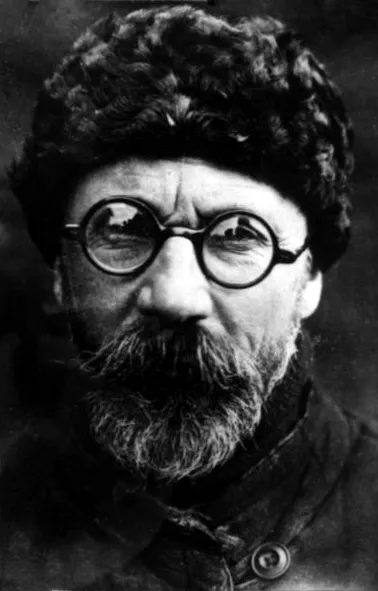
No scientist reached the site for years. Russia was at war, then in revolution, then in civil war. Leonid Kulik began leading expeditions in 1921, and in 1927 the first of them reached the blast zone.
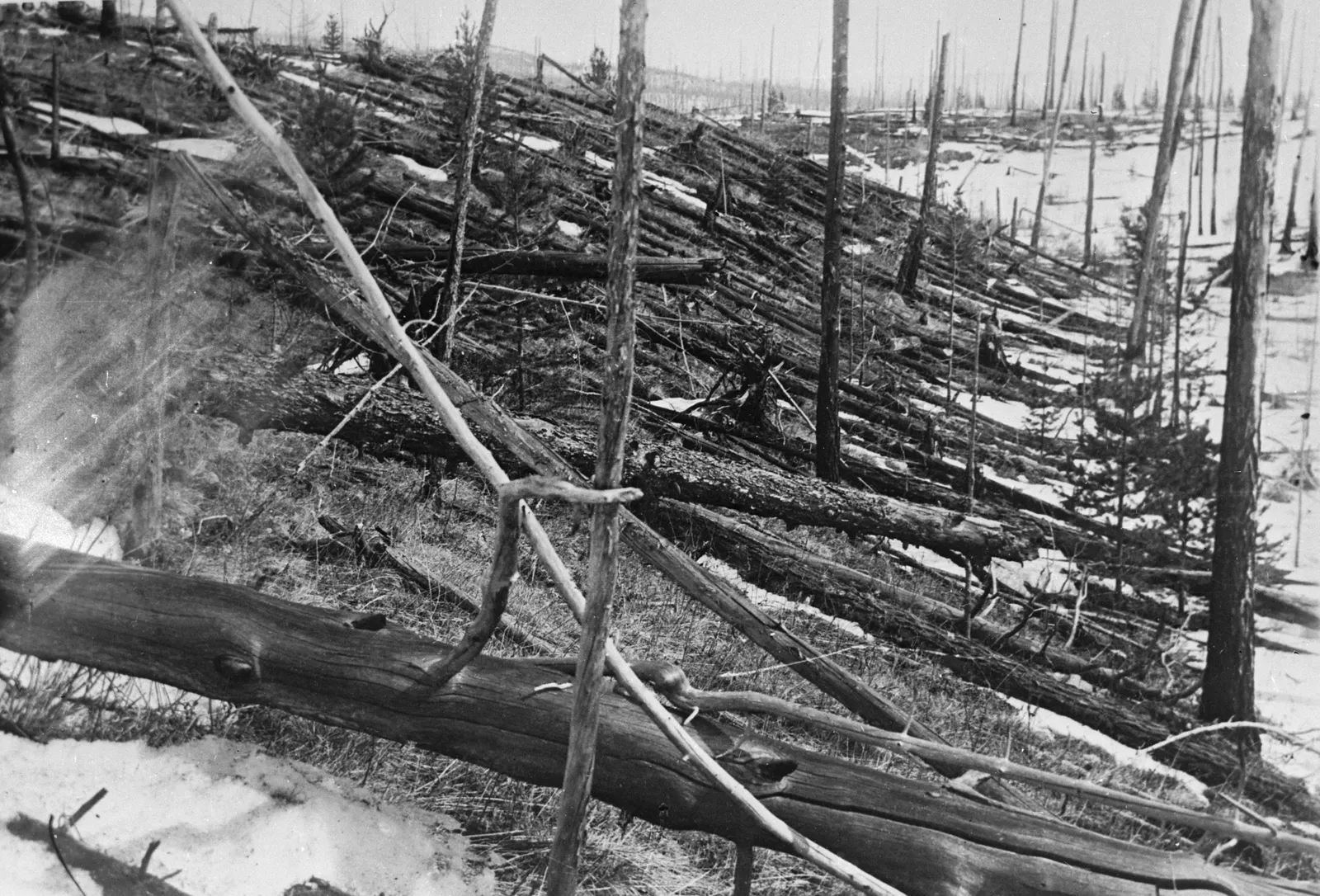
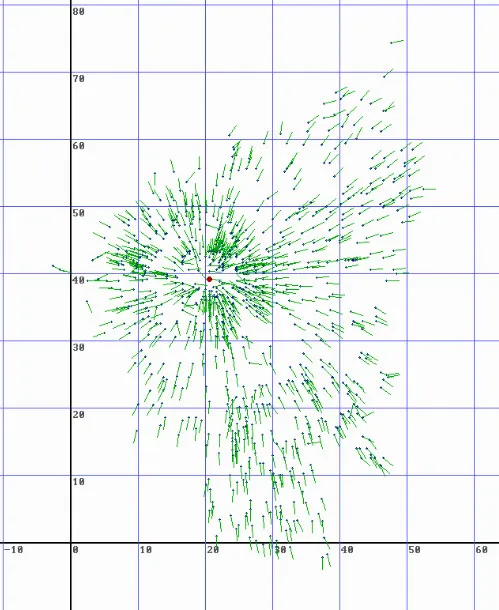
What he found was not what he expected. He had been looking for an impact crater, but there was none. At the centre was a zone about 8 kilometres across where trees “were scorched and devoid of branches, but still standing upright”. Farther out, the trees had been “knocked down away from the centre, creating a large radial pattern.”
How Many Trees?
For decades the number most often quoted was 80 million trees. The more careful modern estimate of the devastated area is about 2,150 square kilometres, and the older claim of “over 80 million trees” appears to have overestimated the affected area by roughly a factor of four. The spread of the damage is clear, though. This was a blast on a regional scale.
The Explanation: An Airburst
The leading explanation is that the explosion was an airburst. A stony asteroid about 50 to 60 metres across entered the atmosphere at about 27 kilometres a second and broke apart at an altitude of 5 to 10 kilometres. The object was destroyed by the pressure and heat of its passage before it reached the ground, and it released nearly all of its energy as a blast wave. That is why there is no crater.
Alternatives have been proposed, though they are less favoured. One suggested that the object was a comet made of dust and frozen volatiles that vaporised on contact with the air. The astrophysicist Wolfgang Kundt proposed a geophysical cause, a release of natural gas from the Earth’s crust.
Lake Cheko
In 2007, researchers from the University of Bologna suggested that Lake Cheko, about 8 kilometres from the centre of the blast, might be an impact crater formed by a surviving fragment. The idea was challenged in 2017 by Russian research that found at least 280 annual layers in the lake’s sediment cores, which suggested that the lake was older than the Tunguska event.
Chelyabinsk and the Odds
In 2013 a much smaller object, an asteroid of 17 to 20 metres, exploded above Chelyabinsk with about 500 kilotons of energy at a much higher altitude, about 30 kilometres. More than 1,200 people were injured, mostly by broken windows. Studies of the two events suggest that an impact on the scale of Tunguska might occur roughly once every thousand years.
Why It Still Matters
Tunguska is a reminder of how much luck was involved. A blast of that size over a large city would be catastrophic, and this one occurred in one of the emptiest places on the planet. Estimates suggest that, at most, up to three people may have died. The Tunguska event remains the best-studied example of what a small asteroid can do,.
What the Record Shows
7 sourced claims in this story, resting on 4 primary and planetary science records. Numbers link to the bibliography below.
- On June 30, 1908, a massive aerial detonation occurred near the Podkamennaya Tunguska River in Siberia - sources: 1, 4
- The explosion released an estimated 3 to 50 megatons of TNT-equivalent energy, with older estimates of 10 to 15 megatons - sources: 1
- About 2,150 square kilometers (830 sq miles) of forest were flattened (the often-quoted 80 million trees is thought to overstate the area) - sources: 1, 2
- Atmospheric pressure shockwaves circled the globe twice and were detected on microbarographs across Europe - sources: 2, 4
- Night skies across Eurasia exhibited bright, nocturnal luminescence for three consecutive nights - sources: 1
- Leonid Kulik conducted the first scientific field expedition in 1927, finding no impact crater and standing trees at ground zero - sources: 2, 4
- Supercomputer hydrodynamic models establish the event as a stony asteroid airburst detonating 5 to 10 kilometers altitude - sources: 1
Archival Evidence & Picture Credits
Every image on this page was checked against its Wikimedia Commons file page.
- The radial devastation of trees at Tunguska, photographed in the 1927 Kulik expedition (Wikimedia Commons) - Wikimedia Commons file page
- Leonid Kulik, the mineralogist who led the first scientific expeditions to Tunguska (Wikimedia Commons) - Wikimedia Commons file page
- Siberian forest flattened by the Tunguska explosion (Wikimedia Commons) - Wikimedia Commons file page


Verified Archival Sources & Bibliography
Every claim in this account has been fact-checked against primary archives and scholarly repositories:
- Planetary and Space Science: The Tunguska Event - An overview of atmospheric trajectory and energetic parameters (Chyba et al.) (academic)
- Internet Archive: The Tunguska Mystery (Vladimir Rubtsov) (book)
- Wikipedia: Tunguska event (reference)
- Russian Academy of Sciences: Committee on Meteorites Historical Archive of Leonid Kulik Expeditions (primary)
Echoes of History Uncut. "A Blast Flattened 80 Million Trees. No Crater.." Echoes of History Uncut. Last modified September 14, 2026. https://echoesofhistoryuncut.com/articles/tunguska-event/.

An independent history publication using AI-assisted research, drafting and production. Consult each article’s citations and limitations; source inclusion does not establish independent verification of every claim.
▶
Watch the Complete Archival Documentary on YouTube
Subscribe to Echoes of History Uncut on YouTube for full widescreen 16:9 documentaries, primary archival footage, and declassified deep dives.