
The Joyita: A Ship Found Adrift With 25 People Missing
On 3 October 1955 the Joyita left Apia, Samoa, for Tokelau with 25 people aboard. Five weeks later she was found drifting north of Fiji, flooded and listing, with her liferafts gone and no one aboard. A broken pipe explains the flooding. Nothing explains why 25 people left a boat that could not sink.

In this dossier (9 chapters) ▾
Historical Dossier: The disappearance aboard MV Joyita Location: Apia, Samoa, to the Tokelau Islands; found north of Vanua Levu, Fiji | Year: 3 October – 10 November 1955 | Key Figures: Captain Thomas H. “Dusty” Miller, first mate Chuck Simpson, Dr Alfred “Andy” Parsons, Captain Gerald Douglas
A Yacht Built Not to Sink
The Joyita was built in 1931 in Los Angeles as a luxury yacht for the film director Roland West, who named her after his wife, the actress Jewel Carmen; joyita is Spanish for “little jewel”. She was 69 feet long, with a hull of 2-inch cedar on oak frames. The US Navy used her as a patrol boat around Hawaii during the Second World War. In 1943 she ran aground and was repaired, and her new pipework was made of galvanised iron instead of copper or brass. That detail would matter twelve years later.
After the war she became a fishing and cargo boat. Her holds were lined with 640 cubic feet of cork for refrigerated cargo. That cork made her almost impossible to sink. In 1952 she was sold to Katharine Luomala, a professor at the University of Hawaiʻi, who chartered her to her friend Thomas “Dusty” Miller, a British-born sailor living in Samoa.
Leaving on One Engine
The Joyita was due to leave Apia for the Tokelau Islands, about 270 miles away, on the noon tide on 2 October 1955. Her port engine clutch failed, and she sailed at about 5 a.m. the next morning on one engine. On board were 16 crew and 9 passengers, including a government official, a copra buyer, two children and Dr Alfred “Andy” Parsons, a Second World War surgeon on his way to perform an amputation. Her cargo included medical supplies, timber, food and 80 empty oil drums.
The voyage should have taken 41 to 48 hours. On 6 October, Fakaofo reported the ship overdue. No distress call had been heard. From 6 to 12 October, Sunderland flying boats of the Royal New Zealand Air Force searched nearly 100,000 square miles of ocean and found nothing.
Found Adrift
On 10 November, five weeks after she sailed, Captain Gerald Douglas of the merchant ship Tuvalu sighted the Joyita more than 600 miles west of her route, drifting north of Vanua Levu in Fiji. She was partly submerged, her port rail awash. Barnacles high on her port side showed she had been listing for a long time.
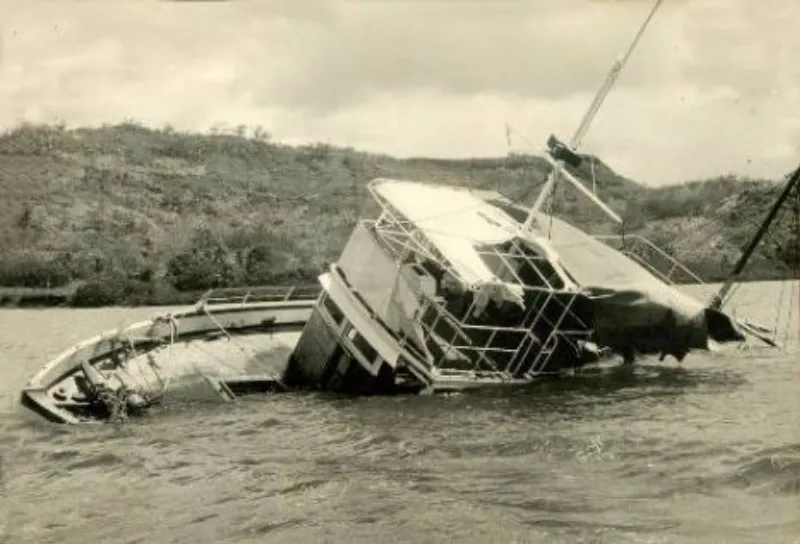
There was no one aboard, and no bodies were ever found. What the boarding party did find has puzzled people ever since:
- The dinghy and all three Carley liferafts were gone. She had never carried enough lifejackets for everyone.
- About four tons of cargo were missing, along with the logbook, sextant, chronometer and Miller’s firearms.
- The radio was tuned to 2182 kHz, the international distress channel. But a break in the aerial cable, hidden under paint, limited its range to about 2 miles.
- The electric clocks had stopped at 10:25, and the cabin and navigation light switches were on, suggesting that whatever happened, happened at night.
- A doctor’s bag lay on deck, holding a stethoscope, a scalpel and four lengths of bloodstained bandage.
- The flying bridge had been smashed away, and the deckhouse had broken windows. Mattresses covered the starboard engine. A pump had been rigged in the engine room but never connected.
The Broken Pipe
Once the water was pumped out, the hull proved sound, and the Joyita was towed to Suva. At her mooring, investigators heard water coming in. A pipe in the cooling system of the port auxiliary engine had failed through galvanic corrosion: the galvanised iron fitted in 1943. The bilge pumps had no strainers and had clogged. The crew would not have known about the leak until the water rose above the engine room floor, when it would have been almost impossible to find.
From the fuel used, investigators worked out that she had travelled about 243 miles before she was abandoned, probably within 50 miles of Tokelau.
The Inquiry
A formal inquiry sat in Apia in February 1956. It explained the flooding and blamed Miller: he was reckless to sail on one engine with numerous faults, negligent for not providing a working radio or proper lifeboat, and in breach of maritime law, because the boat’s licence to carry fare-paying passengers had lapsed.
But it could not explain the people. Their fate, the inquiry said, was “inexplicable on the evidence submitted at the inquiry.” The Joyita could not sink, and Miller knew it. Why would 25 people leave a floating boat for small rafts on the open Pacific? The inquiry did not mention the bloodstained bandages.
The Theories
Some theories appeared in 1955 and never went away: Japanese fishermen, pirates, a Soviet submarine. None has evidence behind it. Knives stamped “Made in Japan” found aboard turned out to be old and broken, probably left from the boat’s fishing days.
The best-known explanation came from the British writer Robin Maugham, who later owned the wreck and published The Joyita Mystery in 1962. He accepted the broken pipe as the start. In his account, Miller, deep in debt and knowing the boat would float, wanted to press on. First mate Chuck Simpson and others wanted to turn back; there was a fight, and Miller was badly hurt. Simpson then abandoned ship with the injured captain, the navigation equipment and supplies, perhaps making for land they had sighted, and the rafts were carried out to sea. It fits several clues. It is still a theory.
As of 2012, everyone aboard was still officially listed as missing. That year, memorial stones were placed in Apia and in Fakaofo, Tokelau.
What the Record Shows
7 sourced claims in this story, resting on 2 sources. Numbers link to the bibliography below.
- The Joyita left Apia on 3 October 1955, a day late because of a failed port engine clutch, with 16 crew and 9 passengers - sources: 1, 2
- An RNZAF search from 6 to 12 October covered about 100,000 square miles and found nothing - sources: 1, 2
- Captain Gerald Douglas of the Tuvalu found her on 10 November, far off course north of Fiji, with her liferafts gone - sources: 1, 2
- The radio was tuned to the 2182 kHz distress channel, and the electric clocks had stopped at 10:25 - sources: 1, 2
- A doctor’s bag with bloodstained bandages was found on deck - sources: 1, 2
- A corroded cooling pipe let water into the bilges - sources: 1, 2
- The February 1956 inquiry in Apia found the fate of those aboard “inexplicable on the evidence submitted” - sources: 1, 2
Archival Evidence & Picture Credits
Every image on this page was checked against its Wikimedia Commons file page.
- The Joyita after she was found in November 1955, listing heavily to port (public domain) - Wikimedia Commons file page

Verified Archival Sources & Bibliography
Every claim in this account has been checked against the sources below:
- Wikipedia: MV Joyita (reference, drawing on Maugham 1962 and Wright 2002)
- Matāuala: The Joyita, an unsolved mystery (Tokelau community history)
Further reading: David G. Wright, Joyita: Solving the Mystery (Auckland University Press, 2002); Robin Maugham, The Joyita Mystery (1962).
Echoes of History Uncut. "The Joyita: A Ship Found Adrift With 25 People Missing." Echoes of History Uncut. Last modified October 13, 2026. https://echoesofhistoryuncut.com/articles/mv-joyita/.

An independent history publication using AI-assisted research, drafting and production. Consult each article’s citations and limitations; source inclusion does not establish independent verification of every claim.
▶
Watch the Complete Archival Documentary on YouTube
Subscribe to Echoes of History Uncut on YouTube for full widescreen 16:9 documentaries, primary archival footage, and declassified deep dives.