
The Demon Core: Two Lethal Flashes of Blue Light at Los Alamos
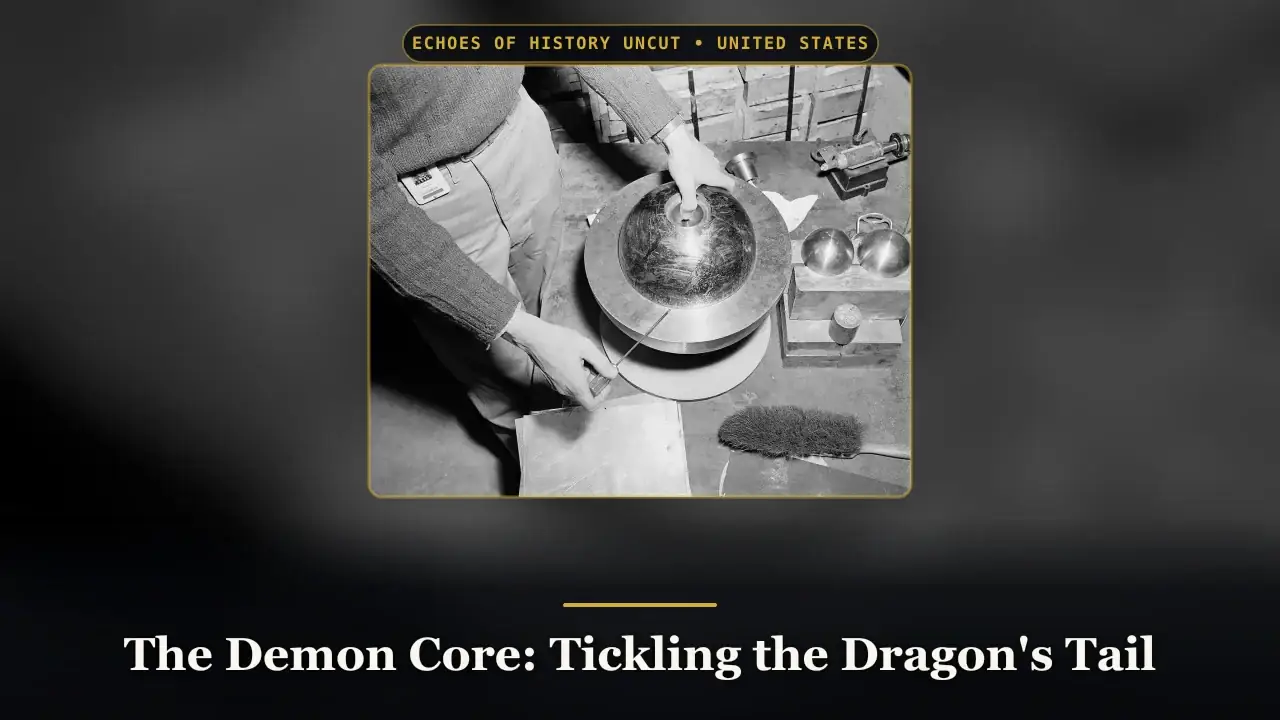
In 1945 and 1946 at Los Alamos Laboratory, a 14-pound subcritical plutonium mass slated for a third atomic bomb fatally irradiated two physicists during manual criticality experiments. Known as 'the Demon Core,' the accidents triggered a flash of blue ionizing radiation, leading to an immediate ban on hands-on assembly and permanently reshaping nuclear safety.
In this dossier (6 chapters) ▾
- 01 Fourteen Pounds of Subcritical Plutonium-Gallium
- 02 August 21, 1945: The Midnight Slip of a Tungsten Brick
- 03 May 21, 1946: Tickling the Dragon’s Tail with a Screwdriver
- 04 The Blue Flash, the Metallic Taste, and the Nine-Day Decline
- 05 End of the Cowboy Era: Remote Control and the Core’s Fate
- 06 Archival Sources & Historical Bibliography
Historical Dossier: The Criticality Accidents of the Demon Core Location: Los Alamos Laboratory (Omega Site), New Mexico, United States | Year: 21 August 1945 & 21 May 1946 | Key Figures: Harry K. Daghlian Jr., Louis Slotin, Alvin C. Graves, Enrico Fermi, Richard Feynman
Fourteen Pounds of Subcritical Plutonium-Gallium
In the summer of 1945, metallurgists and nuclear physicists at the Los Alamos Laboratory cast a 14-pound (6.2-kilogram) solid sphere of delta-phase plutonium-gallium alloy. Measuring just 3.5 inches (8.9 centimeters) in diameter, the heavy, warm metal sphere was intended as the nuclear explosive core for a third atomic weapon—destined to be dropped on Japan if the empire refused to surrender following the detonations at Hiroshima and Nagasaki.
When the Japanese government surrendered unconditionally on August 15, 1945, the shipment of the third pit was abruptly halted. Instead of being shipped across the Pacific, the plutonium sphere remained at Los Alamos in New Mexico. Classified officially as “Rufus,” the core was allocated to the laboratory’s Critical Assemblies Group, directed by physicist Otto Frisch. Their objective was to study how closely a subcritical mass could approach criticality—the self-sustaining chain reaction threshold—by surrounding it with various neutron-reflecting materials.
Physicist Richard Feynman famously warned his colleagues that conducting these manual experiments by hand was as perilous as “tickling the tail of a sleeping dragon.” Within nine months, the sleeping dragon bit twice.
August 21, 1945: The Midnight Slip of a Tungsten Brick
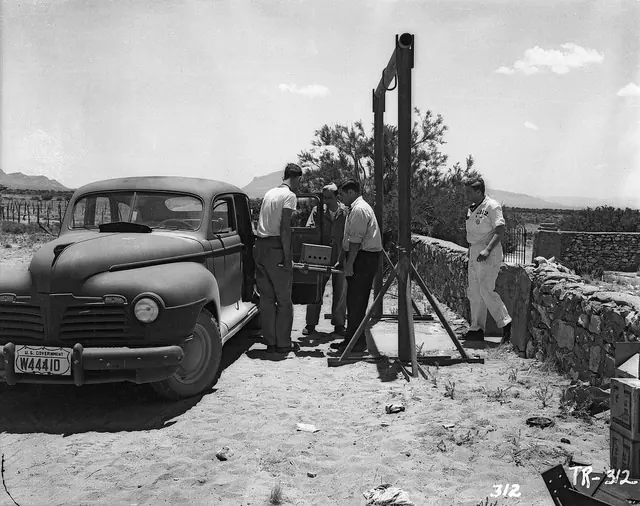
On the night of August 21, 1945, 24-year-old physicist Harry K. Daghlian Jr. returned alone to the laboratory at Omega Site. Violating lab safety protocols that required at least two scientific personnel to be present during critical assembly experiments, Daghlian began manually constructing a neutron-reflecting wall around the plutonium core using 9.7-pound (4.4-kilogram) bricks of dense tungsten carbide.
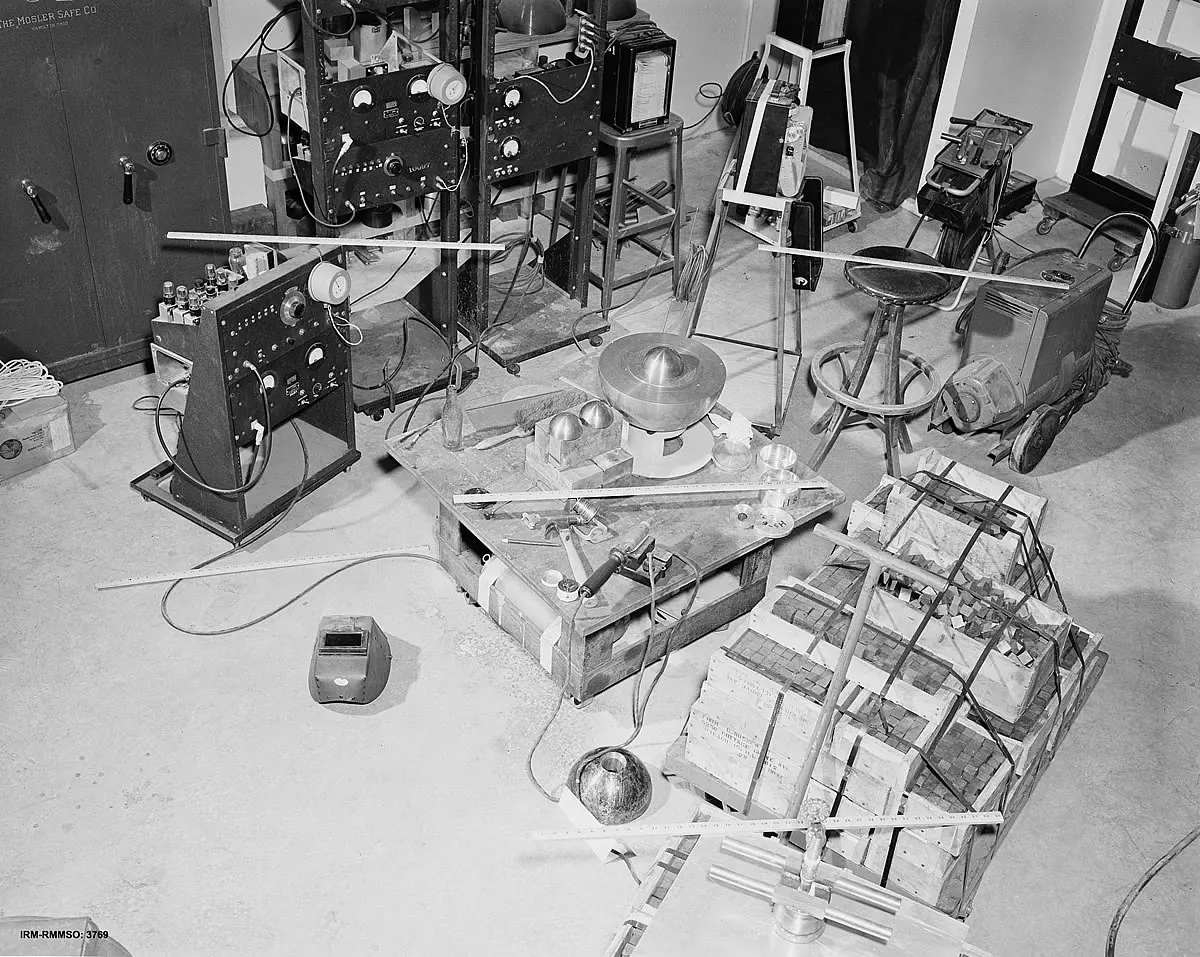
As Daghlian stacked the heavy bricks layer by layer around the sphere, neutron counters clicked with increasing frequency. Each brick reflected escaping neutrons back into the core, driving the plutonium closer to prompt criticality.
At approximately 9:55 p.m., while holding a final brick over the assembly to assess its effect, the neutron monitors went off the scale. Sensing the dangerous spike, Daghlian attempted to pull his hand back, but the heavy 9.7-pound tungsten brick slipped from his sweaty fingers. It fell directly onto the center of the assembly, fully enclosing the core.
Instantly, the surrounding air ionized into a vivid blue glow, accompanied by a wave of intense heat. Daghlian immediately reacted: he knocked the fallen brick away with his right hand, but the assembly remained dangerously active. He was forced to partially dismantle the wall by hand to halt the runaway reaction. In those few seconds, Daghlian absorbed an estimated 510 rem (5.1 Sv) of prompt neutron and gamma radiation. Despite intensive medical treatment at the Los Alamos base hospital, severe radiation sickness, blistered extremities, and bone marrow failure claimed his life 25 days later on September 15, 1945.
May 21, 1946: Tickling the Dragon’s Tail with a Screwdriver
Following Daghlian’s death, Los Alamos tightened experimental rules, but hands-on manual manipulation was still permitted. Nine months later, on May 21, 1946, 35-year-old Canadian physicist Dr. Louis Slotin led another criticality test on the exact same plutonium core. Slotin, an experienced and self-confident researcher who had personally assembled the core for the Trinity test, was preparing to leave Los Alamos and was demonstrating the procedure to his replacement, Dr. Alvin C. Graves.
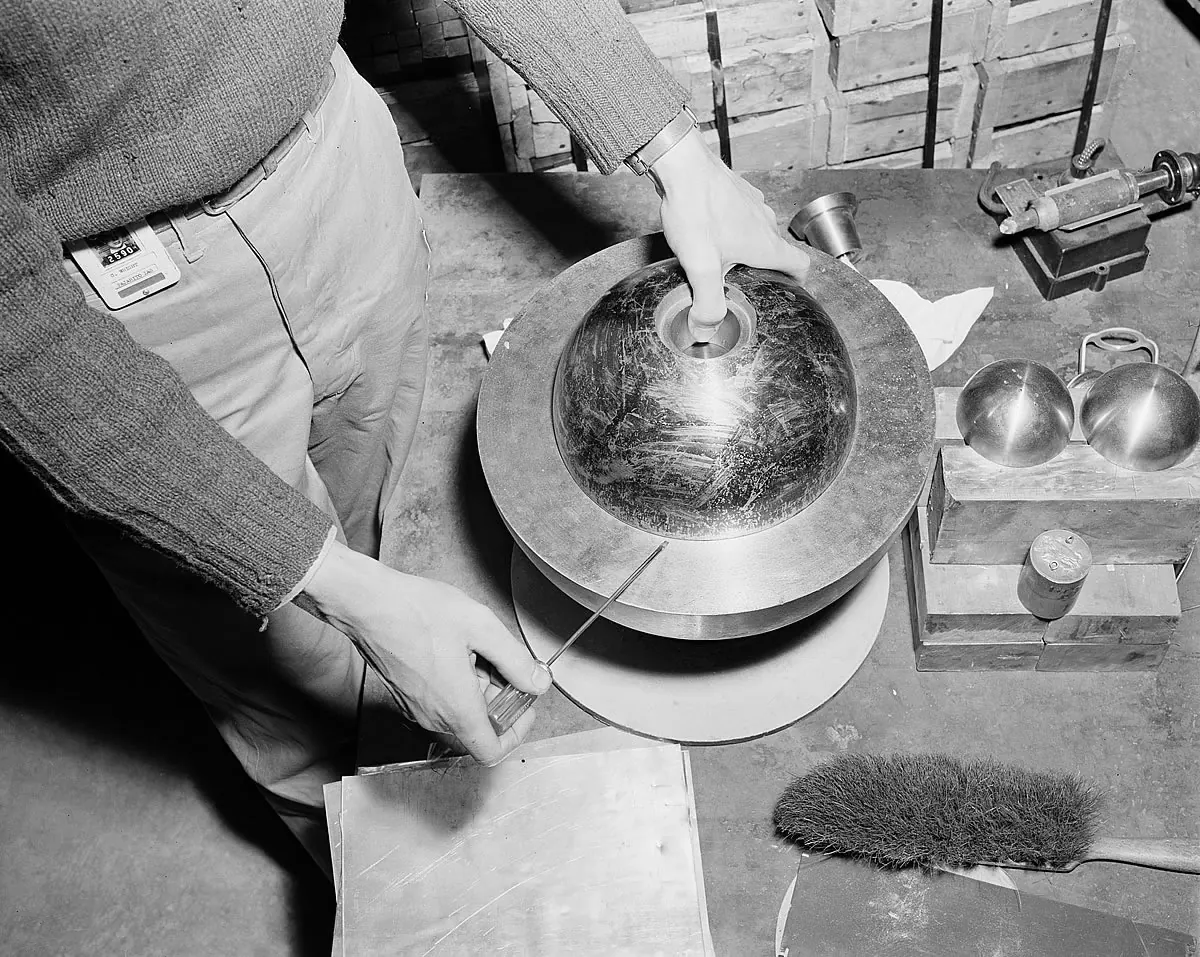
Slotin placed the plutonium sphere into a lower hemispherical shell of beryllium—an exceptionally efficient neutron reflector. The experiment required lowering an upper beryllium dome over the core while monitoring radiation levels with scintillation counters. To keep the assembly from closing completely into a critical geometry, safety protocol required using shim wedges.
Instead, Slotin habitually used his own preferred shortcut: resting the upper dome on the flat steel blade of a standard hand screwdriver, which he tilted manually to regulate the gap. Enrico Fermi had presciently cautioned Slotin months earlier that if he continued using that technique, he would be “dead within a year.”
At 3:20 p.m., as seven colleagues watched in the room, the screwdriver blade slipped outward. The upper beryllium dome snapped down, seating flush against the lower hemisphere.
The core went instantly supercritical.
The Blue Flash, the Metallic Taste, and the Nine-Day Decline
The instant the shells met, the room erupted in a brilliant flash of blue light caused by Cherenkov radiation and ionized nitrogen in the air. Slotin felt a wave of burning heat wash over his skin and tasted an acrid, metallic copper sensation on his tongue—the classic neurological hallmark of massive acute radiation exposure.
Slotin reacted with lightning speed. Rather than flinching away, he flipped the upper beryllium shell off the core with his bare left hand, letting it crash to the floor to terminate the reaction, while shielding his colleagues with his own body. As he did, he shouted to the room: “Well, that does it.”
Realizing the gravity of the accident, Slotin immediately ordered everyone out of the building. In the parking lot outside, while waiting for ambulances, Slotin took a piece of chalk and drew a detailed sketch on the blackboard and asphalt showing the exact location of every person in the room during the flash. This enabled physicists to calculate the precise inverse-square radiation dose received by each witness.
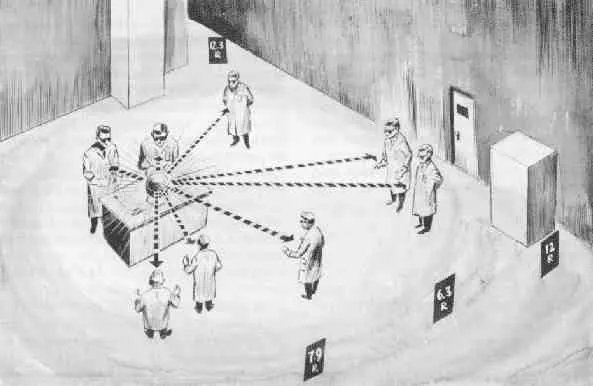
Because Slotin had stood directly over the assembly, his body absorbed a massive dose estimated at 1,000 rads (10 Gy) of neutron and gamma radiation—more than double the lethal threshold. Over the following days at the hospital, Slotin suffered rapid internal organ failure, extreme gastrointestinal distress, and complete destruction of his white blood cells. Dr. Louis Slotin died nine days later on May 30, 1946, at the age of 35.
Dr. Alvin Graves, who was standing immediately behind Slotin, received roughly 390 rads. Graves survived after weeks of hospitalization, though he suffered permanent vision damage, developing radiation cataracts, and died twenty years later of a heart attack at age 54. The remaining six observers were farther away or partially shielded by Slotin’s body and survived with lower doses.
End of the Cowboy Era: Remote Control and the Core’s Fate
Slotin’s death marked the permanent end of what physicists grimly called the “cowboy era” of nuclear research. The 14-pound plutonium sphere was formally christened the Demon Core by the shaken scientists of Los Alamos.
Laboratory director Norris Bradbury immediately issued strict orders that prohibited all hands-on manual manipulation of critical or subcritical nuclear assemblies. From that point forward, all criticality experiments were required to be conducted by remote-controlled mechanical manipulators, with scientific teams stationed in fortified control rooms at least a quarter-mile away behind thick concrete and lead-glass blast shielding. This remote-handling doctrine laid the foundation for modern nuclear engineering, reactor safety controls, and glovebox protocols worldwide.
The Demon Core itself was scheduled to be detonated in the Pacific during Operation Crossroads at Bikini Atoll. However, following Slotin’s accident, the core was found to be still slightly radioactive from the sudden neutron burst and required cooldown time. After the initial Bikini tests were evaluated, the core was melted down in the summer of 1946, and its high-grade plutonium was blended back into the national stockpile to be refabricated into standard production weapons.
Though the physical core was destroyed, the memory of its lethal blue flash remains one of the darkest and most enduring cautionary tales in the history of science—a terrifying reminder that nature’s fundamental forces offer no second chances when human precision slips.
Archival Sources & Historical Bibliography
- Los Alamos National Laboratory Archives: A Review of Criticality Accidents: 2000 Revision (LA-13638), McLaughlin, T. P., et al. (Comprehensive technical reconstruction of the Daghlian and Slotin criticality incidents).
- United States Department of Energy: Office of History and Heritage Resources, The Manhattan Project: Making the Atomic Bomb, declassified records on the Los Alamos Critical Assemblies Group (1945–1946).
- Schreiber, Raemer E.: Personal Account of the Slotin Accident at Omega Site, May 21, 1946, Los Alamos Scientific Laboratory Memorandum (Declassified firsthand eyewitness testimony).
- National Archives and Records Administration (NARA): Record Group 326, Records of the Atomic Energy Commission, Division of Biology and Medicine: Medical Reports on Acute Radiation Syndrome in Harry Daghlian and Louis Slotin.
- Wellerstein, Alex: Restricted Data: The History of Nuclear Secrecy in the United States, University of Chicago Press (Detailed analysis of the Demon Core’s metallurgical history and naming).
- Wikimedia Commons & Los Alamos Public Records: Primary photographic documentation of the Demon Core replica assembly, declassified floor plan diagrams, and Manhattan Project personnel records.
Recommended Archival Reading
Primary memoirs, declassified investigative reports, and authoritative historical treatises directly related to this dossier.
- Archival Literature Recommended
- Audiobook Edition Free Trial
* Affiliate Disclosure: As an Amazon Associate, Echoes of History Uncut earns from qualifying purchases. This supports our independent historical research, declassified document retrieval, and archival audio production at no additional cost to you.
Echoes of History Uncut. "The Demon Core: Two Lethal Flashes of Blue Light at Los Alamos." Echoes of History Uncut. Last modified October 24, 2026. https://echoesofhistoryuncut.com/articles/the-demon-core/.