
The Navy Named Two Gunboats Mimi and Toutou. They Took Control of a Lake.
In 1915, the British Admiralty approved an audacious plan to transport two tiny armed motorboats three thousand miles through the African bush to challenge German naval dominance on Lake Tanganyika. The eccentric commander who led the mission suggested naming them Cat and Dog—rejected by the Admiralty—so he tried the French equivalents, Mimi and Toutou, meaning Meow and Bow-Wow. The Admiralty approved them without knowing the translation. After months of hauling the boats by train, river barge, and ox team through jungle and over mountains, they launched on 22 and 23 December 1915, capturing one German gunboat and sinking another to break Germany's grip on Central Africa.

In this dossier (11 chapters) ▾
Historical Dossier: The Naval Africa Expedition and Lake Tanganyika Location: Lake Tanganyika, Central Africa | Year: 1915–1916 | Key Figures: Geoffrey Spicer-Simson, John R. Lee, Sub-Lieutenant Junge, Gustav Zimmer
The Lake the Germans Ruled
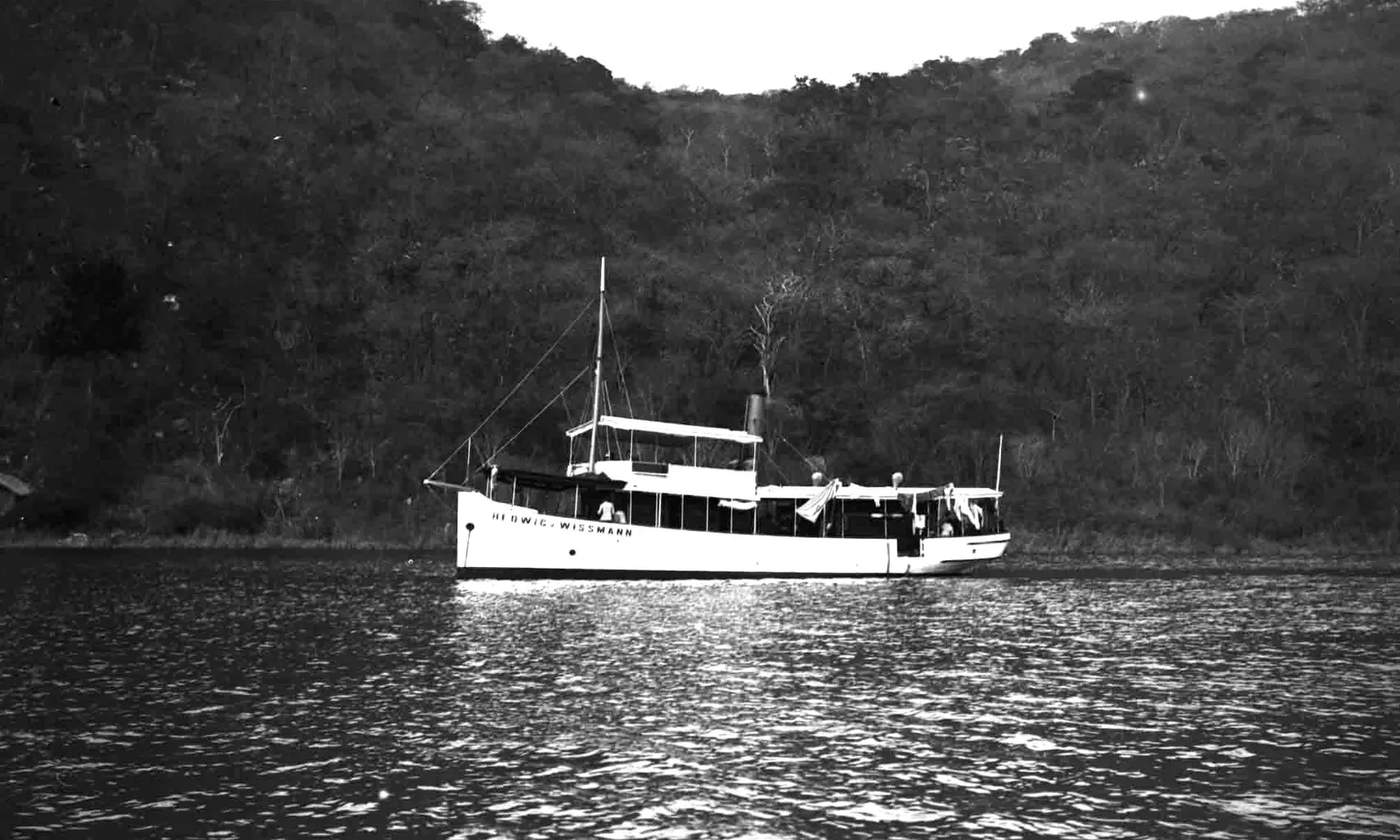
Lake Tanganyika lies between the Belgian Congo and German East Africa. By 1914 Germany had undisputed control of its waters with two armed vessels, the Hedwig von Wissmann, of 60 tons, and the Kingani, of 45 tons. In August 1914 they sank the Belgian steamer Alexandre Del Commune, and in November the British Cecil Rhodes. The Germans could now move troops and cut Allied supply lines at will.
They also had a larger ship under construction. The Graf von Götzen, of 1,575 tons, was built in Germany, taken apart into some 5,000 crates, sent by rail to Dar es Salaam and reassembled in secret at Kigoma. She was 220 feet long and could carry 800 to 900 troops.
A Mad Plan
In April 1915 a big-game hunter and Boer War veteran, John R. Lee, put forward an unorthodox idea to the Admiralty. He proposed sending small, fast motor gunboats that could be carried whole across the African interior. The First Sea Lord, Admiral Sir Henry Jackson, approved it, and is said to have declared: “It is both the duty and the tradition of the Royal Navy to engage the enemy wherever there is water to float a ship.”
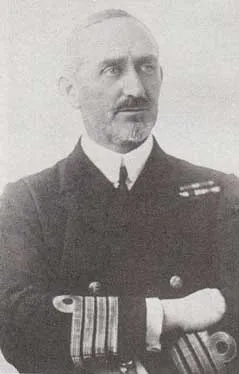
The commander was Lieutenant-Commander Geoffrey Spicer-Simson. The author Giles Foden describes him as “a man court-martialled for wrecking his own ships, an inveterate liar and a wearer of skirts.” His record included nearly sinking a submarine, running a ship aground at Portsmouth, and seeing his ship HMS Niger torpedoed while he entertained guests at a hotel.
Meow and Bow-wow
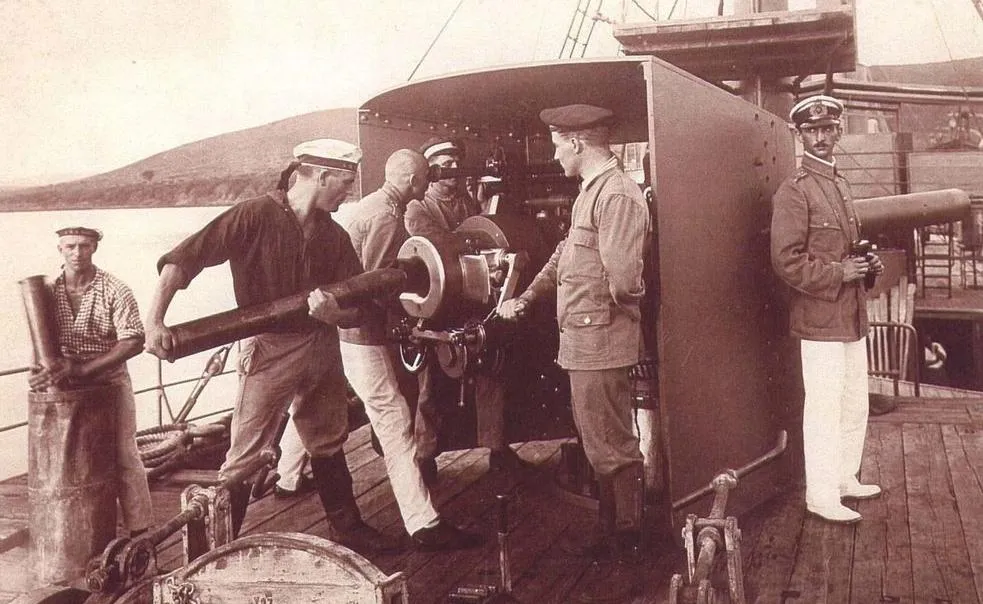
The two 40-foot boats were first going to be called Cat and Dog. They became HMS Mimi and HMS Toutou, French for “Miaow” and “Bow-wow.” They were fitted with Maxim guns and a 3-pounder Hotchkiss cannon, which had to be fired from a kneeling position. On a test on the Thames on 8 June, the gun was not bolted down properly, and “both gun and gunner” flew “into the river.”
The expedition left on 15 June aboard the SS Llanstephen Castle. It sailed 17 days to Cape Town, took the railway through Bulawayo to Elisabethville, arriving on 26 July, and then crossed 146 miles overland with oxen and steam tractors. It went down the Lualaba River through Lake Kisale to Kabalo, arriving on 22 October, and then took a final railway section to Lukuga, on the lakeshore.
The Capture of the Kingani
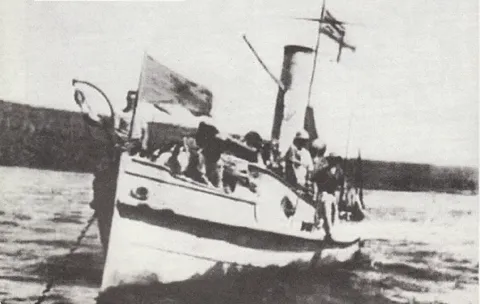
On 26 December 1915, at 6 a.m., while Spicer-Simson was holding morning prayers, the Kingani appeared off the harbour of Kalemie under Sub-Lieutenant Junge. In an action of eleven minutes, Mimi and Toutou closed on her while her six-pounder fire missed. A shell passed through the gunshield and killed Junge and two petty officers, and the Kingani surrendered. She became HMS Fifi. King George V sent word that he wished “to express his appreciation of the wonderful work carried out by his most remote expedition.”
The Sinking of the Hedwig
On 8 February 1916 the Hedwig von Wissmann came out to look for the missing Kingani. A joint Anglo-Belgian flotilla went after her, with Mimi, Fifi, Dix-Tonne and a whaleboat. The 12-pounder’s recoil stopped Fifi dead in the water. Spicer-Simson was down to three shells, and a gun jam cost twenty minutes, during which the Hedwig nearly got away. Then Fifi’s second-last shot hit the Hedwig’s hull and flooded it, and her last shell hit the engine room, bursting the boiler and killing five African sailors and two Germans. The British captured a large German naval ensign, the first taken in the war.
The Götzen Goes Down
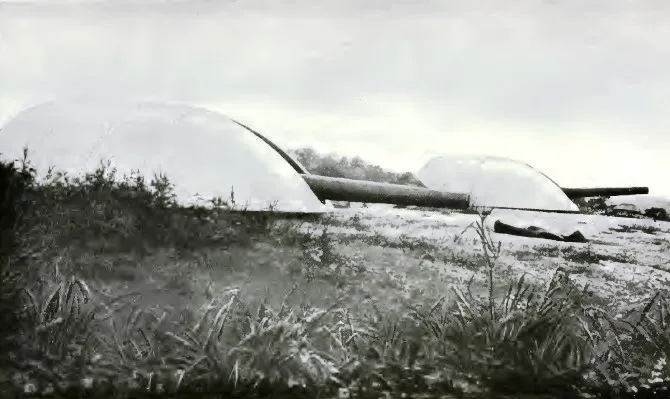
The largest ship was never fought. On the orders of Paul von Lettow-Vorbeck, her commander, Gustav Zimmer, stripped her guns and put wooden dummies in their place. When Kigoma fell to Belgian forces on 28 July 1916, the Graf von Götzen had already been scuttled in 20 metres of water at Katabe Bay, with her engines carefully greased in case anyone wanted to use her again.
The Liemba
The greasing paid off. The Belgians raised the ship and towed her to Kigoma, where she sank again at her moorings in a storm. The British raised her again in 1921 and found that the grease had preserved her so well that she needed little repair. She went back into service on 16 May 1927 as the MV Liemba, and she still sails on Lake Tanganyika.
After the War
Spicer-Simson was awarded the Distinguished Service Order but was reprimanded for his hostile behaviour towards the Belgian allies, and was given no further command. Belgium made him a Commander of the Order of the Crown and awarded him the Croix de guerre.
The story is generally thought to have inspired C. S. Forester’s novel The African Queen, which John Huston made into a film in 1951. In Forester’s book the boats are named Amelia and Matilda. In real life, it was the Navy’s two small boats, with their French nicknames, that took control of the lake.
What the Record Shows
8 sourced claims in this story, resting on 5 primary and historical records. Numbers link to the bibliography below.
- The German Navy dominated Lake Tanganyika in early 1915, cutting off Allied transport in East Africa - sources: 1, 2
- Big-game hunter John R. Lee proposed dragging armed motor launches overland to the Admiralty - sources: 2, 3
- Lieutenant Commander Geoffrey Spicer-Simson successfully registered the vessels as HMS Mimi and HMS Toutou - sources: 1, 2
- The two 40-foot motorboats were transported thousands of miles across Africa by railway, traction engines, and ox teams - sources: 2
- HMS Mimi and Toutou were launched into Lake Tanganyika in December 1915 - sources: 1, 5
- On December 26, 1915, Mimi and Toutou attacked and captured the German gunboat Kingani - sources: 1, 3
- Kingani was recommissioned into the Royal Navy as HMS Fifi and participated in sinking Hedwig von Wissmann on 8 February 1916 - sources: 1
- The naval victory broke German dominance over Central Africa’s inland waterways - sources: 2, 6
Archival Evidence & Picture Credits
Every image on this page was checked against its Wikimedia Commons file page.
- The German armed steamer Hedwig von Wissmann on Lake Tanganyika (Wikimedia Commons) - Wikimedia Commons file page
- Commander Geoffrey Spicer-Simson, leader of the Naval Africa Expedition (Wikimedia Commons) - Wikimedia Commons file page
- The captured German gunboat Kingani, renamed HMS Fifi (Wikimedia Commons) - Wikimedia Commons file page
- Shore artillery at Albertville during the First World War (Wikimedia Commons) - Wikimedia Commons file page
- A gun from the German steamer Graf von Götzen (Wikimedia Commons) - Wikimedia Commons file page


Verified Archival Sources & Bibliography
Every claim in this account has been fact-checked against primary archives and scholarly repositories:
- Wikipedia: Battle for Lake Tanganyika (reference)
- Internet Archive: Mimi and Toutou Go Forth: The Bizarre Battle for Lake Tanganyika (Giles Foden) (book)
- Imperial War Museums: The Naval Africa Expedition 1915–1916 (primary)
- The National Archives (UK): Admiralty War Diaries: Lake Tanganyika Naval Flotilla (primary)
- Encyclopaedia Britannica: Battle for Lake Tanganyika (reference)
Echoes of History Uncut. "The Navy Named Two Gunboats Mimi and Toutou. They Took Control of a Lake.." Echoes of History Uncut. Last modified September 21, 2026. https://echoesofhistoryuncut.com/articles/mimi-toutou-lake-tanganyika-1915/.

An independent history publication using AI-assisted research, drafting and production. Consult each article’s citations and limitations; source inclusion does not establish independent verification of every claim.
▶
Watch the Complete Archival Documentary on YouTube
Subscribe to Echoes of History Uncut on YouTube for full widescreen 16:9 documentaries, primary archival footage, and declassified deep dives.