
A New Sultan Moved In. Britain Opened Fire.
On August 27, 1896, the British Royal Navy bombarded the palace of Zanzibar after Prince Khalid bin Barghash seized the throne without colonial approval. Lasting about thirty-eight minutes by the most often quoted count from first shot to surrender, it remains the shortest recorded war in world history.

In this dossier (10 chapters) ▾
Historical Dossier: The Anglo-Zanzibar War Location: Stone Town, Zanzibar | Year: 25–27 August 1896 | Key Figures: Khalid bin Barghash, Hamoud bin Mohammed, Rear-Admiral Harry Rawson, Basil Cave, General Lloyd Mathews
A Sultan Dies
Sultan Hamad bin Thuwaini of Zanzibar died suddenly on 25 August 1896, in his palace on the seafront of Stone Town. His nephew Khalid bin Barghash, about 29 years old, moved into the palace at once and took power. Many people suspected that Hamad had been poisoned, though the record does not settle it.
The problem was not Khalid’s youth or ambition. It was the rules. Under the 1890 agreement, Zanzibar was a British protectorate, and any new sultan needed the consent of the British. Khalid had not asked for it, and the British had a different candidate in mind: Hamoud bin Mohammed, who was far more favourable to British interests.

The Palace Fills Up
The British consul, Basil Cave, warned Khalid to stand down. Khalid ignored him. By the end of the day about 2,800 armed supporters, soldiers and civilians, had gathered at the palace. They had Maxim machine guns, a Gatling gun and artillery pieces, and some of the guns were aimed at the British ships in the harbour.
The Royal Navy had its own way of dealing with a refusal. On 26 August Rear-Admiral Harry Rawson arrived aboard HMS St George, carrying authority from the Prime Minister, Lord Salisbury, to take “whatever measures you may consider necessary” to remove Khalid. He gave an ultimatum: Khalid must haul down his flag and leave the palace by 9:00 a.m. on 27 August, or the palace would be bombarded.
Two Sides
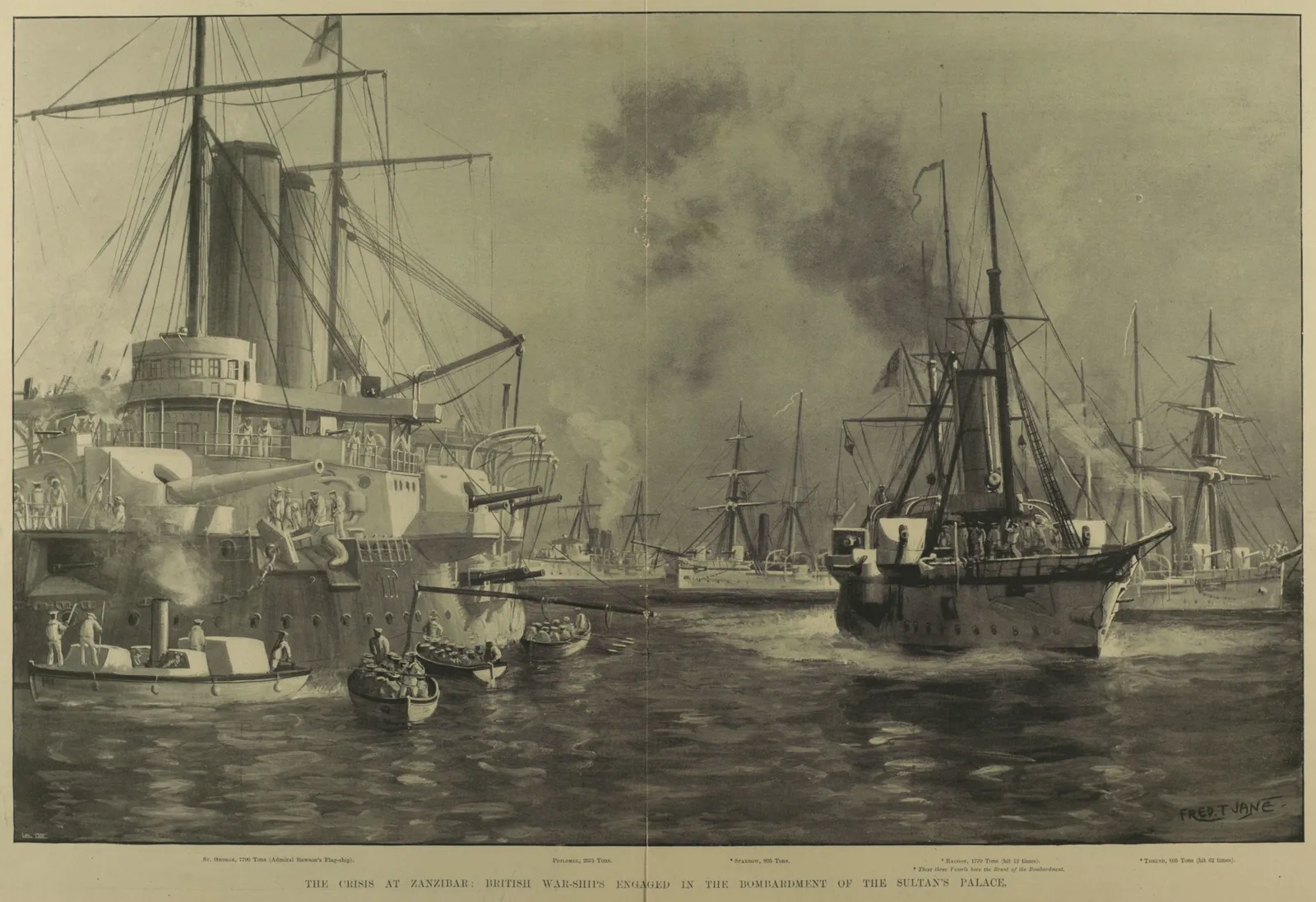
The British had five warships: the St George, the Philomel, the Thrush, the Sparrow and the Racoon. They also had 150 marines and sailors, and 900 pro-British Zanzibari troops under General Lloyd Mathews. Khalid’s side had its roughly 2,800 defenders, the artillery and the royal yacht Glasgow.
At 8:00 a.m. on 27 August, Khalid sent a message to the consul: “We have no intention of hauling down our flag and we do not believe you would open fire on us.” Cave’s answer was that the British had no wish to open fire but would do so if Khalid did not comply.
The Bombardment
At 9:00 a.m. the ultimatum ran out. At 9:02 a.m. three British ships opened fire together. The palace was built mostly of wood, with no defences worth the name, and it caught fire at once. In all, the ships are said to have fired about 500 shells, 4,100 machine-gun rounds and 1,000 rifle rounds.
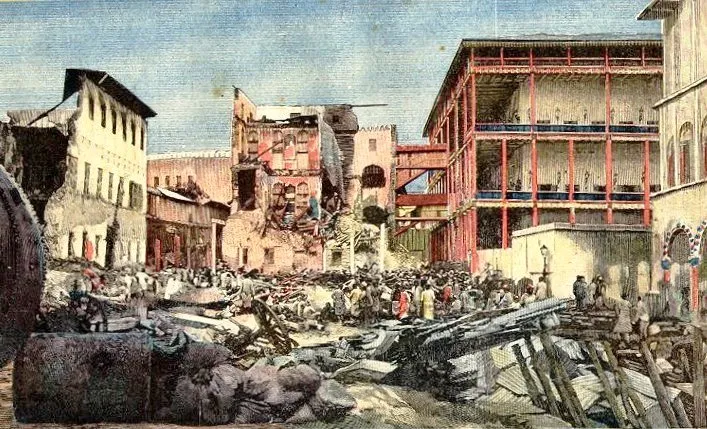
The Glasgow fired back at the St George, but she was quickly sunk in the shallow harbour, with her masts still showing above the water. Khalid’s guns were silenced, and within minutes the palace was a ruin.
How Long Did It Last?
The usual answer is 38 minutes, though the figures vary between 38 and 45. The difference comes from what counts as the start and the end. The start can be taken as the order to fire at 9:00 or the first shot at 9:02, and the end as the moment the shelling stopped, about 9:40, or the time when Khalid entered the German consulate, between 9:35 and 9:45. Whichever way it is counted, the Anglo-Zanzibar War is the shortest recorded war in history.
The Cost
About 500 Zanzibaris were killed or wounded, mostly by the fire that swept the palace. On the British side the casualties amounted to a single petty officer on the Thrush, who was severely wounded and later recovered.
Khalid had fled to the German consulate, where he stayed until 2 October, when the German warship SMS Seeadler took him to German East Africa. Hamoud bin Mohammed was installed as sultan, with the British running the government behind him.
What the War Shows
The Anglo-Zanzibar War is often told as a curiosity, and its length is a fine piece of trivia. The reason it is worth remembering is that it shows how a protectorate worked in practice. The sultan was free to rule so long as he ruled as London wished, and when he did not, the response came from the sea within two days. The war made it plain that the 1890 agreement was not a courtesy.
What the Record Shows
8 sourced claims in this story, resting on 4 primary and historical records. Numbers link to the bibliography below.
- Sultan Hamad bin Thuwaini died unexpectedly on August 25, 1896, and Khalid bin Barghash proclaimed himself Sultan - sources: 4
- British Consul-General Basil Cave delivered an ultimatum demanding Khalid step down by 9:00 AM on August 27 - sources: 2
- Five Royal Navy vessels under Rear-Admiral Harry Rawson formed a firing line off the palace - sources: 3
- The bombardment began at 9:02 AM and ceased at 9:40 AM, lasting approximately 38 minutes - sources: 4
- The Royal Navy sank the Sultan’s armed yacht HHS Glasgow during the brief exchange - sources: 2, 4
- Around 500 Zanzibari defenders were killed or injured, while the British suffered one wounded sailor - sources: 4
- Khalid bin Barghash escaped to the German consulate before fleeing on the German cruiser SMS Seeadler - sources: 2, 5
- The British administration demanded payment from the Sultanate for the ammunition expended during the shelling - sources: 4
Archival Evidence & Picture Credits
Every image on this page was checked against its Wikimedia Commons file page.
- Khalid bin Barghash, who seized the sultanate in August 1896 (Wikimedia Commons) - Wikimedia Commons file page
- British warships bombarding the Sultan’s palace, as shown in the Illustrated London News in 1896 (Wikimedia Commons) - Wikimedia Commons file page
- The Sultan’s palace in Zanzibar after the bombardment of 27 August 1896 (Wikimedia Commons) - Wikimedia Commons file page


Verified Archival Sources & Bibliography
Every claim in this account has been fact-checked against primary archives and scholarly repositories:
- Internet Archive: Zanzibar - Its History and Its People (W. H. Ingrams) (book)
- The National Archives (UK): Admiralty Despatches - Zanzibar Bombardment ADM 116/1001 (primary)
- Wikipedia: Anglo-Zanzibar War (reference)
- BBC News: The Shortest War in History (news)
Echoes of History Uncut. "A New Sultan Moved In. Britain Opened Fire.." Echoes of History Uncut. Last modified September 16, 2026. https://echoesofhistoryuncut.com/articles/anglo-zanzibar-war/.

An independent history publication using AI-assisted research, drafting and production. Consult each article’s citations and limitations; source inclusion does not establish independent verification of every claim.
▶
Watch the Complete Archival Documentary on YouTube
Subscribe to Echoes of History Uncut on YouTube for full widescreen 16:9 documentaries, primary archival footage, and declassified deep dives.