
When Glass Cracks 7 Miles Deep: The Trieste Descent
On 23 January 1960, two men descended into the Mariana Trench aboard the bathyscaphe Trieste. At thirty-five thousand eight hundred feet down, they reached the seabed of Challenger Deep. During the descent, a sharp bang shook the cabin as an outer Plexiglas viewing window cracked under pressure, yet the steel sphere held.

In this dossier (9 chapters) ▾
Historical Dossier: The Trieste Dive to Challenger Deep Location: Challenger Deep, Mariana Trench, western Pacific Ocean | Year: 23 January 1960 | Key Figures: Jacques Piccard, Lieutenant Don Walsh, Auguste Piccard
Building a Vessel for the Bottom of the World
The bathyscaphe Trieste was a Swiss design built in Italy, and it began with a Swiss physicist, Auguste Piccard. He had already ridden a balloon into the stratosphere, and he turned to the sea with the same idea: a heavy, strong cabin for people, hung beneath a large float that kept the whole machine buoyant. The Trieste was about 18 metres long. The float was filled with gasoline, which is lighter than water and, unlike air, will not be crushed by pressure. Beneath it hung the crew sphere, a small steel ball for the men.
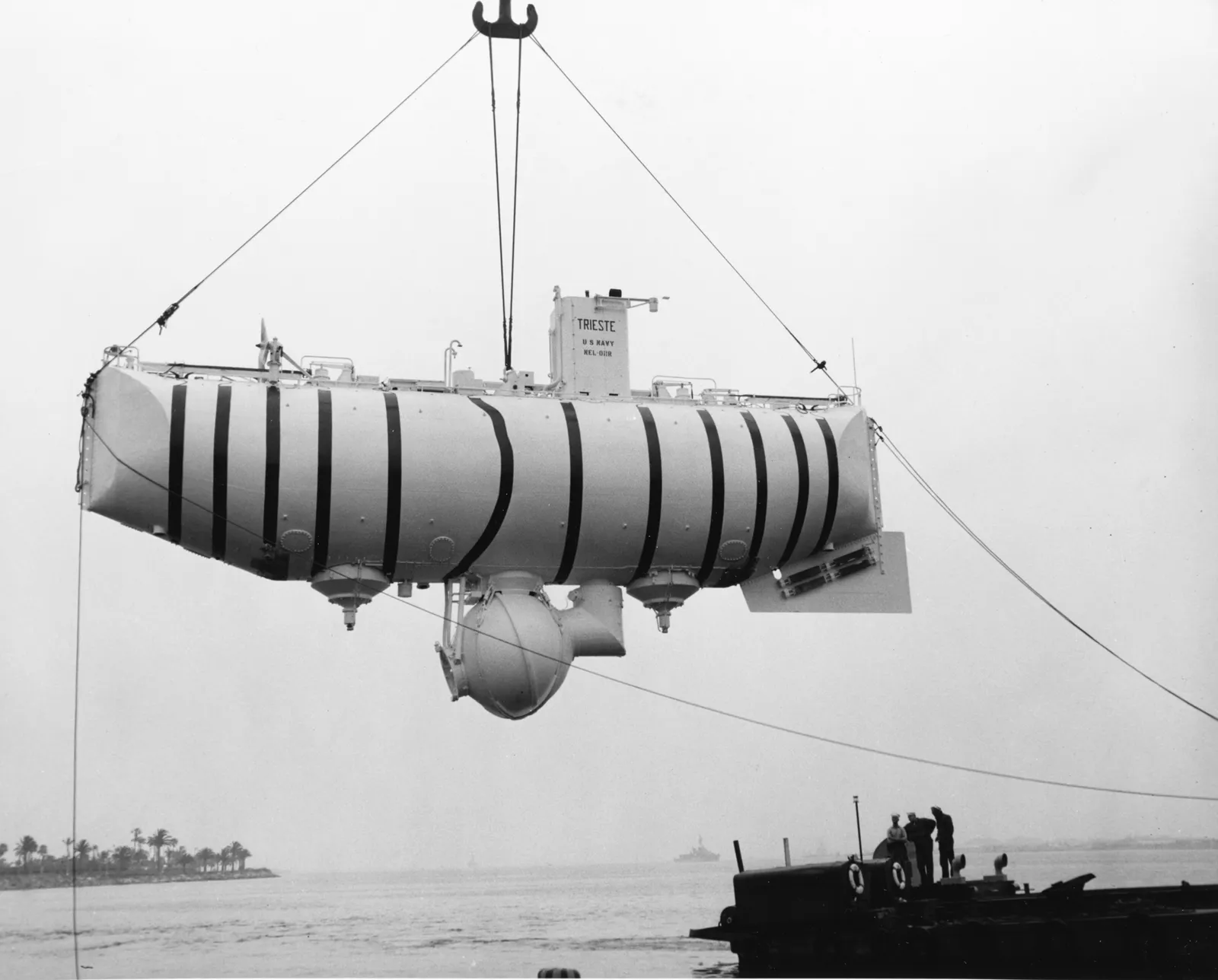
Auguste’s son Jacques carried the project forward. Needing money, he went to the US Navy, which was at the time looking hard at submersibles for research, rescue and salvage. In 1958 the Navy bought the Trieste for $267,000, and hired Jacques Piccard as a consultant. The vessel was modified, and a new pressure sphere was made by the Krupp steelworks, 2.16 metres across, with walls 127 millimetres, or five inches, thick.
The Trieste was by then able to reach about 24,000 feet. Piccard and the Navy aimed at something deeper: the Challenger Deep, the deepest known part of the world’s oceans and of the Earth’s crust under water.
Guam to the Trench
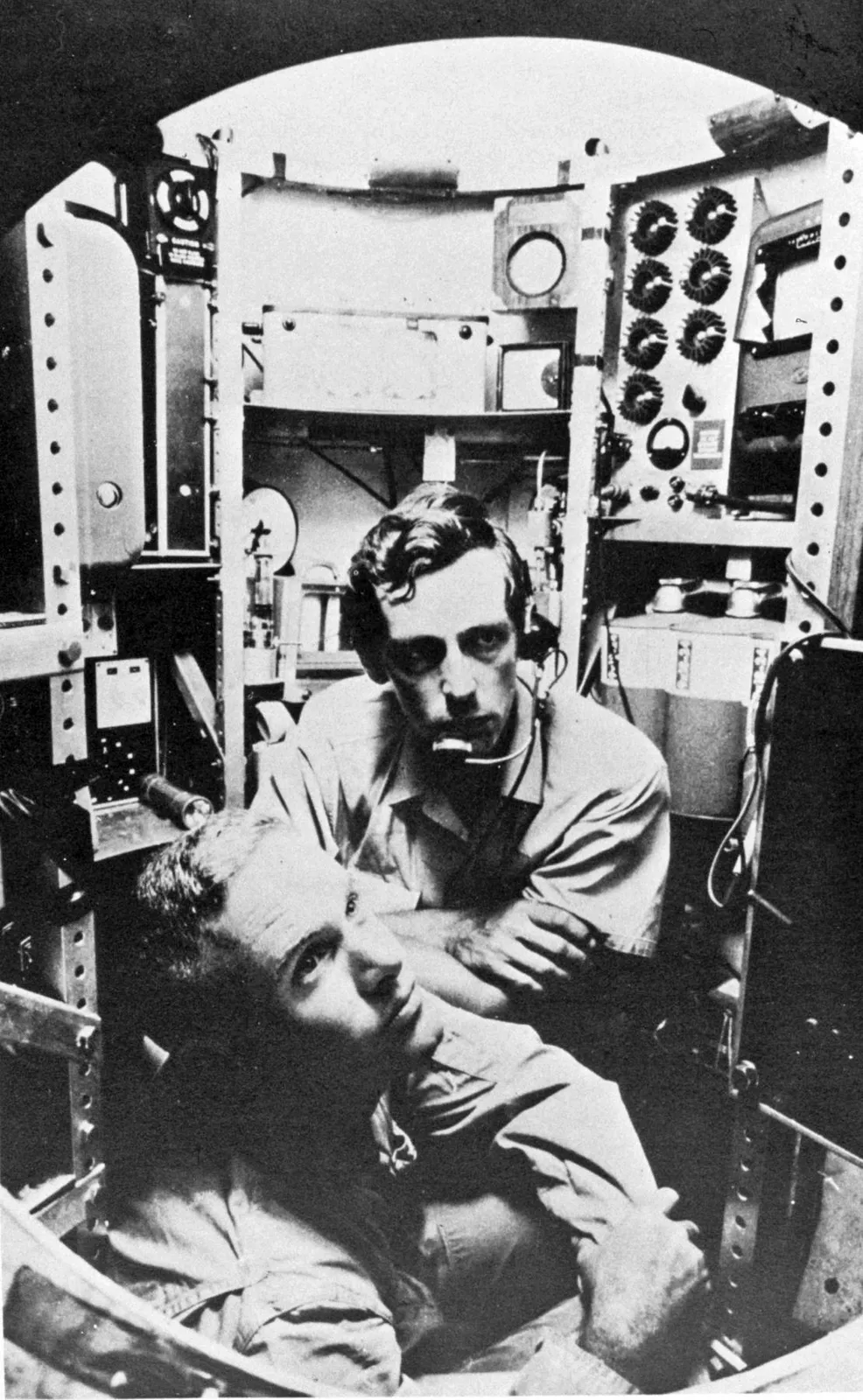
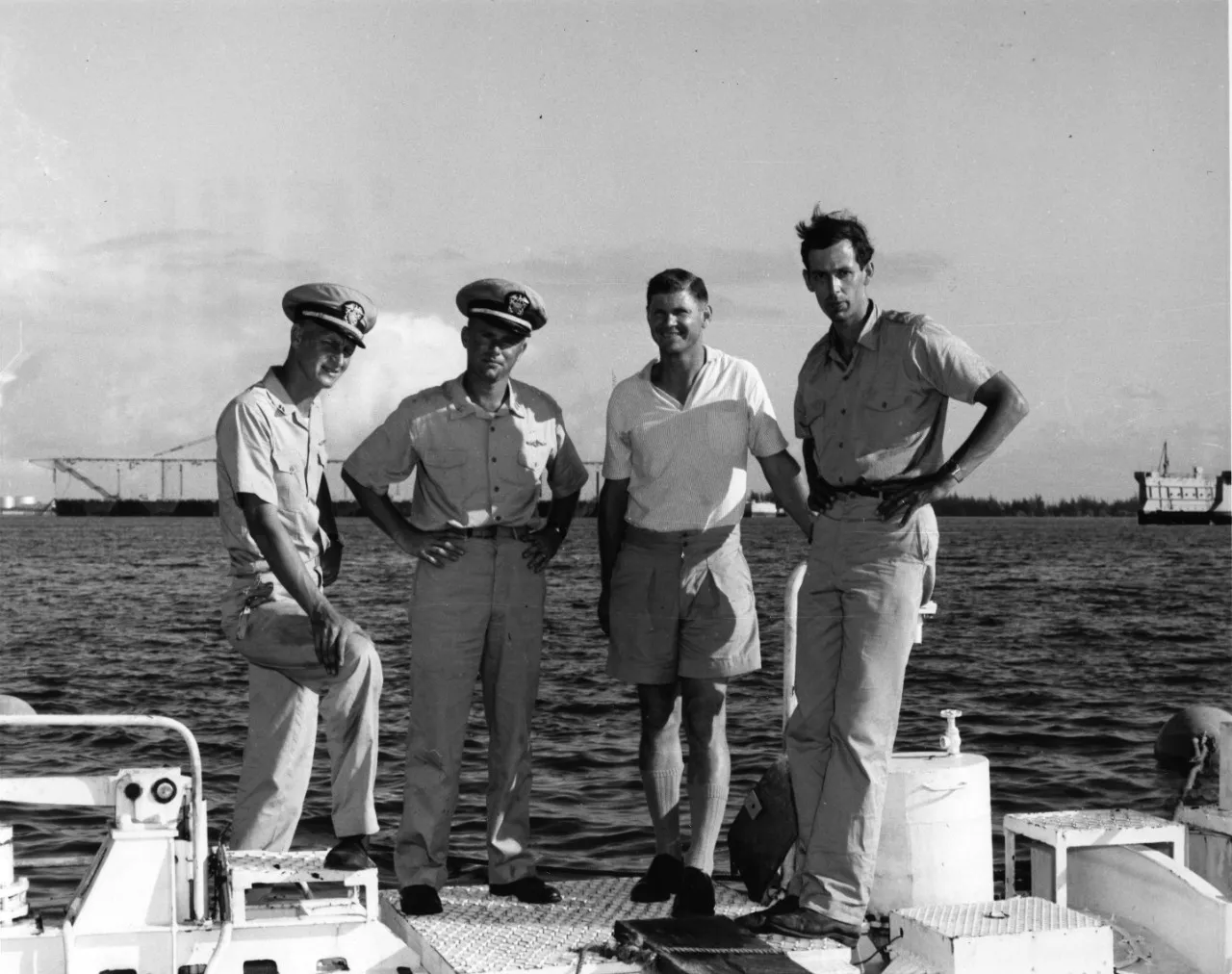
On 23 January 1960, Piccard and a US Navy lieutenant, Don Walsh, set out from Guam for the Mariana Trench, in the western North Pacific. The surface ship USS Lewis (DE-535) accompanied the Trieste over the Trench, and the pair climbed through a hatch and into the sphere, which was barely large enough for two men. It was cold, cramped and dark.
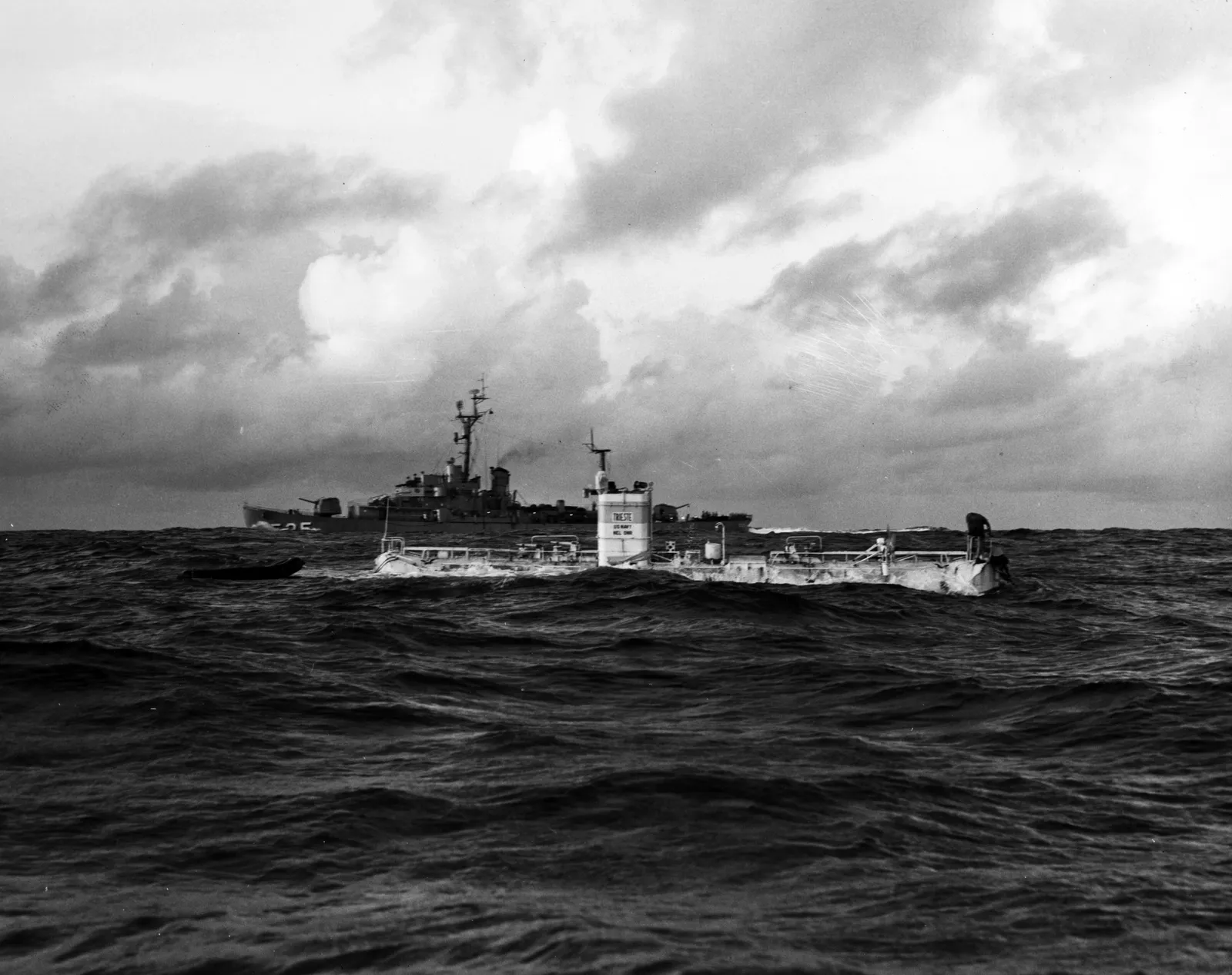
They then began to sink at roughly 0.9 metres a second. The dive would take 4 hours and 47 minutes, with almost nothing to see: after the sunlight is gone, there is only darkness, the hum of the equipment and the cold.
The Crack
Early in the descent the crew heard a loud crack. According to accounts of the dive, an outer Plexiglas window had cracked as the vessel went below about 9,000 metres, or roughly 30,000 feet. The cabin shook, and for a moment the two men had to decide whether to go on. The window was an outer one; the steel sphere and its inner windows were intact. They kept descending.
Twenty Minutes at the Bottom
They reached the bottom at about 10,916 metres, or about 35,800 feet. They spent about twenty minutes there. The temperature in the cabin was 7 degrees Celsius, or 45 Fahrenheit. They were deeper than anyone had ever been, and the water pressure outside was many times that at sea level.
Piccard reported seeing marine life on the bottom, a flatfish and a new kind of shrimp. This was important because it suggested that animals could live even at this depth. Marine biologists later disputed the claim, arguing that a flatfish could not survive the pressure, and the argument has never been entirely settled. What is not in dispute is the dive itself, which is documented by the Navy, the crew and the ships on the surface.
Piccard decided to cut the visit short once cracks were noticed in the viewing windows. The men dumped ballast and began to rise. The ascent took three hours and fifteen minutes, and they surfaced without incident.
Aftermath
The dive received attention across the world. Piccard wrote a book about it with the geologist Robert S. Dietz, Seven Miles Down. But no second dive to the Challenger Deep followed. The Trieste was expensive to maintain and run, and it could neither collect samples nor take photographs, which limited its scientific use.
In 1963 the Trieste took part in the search for the submarine USS Thresher, and the Navy awarded the crew a Navy Unit Commendation. The vessel was decommissioned in 1966. It is now on display at the National Museum of the United States Navy in Washington, D.C.
No crewed vessel went back to the bottom for more than fifty years, until the film director James Cameron made a solo descent in 2012.
Why It Matters
The dive proved that people could reach the deepest point in the ocean and come back. It extended human reach to a place that had seemed completely out of bounds. The Trieste did it with a hull of steel and a hull of gasoline, a cracked window and a lot of nerve.
What the Record Shows
12 sourced claims in this story, resting on 11 sources. Numbers link to the bibliography below.
- On 23 January 1960 two men descended nearly seven miles into the Mariana Trench aboard a submarine vessel - sources: 1, 4, 8, 9
- The Mariana Trench contains Challenger Deep, the deepest point in the world’s oceans - sources: 3, 4, 6, 10
- Jacques Piccard of Switzerland and Navy Lieutenant Don Walsh boarded the bathyscaphe Trieste for the deep descent - sources: 5, 4, 11
- The steel walls of the Krupp crew sphere on the Trieste were five inches thick - sources: 1, 5, 9
- The two-man crew occupied a cramped steel sphere - sources: 5, 4, 11
- Deep into the descent, a sharp bang and loud crack shook the cabin - sources: 4, 5, 11
- An outer Plexiglas viewing window had cracked under crushing pressure but the inner steel sphere held - sources: 5, 4, 9
- Jacques Piccard and Don Walsh decided to proceed and keep sinking despite the cracked viewing window - sources: 5, 4, 11
- They reached the seabed of Challenger Deep at a depth of thirty-five thousand eight hundred feet, 35800 feet, while the manometer depth gauge read 37,800 feet - sources: 1, 2, 8, 11
- At the bottom of the Challenger Deep, crushing oceanic water pressure pressed against the vessel - sources: 5, 4, 9
- Piccard and Walsh arrived safely in Challenger Deep, lingering for twenty minutes before ascending - sources: 4, 9
- The mission proved humans could reach the deepest ocean floor on Earth - sources: 7, 4, 11
Archival Evidence & Picture Credits
Every image on this page was checked against its Wikimedia Commons file page.
- The bathyscaphe Trieste, with its gasoline float above and its small crew sphere below (Wikimedia Commons) - Wikimedia Commons file page
- The Trieste with the destroyer escort USS Lewis over the Marianas Trench on 23 January 1960 (Wikimedia Commons) - Wikimedia Commons file page
- Jacques Piccard and Don Walsh with the Trieste (Wikimedia Commons) - Wikimedia Commons file page
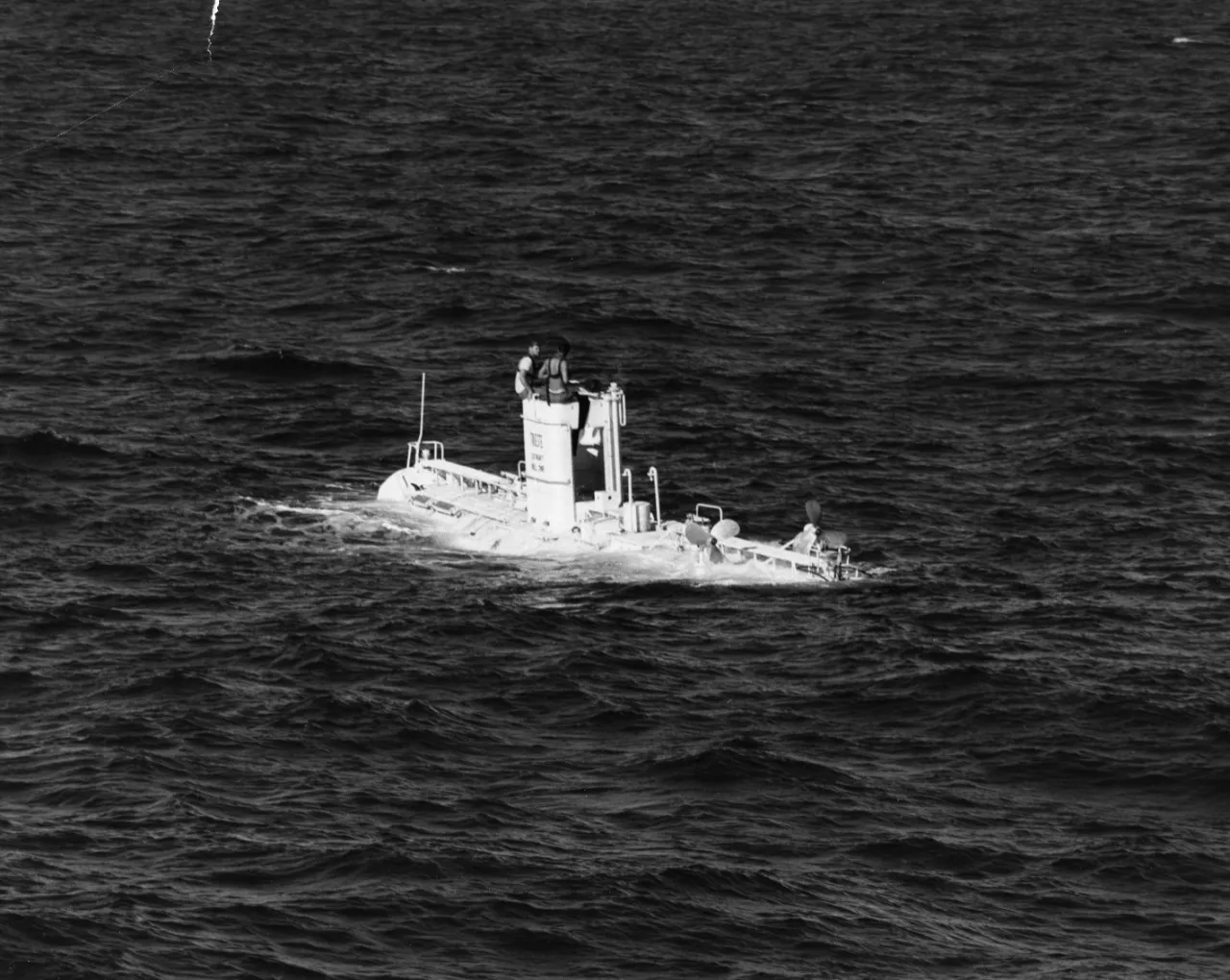
- The Trieste on the surface in 1960 (Wikimedia Commons) - Wikimedia Commons file page
- The Trieste in Navy service (Wikimedia Commons) - Wikimedia Commons file page


Verified Archival Sources & Bibliography
Every claim in this account has been fact-checked against primary archives and scholarly repositories:
- U.S. Navy Electronics Laboratory Research Report 1096: Bathyscaph Trieste (primary)
- NOAA Ocean Exploration: Soundings, Sea-Bottom, and Geodesy History (primary)
- Oceanography: Challenger Deep and the Mariana Trench Exploration (primary)
- National Geographic: Accidental Implosion Yields New Measurement for Ocean Deepest Point (news)
- The Guardian: Jacques Piccard Obituary and Mariana Trench Record (news)
- The Guardian: James Cameron and the 1960 Trieste Mariana Trench Dive (news)
- BBC News: Oceans Deepest Depth Re-measured & Trieste Historical Dive (news)
- The Independent: Legendary Diver Jacques Piccard Dies (news)
- Wikipedia: Trieste (bathyscaphe) (reference)
- Wikipedia: Challenger Deep (reference)
- Wikipedia: Jacques Piccard (reference)
Echoes of History Uncut. "When Glass Cracks 7 Miles Deep: The Trieste Descent." Echoes of History Uncut. Last modified September 25, 2026. https://echoesofhistoryuncut.com/articles/trieste-challenger-deep-1960/.

An independent history publication using AI-assisted research, drafting and production. Consult each article’s citations and limitations; source inclusion does not establish independent verification of every claim.
▶
Watch the Complete Archival Documentary on YouTube
Subscribe to Echoes of History Uncut on YouTube for full widescreen 16:9 documentaries, primary archival footage, and declassified deep dives.