
A 2,000-Year-Old Bronze Lump Was the Oldest Known Analogue Computer
In 1900, Greek sponge divers sheltering from a storm off the tiny island of Antikythera discovered a Roman-era shipwreck laden with bronze and marble treasures. Among the salvaged artifacts was a heavily calcified, corroded green lump of bronze that seemed worthless. When it dried and fractured open, archaeologists made a mind-bending discovery: more than thirty precision bronze gears capable of calculating solar and lunar eclipses, planetary orbits, and the four-year Olympic cycle. It was the world's first analog computer—engineering so sophisticated that nothing of comparable complexity appeared on Earth for over a millennium.

In this dossier (11 chapters) ▾
Historical Dossier: The Antikythera Mechanism Location: Antikythera, Greece (found); National Archaeological Museum, Athens (kept) | Year: Made in the 2nd century BC; found 1900–1901 | Key Figures: Captain Dimitrios Kontos, Valerios Stais, Derek de Solla Price, Mike Edmunds, Tony Freeth
Sponge Divers Off Antikythera
In early 1900 a group of sponge divers led by Captain Dimitrios Kontos found an ancient shipwreck off the Greek island of Antikythera, at a depth of about 45 metres. It was a Roman-era cargo ship, which the evidence dates to about 70–60 BC. Over 1900 and 1901 expeditions brought up statues, jewellery, pottery and many other objects. One of them was a corroded lump of bronze.
The mechanism was probably recovered in July 1901. For two years it was unnoticed. Then on 17 May 1902 an archaeologist, Valerios Stais, and a politician, Spyridon Stais, saw that “one of the pieces of rock had a gear wheel embedded in it.” Most scholars at first dismissed it as an impossibility. A geared device of that kind seemed far too advanced for the ancient world.
What Was Found
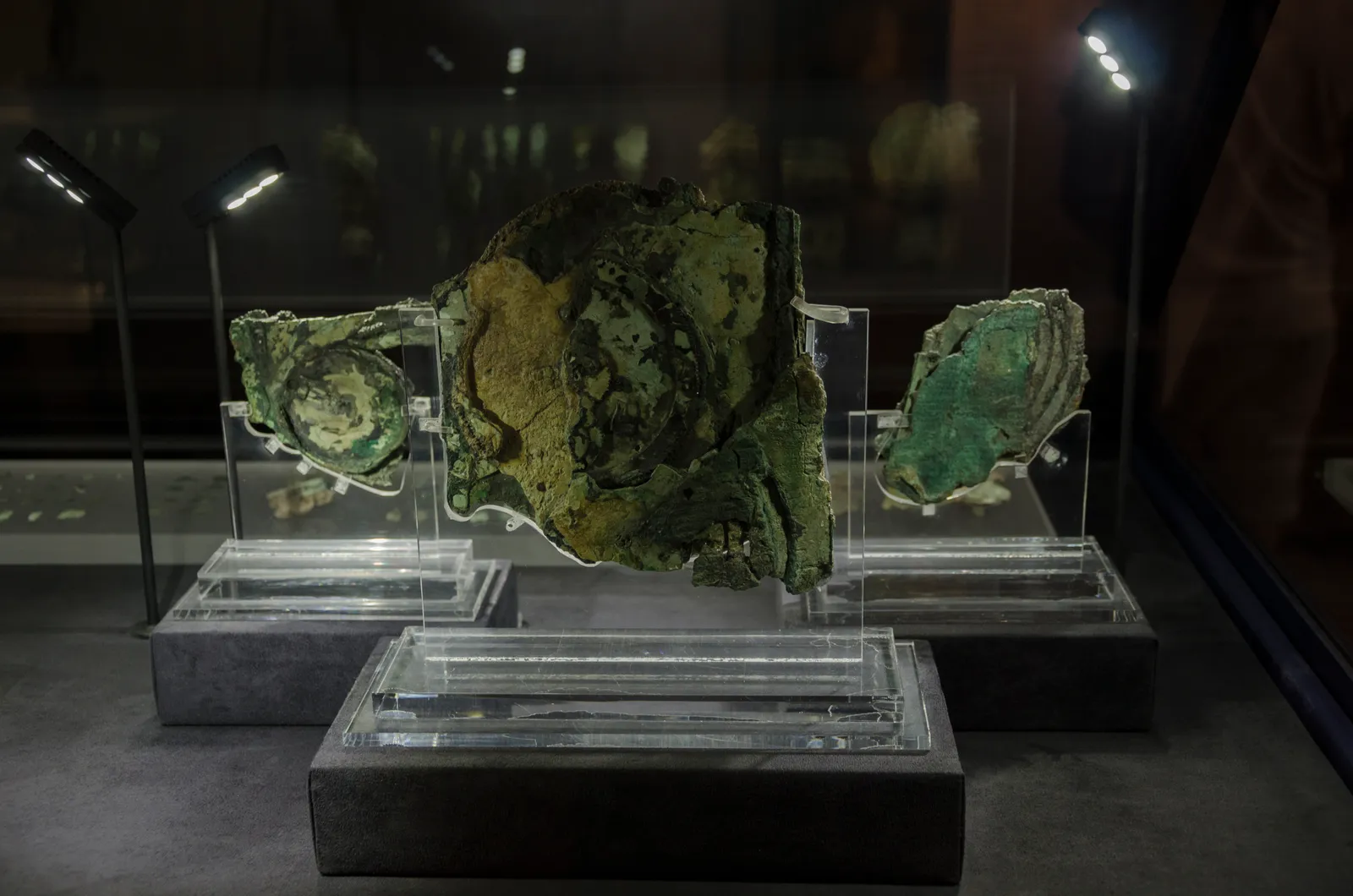
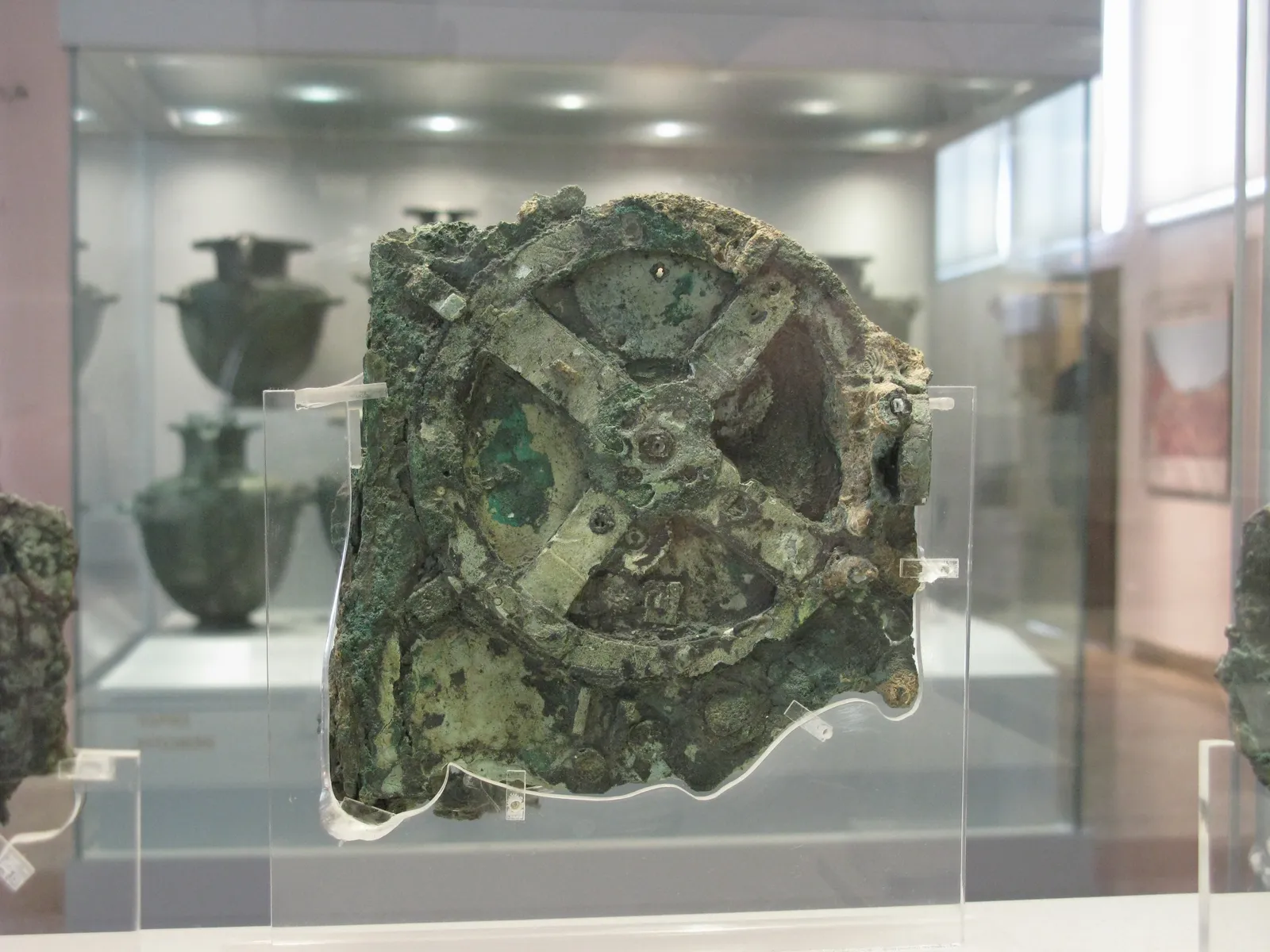
The original device broke into three major pieces, and after conservation there are 82 separate fragments. The largest, Fragment A, measures 180 by 150 millimetres and holds most of the gearing. The largest gear is about 13 centimetres across and originally had 223 teeth. All the fragments are in the National Archaeological Museum in Athens, with reconstructions and replicas that show how the machine may have worked.
A Machine of Gears
Modern analysis shows that the mechanism had at least 30 gears, perhaps 35 to 37. The teeth were cut as equilateral triangles with an average pitch of 1.6 millimetres, and made by hand from bronze blanks, which is why “not all of them are even.”
It was, in the words of the account, “an ancient Greek hand-powered orrery (model of the Solar System),” able to predict “astronomical positions and eclipses decades in advance.” A hand crank turned the main gear. On the front face were dials for the zodiac and the Egyptian calendar, and the crank moved the date pointer about 78 days for each full turn.
The Back Dials
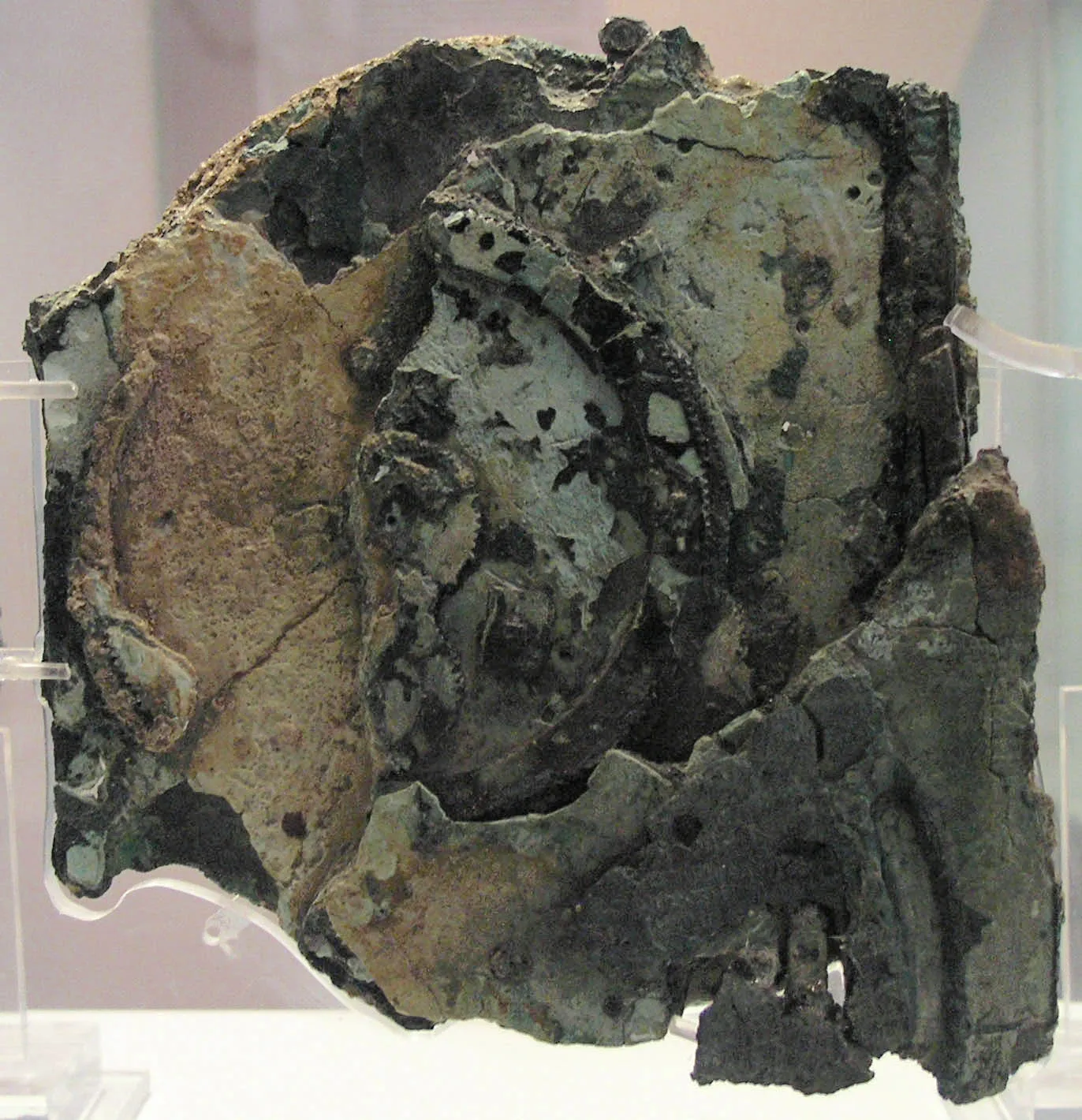
On the back were spiral dials for long cycles. The Metonic dial tracked 235 synodic months over 19 years. The Saros dial predicted eclipses over 223 synodic months, or 6,585.33 days. A dial for the games followed a four-year cycle, including the Olympic Games. The Callippic and Exeligmos dials tracked longer cycles of 76 and 54 years.
The mechanism even modelled the irregular speed of the Moon. A pin-and-slot arrangement, an epicyclic system, made the Moon pointer speed up and slow down as the real Moon does, and a differential gear displayed the lunar phase as well as the Moon’s position. The sidereal month in the model was 27.321 days, against 27.321661 days today.
When and Where Was It Made?
The mechanism is generally dated to the second century BC. Estimates of its construction range from 205 BC to 87 BC, and a 2022 study suggested that its initial calibration date could have been 23 December 178 BC. Its place of origin is also debated. Rhodes, home of the astronomer Hipparchus, is one candidate, and so are Pergamon and Corinthian colonies, and the inscriptions use month names, among them Phoinikaios, Kraneios and Lanotropios, that match calendars from Epirus and suggest Corinthian roots.
Limits
The device was not perfect. Its Mars pointer was “up to 38° wrong in some instances,” because Greek planetary theory at the time was not good enough. The error could be corrected only after Ptolemy’s equant, about 160 AD, or Kepler’s laws of 1609 to 1619.
How We Know
The work of understanding it has gone on for more than a century. Derek de Solla Price studied it from 1951 to 1974 and established how complex it was. In 2005, an X-ray tomography study led by Mike Edmunds at Cardiff University showed a 35-gear arrangement. CT scans in 2016 found the numbers 462 and 442, matching the synodic cycles of Venus and Saturn, which showed that the machine was more accurate than expected. In 2021 a team led by Tony Freeth at University College London proposed a comprehensive model, with gears shared across the planetary systems, “compatible with all the currently known data.”
Why It Matters
“Machines with similar complexity did not appear again until the 14th century in western Europe,” when the astronomical clocks of Richard of Wallingford and Giovanni de’ Dondi were made. The Antikythera Mechanism shows that Greek science and craft had reached a level that few had suspected, and it is a reminder of how much of the ancient world was lost.
What the Record Shows
8 sourced claims in this story, resting on 6 primary and historical records. Numbers link to the bibliography below.
- Greek sponge divers discovered the Antikythera shipwreck at a depth of 60 meters in the spring of 1900 - sources: 1, 2
- Archaeologist Valerios Stais noticed bronze gear teeth inside a calcified fragment in May 1902 - sources: 1, 3
- The device contained at least thirty hand-cut bronze gears inside a wooden casing - sources: 2, 4
- It functioned as an analog computer predicting solar and lunar eclipses according to the Saros cycle - sources: 4, 5
- A pin-and-slot differential gear simulated the Moon’s variable speed caused by Keplerian orbital mechanics - sources: 4, 5
- Dials accurately tracked the 4-year cycle of the ancient Olympic and Panhellenic games - sources: 4, 6
- Over 3,400 tiny Greek characters engraved on plates served as an operating instruction manual - sources: 5, 6
- No mechanical technology of comparable complexity appeared anywhere on Earth for another 1,400 years - sources: 1, 2
Archival Evidence & Picture Credits
Every image on this page was checked against its Wikimedia Commons file page.
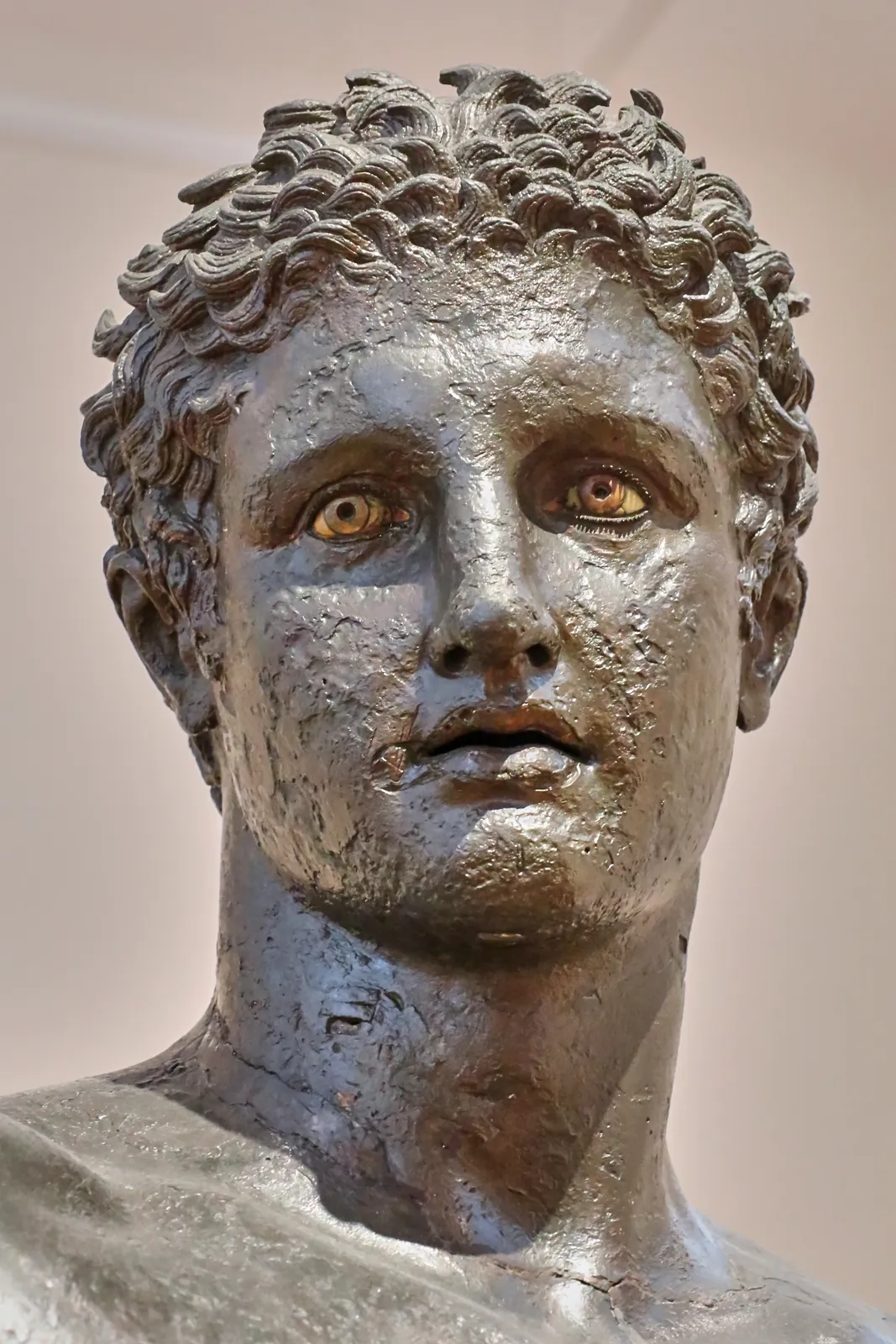
- The bronze statue of a youth recovered from the Antikythera shipwreck, in the National Archaeological Museum of Athens (Wikimedia Commons) - Wikimedia Commons file page
- A fragment of the Antikythera Mechanism, with its corroded bronze gears (Wikimedia Commons) - Wikimedia Commons file page
- Fragments of the Antikythera Mechanism showing Greek inscriptions and dials (Wikimedia Commons) - Wikimedia Commons file page
- The Antikythera Mechanism on display in the National Archaeological Museum, Athens (Wikimedia Commons) - Wikimedia Commons file page
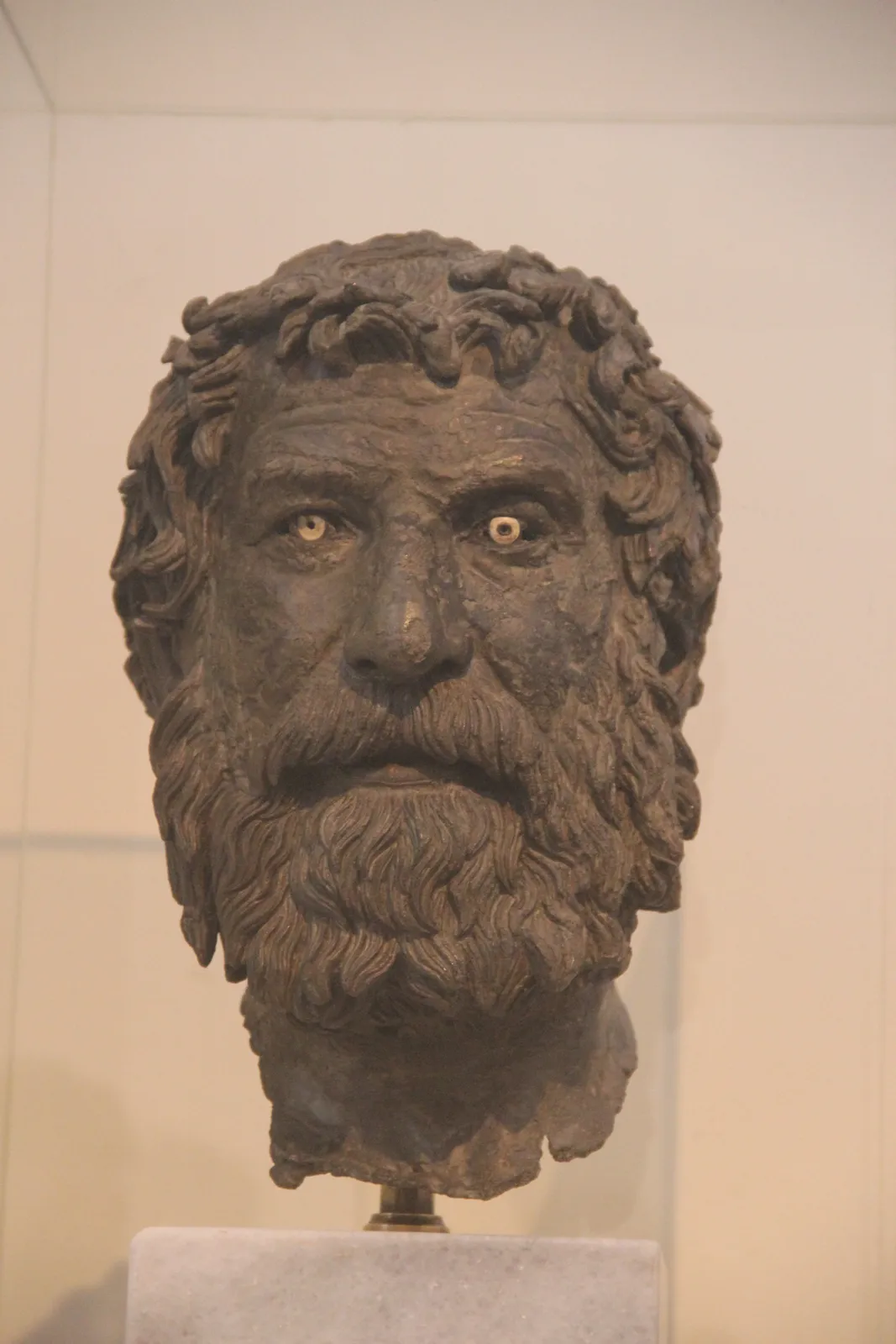
- The bronze head known as the Antikythera Philosopher, recovered from the same wreck (Wikimedia Commons) - Wikimedia Commons file page


Verified Archival Sources & Bibliography
Every claim in this account has been fact-checked against primary archives and scholarly repositories:
- Wikipedia: Antikythera Mechanism (reference)
- Internet Archive: Gears from the Greeks: The Antikythera Mechanism—A Calendar Computer from ca. 80 B.C. (Derek de Solla Price) (book)
- National Archaeological Museum of Athens: The Antikythera Shipwreck and Mechanism Collection (primary)
- Nature: Decoding the Ancient Greek Astronomical Calculator Known as the Antikythera Mechanism (Freeth et al., 2006) (academic)
- Scientific Reports: A Model of the Cosmos in the Ancient Greek Antikythera Mechanism (Freeth et al., 2021) (academic)
- Antikythera Mechanism Research Project (AMRP): Digital Tomography & Inscription Archives (primary)
Echoes of History Uncut. "A 2,000-Year-Old Bronze Lump Was the Oldest Known Analogue Computer." Echoes of History Uncut. Last modified September 19, 2026. https://echoesofhistoryuncut.com/articles/antikythera-mechanism-greece/.

An independent history publication using AI-assisted research, drafting and production. Consult each article’s citations and limitations; source inclusion does not establish independent verification of every claim.
▶
Watch the Complete Archival Documentary on YouTube
Subscribe to Echoes of History Uncut on YouTube for full widescreen 16:9 documentaries, primary archival footage, and declassified deep dives.