
The Indestructible Grain: The Secret Symbolism Behind Dashain's Tika and Jamara
Millions receive the blood-red Tika and golden Jamara every autumn, but few realize its secret: unbroken rice grains representing human resilience, barley sprouted in secret darkness, and cooling yogurt binding a family together.
In this dossier (6 chapters) ▾
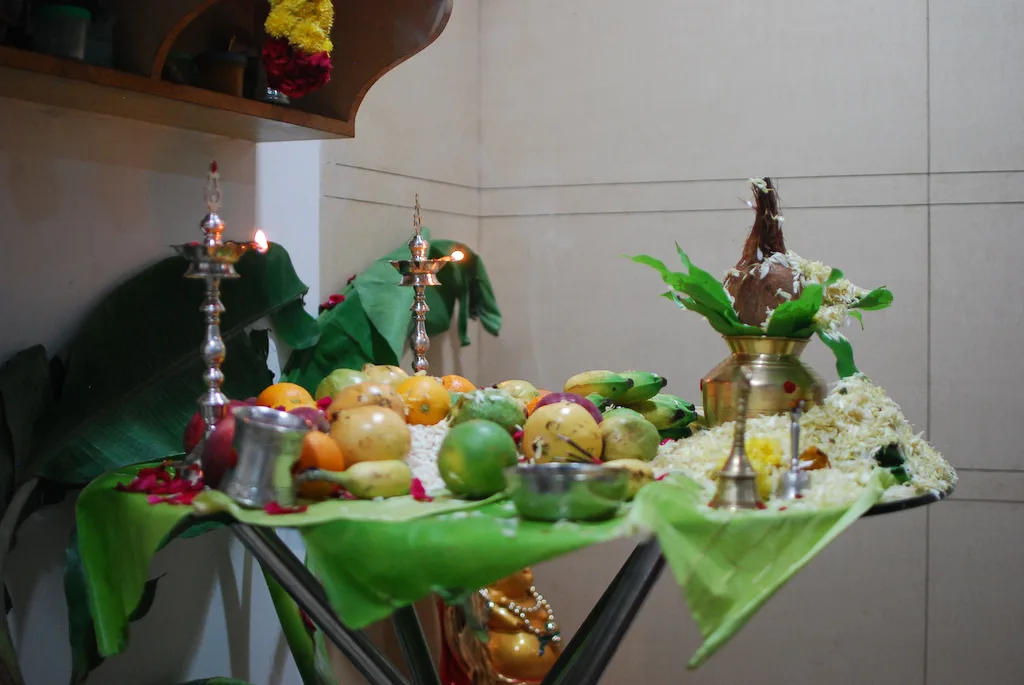
Cultural & Historical Dossier: The Sacred Symbolism of Tika & Jamara Festival: Dashain (Vijaya Dashami) | Geographic Focus: Nepal and the Himalayan Diaspora | Core Ingredients: Akshata (Unbroken Rice), Yava (Barley), Abir (Vermilion), Dahi (Curd)
The Grain That Must Never Break
In the quiet rooms of homes across the Himalayas each autumn, an elder holds a bronze plate piled with scarlet rice and luminous golden shoots. With a firm, deliberate press of their thumb, they imprint a vibrant mark upon the center of a child’s forehead.
It is Dashain’s most recognizable image. Yet behind the celebration lies an intentional ancient philosophy of human endurance, encoded into everyday agricultural elements that have survived across thousands of years.
The most critical rule of the ritual is deceptively simple: the rice used must never be broken.
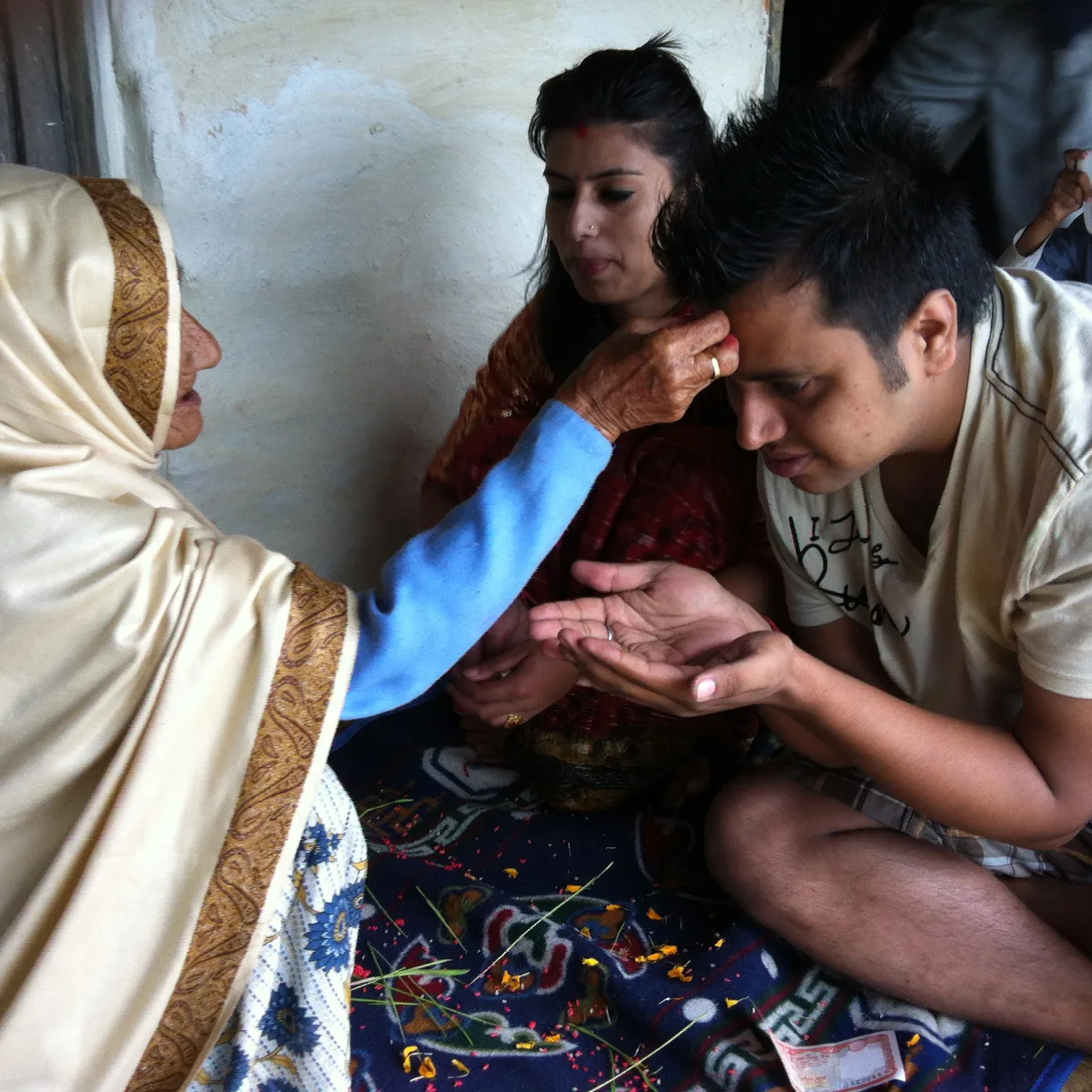
In classical Sanskrit, the grains are called Akshata (अक्षता), derived from the root kshad meaning “to cut or injure,” prefixed by the negating a. It translates literally as “that which is unbroken, uninjured, and indestructible.” In ancient agrarian philosophy, broken grains represented fractures, decay, and vulnerability. To press unbroken grains onto the forehead of the next generation was a tangible, physical prayer: that no matter what tragedies, famines, or winters strike, the human spirit must remain whole.
The Plant That Conquers Darkness
The golden crown accompanying the Tika—the Jamara—begins its life nine days earlier on Ghatasthapana, the opening dawn of the festival.
In the sacred prayer room (Puja Kotha), a clay vessel filled with pure river sand is consecrated. Barley seeds (Yava) are sown into the earth and watered with sacred water. But unlike ordinary farming, the vessel is immediately sealed in total, pitch-black darkness, shielded from every ray of sunlight.
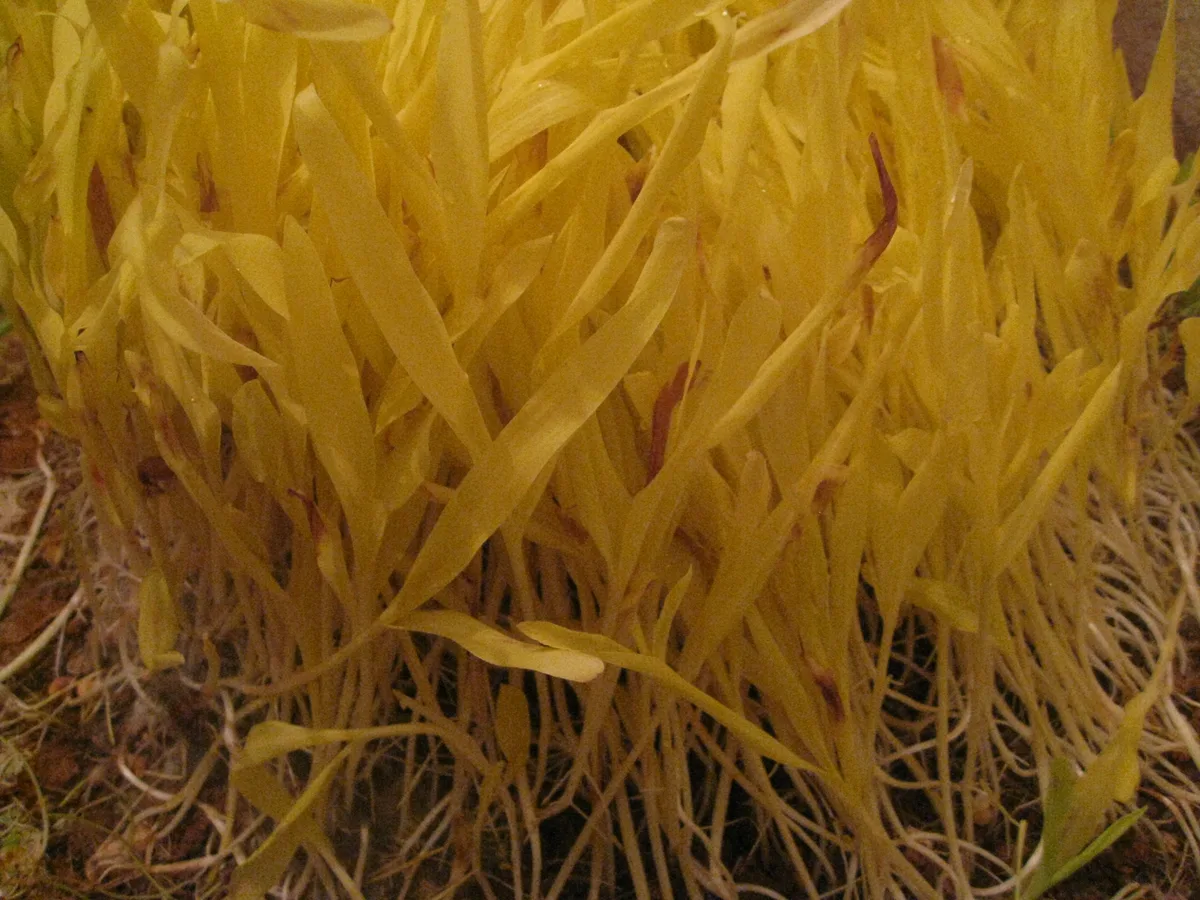
Deprived of light, the barley seedlings are unable to produce green chlorophyll. As they strain upward toward the unseen sky, they emerge not green, but as a striking, luminous pale yellow.
In Vedic literature, barley was celebrated as the first domesticated grain—the “king of healing herbs” (अन्नराज). Growing it in darkness was a deliberate ritual metaphor: life emerging victorious and unbent from the underworld. Worn behind the ear or woven into the hair, the cooling barley shoots functioned as a protective natural crown, shielding the wearer against seasonal illness as the autumn mountain air chilled into winter.
The Trinity of the Forehead: Fire, Peace, and Cohesion
The red paste applied to the forehead is not mere pigment; it is a carefully balanced alchemical trinity of three distinct elements:
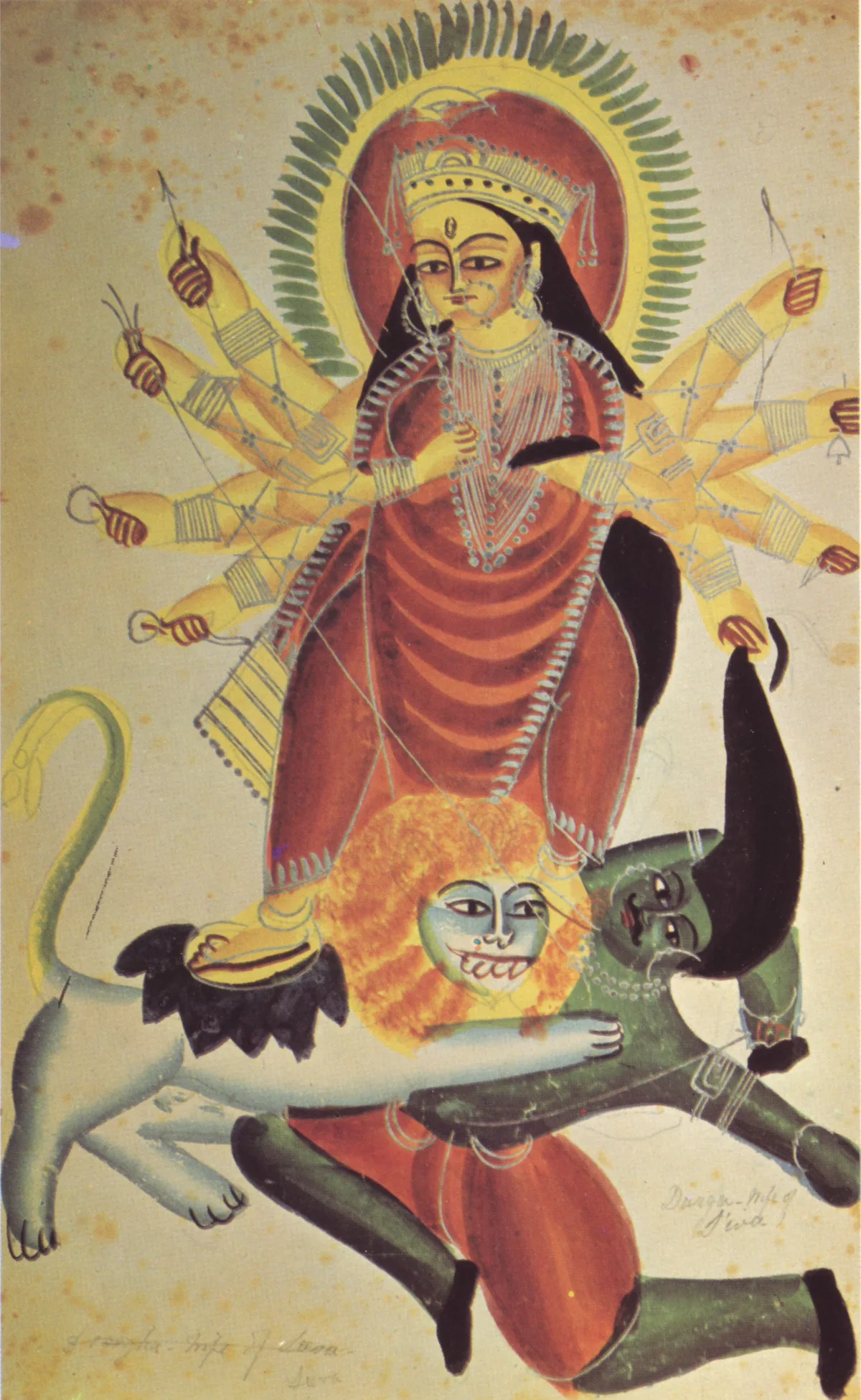
- The Scarlet Vermilion (Abir / Sindoor): The color of blood, raw life-force, and Shakti—the fiery, warrior energy of Goddess Durga overcoming the buffalo demon Mahishasura. It represents courage, action, and the will to confront chaos.
- The White Yogurt (Dahi): Fire untamed leads to fury and destruction. Fresh white curd is mixed into the vermilion to introduce coolness, emotional temperance, and peace.
- The Binding Force: Yogurt serves an essential physical function. It acts as the natural adhesive that binds individual, scattered grains of rice into a single unified emblem. Just as Dashain brings family members scattered across distant valleys back to the ancestral hearth, the yogurt unites isolated grains into one.
The paste is pressed firmly over the Ajna Chakra—the third eye between the eyebrows—revered in yogic tradition as the command center of clarity, perception, and inner discipline.
The Elder’s Touch and Generational Lineage
The ceremony of Tika flows in a single immutable direction: from oldest to youngest.
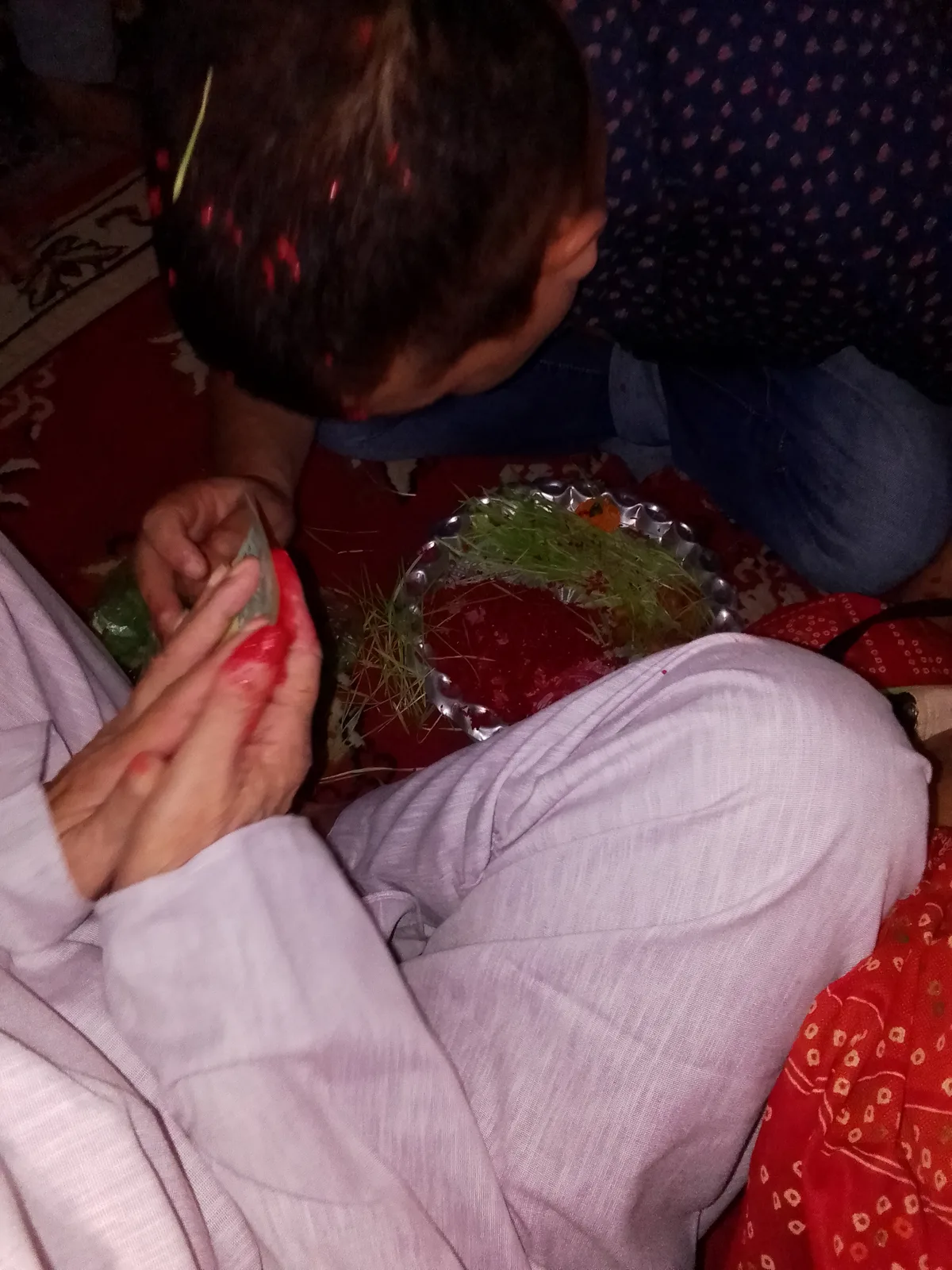
When the elder’s thumb touches the forehead, it is accompanied by the rhythmic chanting of the Sanskrit Ashirwad—invoking the legendary lifespans, moral courage, and resilience of historical and mythic ancestors. It is accompanied by Dakshina, small gifts of currency and blessings, symbolizing the material and spiritual duty of elders to support and uplift the young.
In a modern world of rapid migration and fragmented families, Tika and Jamara remain an unbroken physical thread connecting modern youth to ancient Himalayan ancestors. It is a reminder that resilience is not an accident—it is an inherited practice.
Archival Evidence & Primary Sources
- Library of Congress South Asian Collections. Archival documentation of traditional Himalayan festive and ritual practices, recording the agricultural symbolism of Yava (barley) and Akshata in Newar and Khas traditions.
- UNESCO Intangible Cultural Heritage Registry. Documentation on community festive heritage, familial lineage transmission, and ritual seasonal markers across South Asia.
- English Wikipedia — Dashain. Comprehensive cultural overview of the fifteen-day festival, Ghatasthapana rituals, and Vijaya Dashami observances.
Recommended Archival Reading & Literature
- Nepal Mandala: A Cultural Study of the Kathmandu Valley by Mary Shepherd Slusser (Princeton University Press, the definitive archival survey of Valley rituals and festivals).
- The Sacred Books of the East edited by Max Müller (Vedic agricultural hymns and ritual symbolism).
- Audible 30-Day Free Trial (Includes 1–2 free audiobooks exploring world mythology and ancient cultural anthropology).
Recommended Archival Reading
Primary memoirs, declassified investigative reports, and authoritative historical treatises directly related to this dossier.
- Primary Archival Account Recommended
Nepal Mandala: A Cultural Study of the Kathmandu Valley
By Mary Shepherd Slusser .
- Primary Archival Account Recommended
The Sacred Books of the East
By edited by Max Müller .
- Audio Edition Free Trial
* Affiliate Disclosure: As an Amazon Associate, Echoes of History Uncut earns from qualifying purchases. This supports our independent historical research, declassified document retrieval, and archival audio production at no additional cost to you.
Echoes of History Uncut. "The Indestructible Grain: The Secret Symbolism Behind Dashain's Tika and Jamara." Echoes of History Uncut. Last modified October 18, 2026. https://echoesofhistoryuncut.com/articles/symbolism-of-tika-and-jamara/.