
Shonen Jump Rejected Demon Slayer's First Pitch
In 2015, after four unserialized one-shots, manga artist Koyoharu Gotouge submitted a bleak three-chapter prototype titled Kisatsu no Nagare featuring a blind, one-armed swordsman on wooden peg legs. Weekly Shōnen Jump rejected the grim draft—until editor Tatsuhiko Katayama asked whether a brighter, ordinary character lived in that world, elevating a side sketch of a charcoal-selling boy named Tanjiro Kamado.

In this dossier (7 chapters) ▾
Historical Dossier: The Rejected Kisatsu no Nagare Storyboards & The Editorial Genesis of Demon Slayer Location: Fukuoka Prefecture & Jimbocho, Chiyoda, Tokyo (Shueisha) | Year: 2013–2020 | Key Figures: Koyoharu Gotouge, Tatsuhiko Katayama
The Four-Draft Wall (2013–2015)
In April 2013, a 23-year-old newcomer from Fukuoka Prefecture writing under the pen name Koyoharu Gotouge submitted a 45-page dark fantasy manuscript titled Kagarigari (過狩り狩り, “Over-Hunting Hunt”) to the 70th Jump Treasure Newcomer Manga Award. Set in early twentieth-century Japan, the story followed a taciturn, one-armed demon hunter confronting a foreign vampire stalking Meiji- and Taishō-era streets.
The submission earned an honorable mention and paired Gotouge with a young Weekly Shōnen Jump editor at Shueisha’s Tokyo headquarters named Tatsuhiko Katayama. Yet breaking through from newcomer contests to weekly serialization inside Japan’s most competitive manga anthology proved brutally difficult.

Over the next two years, Gotouge published three consecutive standalone one-shots across Shueisha magazines: Monju Shirō Kyōdai (Jump NEXT!, 2014), Rokkotsu-san (Weekly Shōnen Jump, 2014), and Haeniwa no Zigzag (Weekly Shōnen Jump, 2015). Although readers praised Gotouge’s eccentric dialogue and unsettling creature designs, none of the three manuscripts survived Shueisha’s serialization conferences.
By mid-2015, after two years without a serialized contract, Gotouge stood on the verge of leaving professional manga altogether. Katayama proposed one final strategic pivot: return to the sword-and-demon folklore of Kagarigari, simplified around classical Japanese motifs that any reader could grasp on page one.
The Rejected Prototype: Kisatsu no Nagare
Working from Kagarigari’s universe, Gotouge drafted full storyboards (name) for the opening three chapters of a proposed weekly series titled Kisatsu no Nagare (鬼殺の流れ, “The Flow of Demon Slaying”).
The prototype bore almost no emotional resemblance to the series audiences later embraced. Its lead character, Nagare, was an unwanted child cast out by an impoverished family and rescued near death by an elderly masked cultivator named Sakonji Banda. During the brutal Final Selection trial, Nagare suffered catastrophic mutilation while trying to recover the body of a fallen fellow examinee: demon claws permanently blinded both of his eyes, severed his lower right arm, and tore away the lower halves of both legs.
Fitted with black wooden prosthetic peg legs and wielding a single sword one-handed in total darkness, Nagare hunted demons with stoic, unsmiling severity. The draft lacked comic relief, domestic warmth, or approachable supporting leads. Every scene unfolded inside an oppressive atmosphere of mutilation and grim retaliation.
When Katayama submitted the three-chapter Kisatsu no Nagare storyboards to the Weekly Shōnen Jump serialization committee in Tokyo’s Jimbocho district, senior editors rejected the pitch outright. In a magazine aimed primarily at teenage readers—and already navigating shifting readership tastes in 2015—a mercilessly bleak world anchored by an emotionally closed protagonist was judged commercially unviable.

Katayama’s Crucial Question and the Charcoal Seller
Refusing to abandon the world Gotouge had constructed, Katayama sat down to diagnose why the manuscript repelled the committee. As Katayama later recounted in Shueisha’s official MANGA Plus editorial retrospective (The Making of a Jump Manga!), the setting itself—Taishō-era demon hunters wielding traditional Japanese blades—was compelling, but readers had no human entry point into its darkness.
Katayama posed a single structural question to Gotouge: wasn’t there a “brighter, more normal character” living somewhere inside that grim universe?

Searching through unused background notes from the prototype, Gotouge pulled out a minor supporting concept: an ordinary, hardworking boy from a rural mountain family who trudged through winter snow selling kiln-fired charcoal (sumi) to villagers, only to return home and discover his family slaughtered and his younger sister transformed into a demon.
Gotouge worried aloud to Katayama that this boy—Tanjiro Kamado—might be “too normal” and polite to carry a battle manga. Katayama recognized the exact opposite: placing an extraordinarily empathetic, earnest boy inside an unforgiving world created immediate moral tension. Unlike Nagare, Tanjiro did not swing his blade out of bloodlust; he mourned even the monsters he slew while fighting solely to restore his sister Nezuko’s humanity.
Softening the Blade and Shattering Cinema History
Alongside reconstructing the protagonist—while repurposing elements of Nagare’s stoic demeanor and scarred history into supporting Pillars such as Giyu Tomioka and the blind Stone Hashira Gyomei Himejima—Gotouge and Katayama also reworked the series’ title.
The word Kisatsu (鬼殺, “Demon-Killing”) struck the pair as overly harsh for a weekly youth serial. Searching for a sharper classical term that retained historical weight without gratuitous cruelty, they replaced satsu (“kill”) with metsu (“annihilate/destroy”) and paired it with yaiba (“blade”), arriving at Kimetsu no Yaiba (鬼滅の刃). Visually, Gotouge anchored Tanjiro’s swordsmanship in the swirling indigo crests of Edo-period ukiyo-e woodblock prints, directly evoking Katsushika Hokusai’s Under the Wave off Kanagawa.

The redesigned draft passed Shueisha’s serialization board immediately, debuting in Weekly Shōnen Jump Issue #11 on February 15, 2016. Over its four-year serialization concluding in May 2020, collected tankōbon circulation surpassed 150 million copies—and eventually exceeded 220 million copies worldwide.
In October 2020, its theatrical feature sequel Demon Slayer: Kimetsu no Yaiba – The Movie: Mugen Train—modeled around a real-world Taishō-era JGR Class 8620 steam locomotive—grossed ¥40.43 billion in Japan alone (over $507 million globally), dethroning Hayao Miyazaki’s Spirited Away (2001) to become the highest-grossing film in the century-long history of the Japanese box office.

In February 2021, Shueisha finally published Gotouge’s surviving three-chapter Kisatsu no Nagare storyboards inside the Official Fanbook: Kisatsutai Kenbunroku・Ni, preserving on paper how close a blind, revenge-driven prototype came to burying one of modern Japan’s defining cultural phenomena.
What the Record Shows
8 sourced claims in this dossier, cross-referenced to the primary interviews and archival records below:
- Four Pre-Serialization One-Shots (2013–2015): Koyoharu Gotouge debuted with Kagarigari in the 70th Jump Treasure Newcomer Manga Award (2013), followed by three unserialized one-shots—Monju Shirō Kyōdai (2014), Rokkotsu-san (2014), and Haeniwa no Zigzag (2015)—before facing a make-or-break serialization pitch. — sources: [1], [3], [4]
- The Rejected Kisatsu no Nagare Prototype: Gotouge’s initial three-chapter serialization storyboard, Kisatsu no Nagare, starred a severe swordsman named Nagare who was blinded, lost his right forearm, and fought on wooden prosthetic peg legs. — sources: [1], [2], [3]
- Shōnen Jump Serialization Rejection: Shueisha’s serialization committee rejected Kisatsu no Nagare because its unrelentingly grim atmosphere and stoic lead lacked warmth, humor, and reader accessibility. — sources: [1], [2]
- Tatsuhiko Katayama’s Editorial Prompt: First editor Tatsuhiko Katayama asked Gotouge whether a “brighter, more normal character” existed inside that world, prompting Gotouge to elevate a minor background concept of a charcoal-selling boy into protagonist Tanjiro Kamado. — sources: [1], [5]
- Renaming the Blade: Gotouge and Katayama dropped the harsh word Kisatsu (“demon-killing”) in favor of Kimetsu no Yaiba (“Blade of Demon Destruction”) prior to its February 15, 2016 debut in Weekly Shōnen Jump. — sources: [1], [3]
- Classical Ukiyo-e Visual Lineage: Tanjiro’s Water Breathing techniques explicitly channel Edo-period woodblock wave stylings exemplified by Katsushika Hokusai’s Under the Wave off Kanagawa (c. 1831). — sources: [3], [7]
- All-Time Japanese Box Office Record: Released in October 2020, Demon Slayer: Kimetsu no Yaiba – The Movie: Mugen Train earned over ¥40.4 billion domestically, surpassing Spirited Away (2001) as the highest-grossing film in Japanese history. — sources: [6], [8]
- Archival Publication of the Pilot: The original three-chapter storyboards of Kisatsu no Nagare were officially published in February 2021 inside Demon Slayer Official Fanbook: Kisatsutai Kenbunroku・Ni. — sources: [2], [3]
Archival Evidence & Picture Credits
Every image on this page was verified against its official publication archive and repository record:
- Figure 1 (Volume 1 Manga Debut) — Debut tankōbon cover of Demon Slayer: Kimetsu no Yaiba. Provenance: Koyoharu Gotouge / Shueisha, Fair Use — Wikipedia file page.
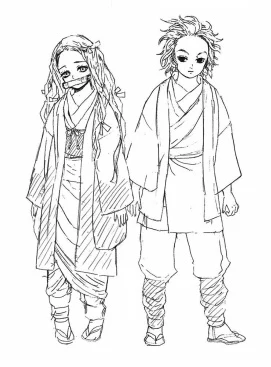
- Figure 2 (Tanjiro & Nezuko Early Concept Sketch) — Koyoharu Gotouge’s original developmental sketch of Tanjiro and Nezuko Kamado. Provenance: Koyoharu Gotouge / Shueisha, Fair Use — Wikipedia file page.
- Figure 3 (Weekly Shōnen Jump Masthead) — Official pirate emblem and logo of Weekly Shōnen Jump. Provenance: Shueisha, Public Domain — Wikimedia Commons file page.
- Figure 4 (Tanjiro Kamado Manga Artwork) — Official full-color character artwork of Tanjiro Kamado. Provenance: Koyoharu Gotouge / Shueisha, Fair Use — Wikipedia file page.
- Figure 5 (Official Demon Slayer Anime Artwork) — Ufotable official anime visual depicting Tanjiro Kamado with Water Breathing and Nezuko. Provenance: Ufotable / Shueisha / Aniplex, Fair Use — Wikipedia file page.
- Figure 6 (Mugen Train Theatrical Poster) — Official theatrical movie poster for Demon Slayer: The Movie: Mugen Train. Provenance: Ufotable / Toho / Aniplex, Fair Use — Wikipedia file page.


Verified Archival Sources & Bibliography
- Katayama, Tatsuhiko. (2019). “The Making of a Jump Manga! Vol. 5 — Demon Slayer: Kimetsu no Yaiba.” Official Shueisha Editorial Interview, MANGA Plus by Shueisha. mangaplus.shueisha.co.jp/web_pages/234/
- Gotouge, Koyoharu. (2021). Kimetsu no Yaiba Official Fanbook: Kisatsutai Kenbunroku・Ni (鬼殺隊見聞録・弐, containing the archived Kisatsu no Nagare storyboards, Chapters 1–3). Tokyo: Shueisha Jump Comics. ISBN 978-4-08-882567-0.
- Wikipedia Contributors. “Demon Slayer: Kimetsu no Yaiba — Production & Concept.” en.wikipedia.org/wiki/Demon_Slayer:_Kimetsu_no_Yaiba
- Wikipedia Contributors. “Koyoharu Gotouge — Career & One-Shots (2013–2016).” en.wikipedia.org/wiki/Koyoharu_Gotouge
- Livedoor News Editorial Desk. (2020). “Interview with Demon Slayer First Editor Tatsuhiko Katayama: How Tanjiro’s Kindness Was Born.” Livedoor News (Tokyo, February 2020). news.livedoor.com/article/detail/17767126/
- Nippon.com Data Desk. (2020). “Demon Slayer Movie Tops Spirited Away to Become Japan’s Highest-Grossing Film Ever.” Nippon Communications Foundation. www.nippon.com/en/japan-data/h00894/
- Metropolitan Museum of Art Open Access Archive. Katsushika Hokusai, Under the Wave off Kanagawa (Kanagawa oki nami ura), ca. 1830–32. Accession JP1847. www.metmuseum.org/art/collection/search/45434
- Motion Picture Producers Association of Japan (Eiren). (2021). Statistics of Film Industry in Japan: All-Time Box Office Gross Records (¥40.43 Billion Certified Record). www.eiren.org/statistics_e/
Echoes of History Uncut. "Shonen Jump Rejected Demon Slayer's First Pitch." Echoes of History Uncut. Last modified November 6, 2026. https://echoesofhistoryuncut.com/articles/demon-slayer-rejected-pilot/.

An independent history publication using AI-assisted research, drafting and production. Consult each article’s citations and limitations; source inclusion does not establish independent verification of every claim.
▶
Watch the Complete Archival Documentary on YouTube
Subscribe to Echoes of History Uncut on YouTube for full widescreen 16:9 documentaries, primary archival footage, and declassified deep dives.